

Table of Contents
- Introduction
- Why Traditional Brand Monitoring No Longer Works in AI Driven Search
- The 5 Best Ways to Track Brand Mentions in AI Search
- What Effective AI Brand Monitoring Actually Measures
- The Gap Between Knowing and Doing
- How to Start Tracking Brand Visibility in AI Search
- Conclusion
Search is quietly changing in a way most brands have not fully realized yet. For years, companies monitored their reputation through traditional channels such as Google rankings, social media mentions, backlinks, and review platforms. Those signals helped marketers understand how visible and credible their brand was online. But the rise of AI search engines and conversational AI systems has introduced an entirely new layer of brand visibility. Tools like AI assistants, generative search results, and conversational discovery engines now summarize information for users instead of simply showing links. This means users may learn about your brand without ever visiting your website or seeing your content directly.
That is why businesses are now exploring the best ways to track brand mentions in AI search. Understanding how your brand appears inside AI generated answers is becoming essential for marketing, SEO strategy, and reputation management.
This guide explains why traditional monitoring methods are no longer sufficient, how AI search changes brand visibility, and the most effective ways to track brand mentions across AI platforms in 2026.
Why Traditional Brand Monitoring No Longer Works in AI Driven Search
Traditional brand monitoring focuses on measurable content signals. Companies track mentions through social listening platforms, SEO ranking tools, media monitoring services, and backlink analysis platforms. These tools were effective when information discovery relied on links and websites. AI search systems work differently. Instead of directing users to multiple pages, AI models synthesize information and present summarized answers. Those answers may cite a brand without linking to it. In many cases, the brand is referenced indirectly as part of a broader explanation.
This creates a major visibility gap. A company may influence an AI generated answer through its content, but traditional tools will not capture that influence because the reference exists inside the AI output rather than on a webpage. AI search introduces a new dimension of brand monitoring where context, positioning, and response patterns matter as much as raw mentions.
The 5 Best Ways to Track Brand Mentions in AI Search
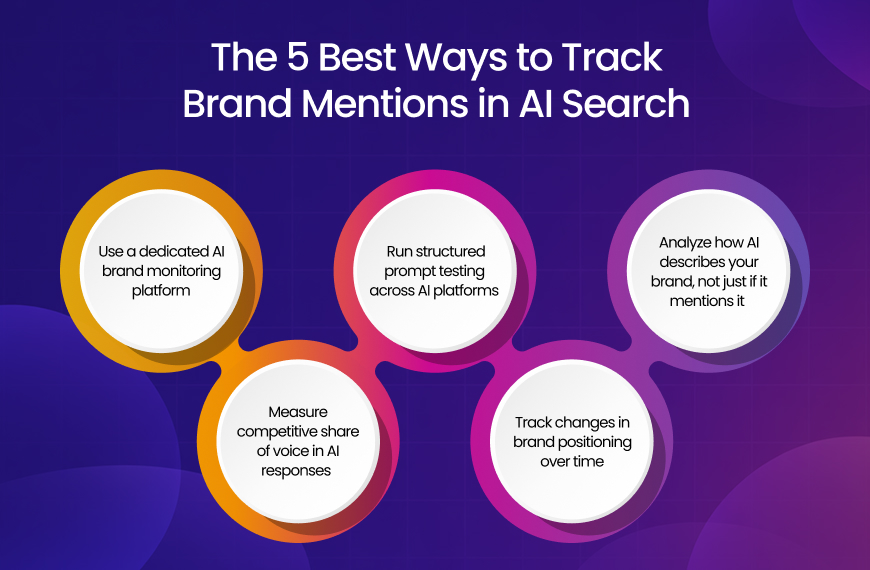
As AI search grows, companies need structured methods to measure how their brand appears across AI generated responses. The following approaches provide a practical framework for ai search brand tracking.
1. Use a Dedicated AI Brand Monitoring Platform
Specialized AI monitoring platforms are emerging to analyze how brands appear in AI generated responses. These tools simulate search prompts across multiple AI systems and capture the answers they produce.
Unlike traditional monitoring tools, these platforms evaluate:
- Whether your brand is mentioned
- How frequently it appears across queries
- The context in which it is described
- Which competitors appear alongside it
This approach helps organizations understand how AI systems interpret their brand authority within a topic.
For example, a company offering marketing automation software might test prompts such as:
“Best marketing automation tools for startups”
“Top platforms for customer journey automation”
If the AI consistently mentions competitors but rarely references your brand, it signals a visibility gap in AI search ecosystems.
Dedicated AI monitoring tools also track how mentions evolve over time, allowing companies to see whether content updates or PR efforts improve AI visibility.
2. Run Structured Prompt Testing Across AI Platforms
One of the most reliable ways to track brand in AI search is through systematic prompt testing.
AI platforms do not respond identically. The same query may produce different results across ChatGPT, Gemini, Perplexity, and other generative search systems.
Organizations should develop a structured prompt library that reflects how real users ask questions. These prompts can include:
- Informational queries
- Comparison queries
- Purchase intent questions
- Industry trend questions
For example:
“What are the best UX design agencies in Chicago?”
“Which SaaS tools are best for property management automation?”
“Top companies offering AI data annotation services.”
By running these prompts across AI platforms and documenting the outputs, companies can track whether their brand appears, how it is described, and where competitors dominate.
This method reveals patterns that traditional analytics cannot detect.
3. Analyze How AI Describes Your Brand, Not Just If It Mentions It
Many companies focus only on whether their brand appears in AI responses. That approach misses the bigger picture.
The real insight lies in how the brand is described. AI models often summarize brand attributes based on available information across the web. Those summaries influence user perception immediately.
For example, AI responses may frame a company as:
- A niche specialist
- A budget option
- A premium enterprise provider
- A fast growing startup
These descriptions shape market positioning.
When conducting ai search brand tracking, companies should evaluate:
- Brand adjectives used by AI systems
- Industry categories assigned to the brand
- Competitors mentioned alongside the brand
- Expertise signals referenced in responses
Monitoring these elements helps companies understand the narrative AI systems associate with their brand.
4. Measure Competitive Share of Voice in AI Responses
Another critical metric is competitive visibility within AI generated answers.
In traditional SEO, companies track keyword rankings. In AI search, visibility is determined by whether the brand is included in the generated explanation.
Competitive share of voice measures how frequently your brand appears compared to competitors across AI responses.
For example, if ten AI responses about “top SaaS development companies” mention five competitors but not your company, it indicates an authority gap within the AI knowledge ecosystem.
Tracking competitive share of voice reveals:
- Which competitors dominate AI responses
- Which topics your brand is associated with
- Where your brand is missing entirely
This information helps shape future content and authority building strategies.
5. Track Changes in Brand Positioning Over Time
AI systems continuously update their knowledge based on evolving web content and training updates.
As a result, brand positioning inside AI responses may change gradually. A company that was rarely mentioned six months ago may appear more frequently after publishing authoritative content or gaining industry recognition.
Monitoring changes in AI generated responses helps companies understand whether their visibility is improving.
Businesses should document:
- Monthly brand mention frequency in AI responses
- Changes in brand positioning language
- New competitors appearing in responses
- Topics where the brand gains or loses visibility
This historical tracking provides insight into how AI systems interpret the brand over time.
What Effective AI Brand Monitoring Actually Measures
Successful ai search brand tracking goes beyond counting mentions. It focuses on deeper signals that reflect brand authority within AI ecosystems.
A robust monitoring strategy should measure:
Brand inclusion frequency
How often your brand appears across relevant AI prompts.
Context of the mention
Whether the brand is described positively, neutrally, or critically.
Topic authority coverage
Which industry topics trigger brand mentions in AI responses.
Competitive visibility
How often competitors appear alongside your brand.
Narrative framing
The descriptors and positioning AI systems assign to the brand.
Together, these metrics provide a more complete picture of brand visibility in AI driven discovery environments.
The Gap Between Knowing and Doing
Many organizations now understand that AI search affects brand visibility. However, very few have operational processes for monitoring it consistently.
One reason is that AI monitoring requires cross functional collaboration between SEO teams, brand strategists, and content creators. Traditional marketing structures often separate these roles.
Another challenge is measurement discipline. AI monitoring requires regular prompt testing, documentation, and interpretation of results. Without structured workflows, insights remain anecdotal rather than strategic.
Companies that treat AI brand monitoring as an ongoing research process rather than a one time experiment gain a clearer understanding of how AI systems represent their brand.
How to Start Tracking Brand Visibility in AI Search
As AI search tools such as ChatGPT, Perplexity AI, and Google Gemini increasingly influence how people research products and services, brands are facing a new visibility challenge.
Traditional SEO tools track rankings on search engine result pages, but AI search works differently. Instead of presenting a list of links, AI systems generate direct answers that reference or summarize brands. This means your brand visibility now depends on whether AI systems mention you, how they describe you, and in what context they position you relative to competitors.

For organizations beginning to monitor their presence in AI-generated answers, a structured approach is essential. The framework below provides a best ways to track brand mentions in AI search and turning those insights into actionable strategy.
1. Identify the Core Questions Your Customers Ask
The first step in AI brand tracking is understanding what real users are asking AI systems when researching your industry.
Unlike traditional keyword research, AI queries tend to be longer, conversational, and decision-oriented. People do not simply search for “best CRM software” anymore. Instead, they ask questions like:
- “What are the best CRM platforms for small businesses?”
- “Which CRM tools integrate well with marketing automation?”
- “What are affordable CRM alternatives to Salesforce?”
These questions represent decision-making prompts that AI systems answer with synthesized responses.
How to Identify These Questions
Start by mapping the research journey of your ideal customer. Common sources for prompts include:
- Customer support questions
- Sales team discovery calls
- Google “People Also Ask” queries
- Community forums like Reddit or Quora
- Competitor comparison pages
These questions become the testing prompts used to monitor AI responses.
Instead of tracking keywords alone, you are effectively tracking AI-generated brand recommendations within industry conversations.
2. Test Prompts Across Major AI Platforms
Once you have defined your core prompts, the next step is testing them across multiple AI systems.
Different AI platforms use different training data, retrieval methods, and ranking logic. Because of this, brand visibility can vary significantly across platforms.
For example:
- One AI assistant might cite a brand as a market leader
- Another might describe it as a niche provider
- A third may not mention it at all
This makes multi-platform testing essential.
Key Elements to Document
When running prompt tests, record the following information:
Brand Mentions
Which companies appear in the response?
Are you mentioned alongside competitors?
Positioning
How is each brand described?
Examples:
- “Leading provider”
- “Popular option”
- “Affordable alternative”
- “Enterprise-focused solution”
Context
Is the brand referenced as:
- an industry authority
- a comparison option
- a niche alternative
- or simply a passing mention
These contextual signals are important because AI systems often influence perceived authority, not just awareness.
3. Repeat Tests Regularly to Track Changes
AI search ecosystems evolve rapidly.
Models update, retrieval systems change, and the web content that feeds these systems continuously grows. As a result, brand visibility inside AI responses is dynamic rather than static.
To track meaningful trends, organizations should run prompt tests on a recurring basis.
A typical monitoring cadence may include:
- Monthly testing for competitive industries
- Quarterly testing for stable markets
Regular testing allows teams to observe patterns such as:
- Increasing brand mentions
- Shifts in competitive positioning
- Emerging industry narratives
For instance, a brand that was rarely mentioned six months ago might begin appearing more frequently after publishing authoritative research or gaining industry recognition.
Tracking these changes over time helps organizations understand what influences AI perception.
Brands that begin monitoring AI search today gain an early advantage in understanding how AI systems shape industry perception. By identifying customer prompts, testing AI responses, tracking trends, and aligning insights with content strategy, organizations can proactively influence how their brand appears in the next generation of search experiences.
Conclusion
AI search is reshaping how people discover brands and evaluate expertise. Instead of browsing multiple websites, users increasingly rely on AI generated summaries to guide decisions. The best ways to track brand mentions in AI search involve combining structured prompt testing, AI monitoring tools, competitive analysis, and narrative evaluation. Together, these methods reveal how AI systems represent your brand and how that perception evolves over time.
As AI search continues to expand, proactive monitoring will become an essential part of modern SEO and brand strategy. Organizations that understand this shift early will be better positioned to shape how their brand is represented in the next generation of search experiences.
Ready to Grow Your Website in Ai Search : Click Here