


Search behavior is rarely linear. A user enters one query, clicks a result, returns to Google, adjusts the wording, explores a nearby angle, and keeps refining until the answer feels complete. That is exactly why understanding Google’s People Also Search For feature matters more than many marketers realize. It is not just another SERP element. It is a live signal of unresolved intent, next-step curiosity, and search refinement patterns.
For SEO teams, this creates a practical opportunity. Instead of guessing what a user may search next, PASF gives a strong clue about where their intent expands, narrows, or shifts. That makes it useful for content planning, topical coverage, on-page optimization, and even GEO thinking, because AI search systems also favor content that covers the surrounding context of a query, not just the exact phrase itself. In this guide, you will learn what People Also Search For means, why it matters, how it influences user journeys, how to use it inside a real SEO workflow, which tools help measure performance, and where PASF fits into a broader modern search strategy.
Understanding Google’s People Also Search For Feature
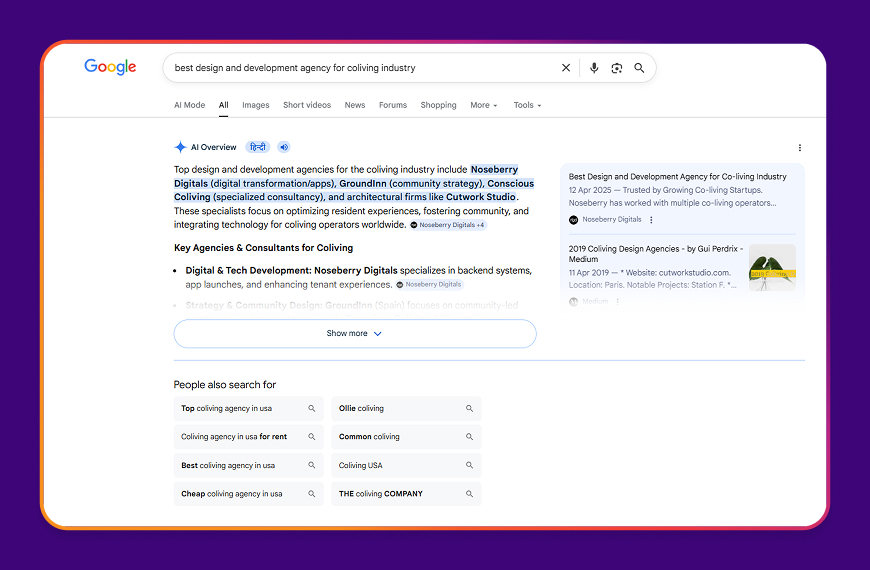
People Also Search For is a Google search feature that commonly appears after a user clicks a result and then returns to the search results page. In simple terms, it acts like a set of related follow-up searches that reflect what other users often explored next when the first result did not fully satisfy intent. Multiple SEO references describe PASF this way, and Google’s own help documentation confirms that refining and expanding searches is a normal part of how people use Search.
What makes PASF useful is that it is not exactly the same as the “Related searches” section at the bottom of the page. Related searches are broader and more static. PASF is more connected to user behavior after interaction with a result. That makes it especially valuable for understanding follow-up intent. If someone searches for “technical SEO audit,” clicks a page, comes back, and then sees terms like “technical SEO checklist” or “crawl budget issues,” that is a clue that their original need may have been only partially met.
From an SEO perspective, people also searched for it as a query refinement signal. It tells you where search intent branches. It may reveal missing subtopics, nearby pain points, comparison angles, or beginner-to-advanced transitions that your page should cover more clearly.
Why People Also Search For Carrie’s Real SEO Value
The SEO value of PASF is not that you “rank in the box” in some isolated way. Its real value is strategic. It helps you understand how Google connects one query to another, and how users move through a topic cluster. Google’s documentation emphasizes building content for users and making it easy for search engines to understand what a page is about. PASF helps you do both by exposing the semantic neighborhood around a query.
This matters for three reasons.
First, PASF helps uncover hidden intent. Many keywords look simple on the surface but contain layered expectations. A user searching “local SEO” might actually want tools, a checklist, pricing expectations, case studies, or ranking factors. PASF often reveals those next-step needs faster than a standard brainstorm.
Second, PASF improves topical completeness. A page that covers only the exact keyword may feel narrow. A page that also addresses related concerns, definitions, comparisons, and follow-up questions tends to satisfy users better.
Third, PASF can reduce content guesswork. Instead of relying only on keyword volume, you can use real query relationships to shape sections, supporting articles, FAQ blocks, and internal links.
One practical lesson many teams miss is this: PASF is often a sign that your page should do more to close the loop on the reader’s next question. In other words, it is not only a keyword research shortcut. It is a content satisfaction clue.
How PASF Shapes the Way Users Continue Searching

Search journeys often evolve in one of four directions, and PASF frequently reflects these patterns.
1. The user narrows the topic
A broad query becomes specific. “CRM software” turns into “CRM software for real estate teams.” This suggests the user is moving from awareness to evaluation.
2. The user widens the topic
A narrow question expands into a broader subject. “Core Web Vitals” may lead to “technical SEO ranking factors.” This often means the user wants context, not just a single answer.
3. The user changes intent
An informational search can become commercial. “Best email marketing platforms” can shift into “Mailchimp vs HubSpot pricing.” PASF can expose that transition earlier than traditional ranking reports.
4. The user seeks clarification
A user may need definitions or comparisons before they can act. “Schema markup” might lead to “structured data examples” or “JSON-LD vs microdata.”
This is why PASF is valuable beyond keyword discovery. It helps map momentum. Good SEO today is not just about matching the first search. It is about anticipating the second and third.
How to Use People Also Search For Inside Your SEO Strategy
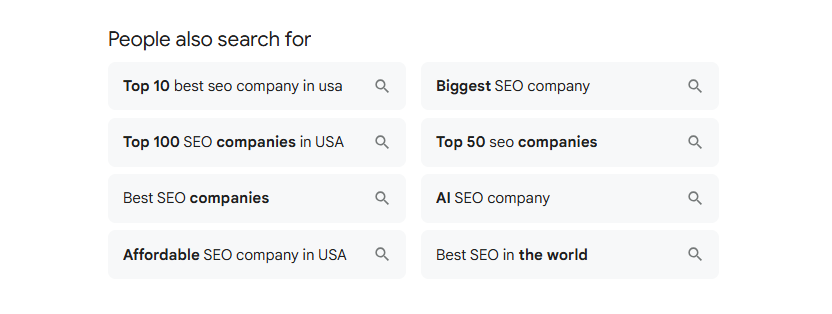
A practical PASF strategy starts by treating these terms as intent clues, not just extra keywords to scatter through a page.
Begin with your core query. Search it manually and note the PASF terms that appear after interacting with the results. Then group those terms into buckets. Some will be definitions. Some will be comparisons. Some will be troubleshooting queries. Some will reveal commercial investigation.
Next, decide how each bucket should be handled. Not every PASF term belongs on the same page.
Use this simple framework:
Cover on the same page when:
- The PASF term is a subquestion of the main topic
- The user expects that answer without needing a separate deep dive
- It improves completeness without weakening focus
Create a supporting page when:
- The PASF term has distinct intent
- It deserves its own examples, process, or use case
- Combining it would make the main article too broad
Use as internal links when:
- The term reflects a next-step query
- A dedicated supporting article already exists
- You want to guide readers deeper into the topic cluster
For example, if your main page is about “People Also Search For,” supporting pieces might target related ideas such as search intent mapping, topic clusters, People Also Ask, semantic SEO, and entity-based optimization. That creates a stronger content system than trying to force everything into one article.
Making Your Content More Likely to Align With people also searched for Suggestions
There is no official Google setting or schema markup that guarantees appearance in PASF. Google does not offer a direct optimization method for it, and its Search documentation generally emphasizes creating useful, crawlable, understandable content rather than chasing a single interface feature. That said, content can be made more PASF-aligned.
Start with intent coverage. If users commonly branch into comparisons, definitions, costs, examples, mistakes, and alternatives, your content should address those naturally.
Improve information scent. A reader should be able to scan headings and immediately see that the page covers core and adjacent questions. Weak heading structure often causes quick returns to search results.
Use semantic support terms. This does not mean stuffing variants. It means using the language that naturally belongs to the topic. For PASF, that may include related searches, search refinement, user intent, SERP features, keyword clustering, topical authority, and query expansion.
Add concise sub answers. PASF-adjacent queries are often short and direct. Small answer blocks under well-labeled headings help satisfy those needs quickly.
Refresh pages based on real search behavior. If a page ranks but users keep returning to search, the page may be missing a key angle. PASF can help identify what that missing angle is.
One original insight worth noting is that PASF optimization is often less about “getting featured” and more about reducing bounce-back behavior by making your page the last stop in the search path.
A Practical Content Model for PASF Optimization
A useful way to apply PASF is through what can be called the Core, Branch, and Bridge model.
Core
This is the main intent the page targets. Example: “People Also Search For meaning.”
Branch
These are the follow-up directions users may take. Example: how PASF works, why PASF matters, PASF vs related searches, PASF keyword research.
Bridge
These are the transitions that connect the topic to broader SEO goals. Example: topical authority, content clusters, internal linking, GEO, and query refinement strategy.
Pages built with this model usually perform better because they do not stop at the definition. They connect the definition to action and then to broader relevance.
Tools That Help Measure PASF-Related Keyword Opportunities
There is no standalone Google report called “PASF performance,” so measurement has to be assembled through a mix of tools and interpretation.
Google Search Console is the most important starting point because it shows actual queries, clicks, impressions, and page-level visibility. It helps you identify whether related query coverage is growing around a page. If a page begins attracting impressions for adjacent searches, that is often a sign that your topical relevance is expanding.
SEO platforms such as Semrush, Ahrefs, and similar suites can help cluster related keywords, track rankings across related phrases, and spot SERP feature overlap. These tools are useful for scale, but they should validate a strategy, not replace direct observation.
Manual SERP review is still underrated. Search the main keyword, review PASF and related refinements, compare top-ranking pages, and note missing sections. This often reveals more than a spreadsheet alone.
Analytics platforms also matter. If users land on a page and then continue deeper into your related content, that is a positive signal of intent satisfaction and journey alignment. If they exit quickly, your page may not be answering the next obvious question.
A practical KPI set for PASF work includes:
- Growth in impressions for adjacent queries
- Increase in long-tail keyword coverage
- Better engagement on supporting articles
- More internal click-throughs to related pages
- Improved visibility across a topic cluster
Where People Also Search For Fits in a Modern SEO and GEO Framework
PASF should not be treated as a standalone tactic. It works best as part of a broader search strategy built on search intent, topical depth, structured internal linking, and helpful content principles.
Google’s public guidance consistently returns to a core idea: create content that is useful, understandable, and focused on people first. PASF strengthens that approach because it helps identify what “helpful” actually needs to include for a given query.
In broader SEO, PASF supports:
- Keyword clustering
- Content briefs
- topic maps
- FAQ planning
- internal linking
- content refresh workflows
In GEO and AI search contexts, PASF has another role. AI systems and answer engines tend to reward content that covers entities, relationships, subtopics, and likely follow-up questions. A page that mirrors how a topic naturally expands stands a better chance of being cited, summarized, or referenced by search assistants.
So while PASF comes from traditional Google behavior, its strategic value now extends into answer engine optimization as well.
Final Thoughts
People Also Search For is one of the clearest windows into how search journeys actually unfold. It shows that users do not search in isolated keywords. They search in steps, adjustments, and related needs. For SEO, that makes PASF valuable not because it is flashy, but because it is practical.
If you use PASF well, you create content that does more than rank for one term. You create pages that anticipate the next question, guide the next click, and reduce the need for users to go back to Google. That is good SEO in the traditional sense, and it is also increasingly important in a world shaped by AI-driven search experiences.