


 Our Work


Real Estate
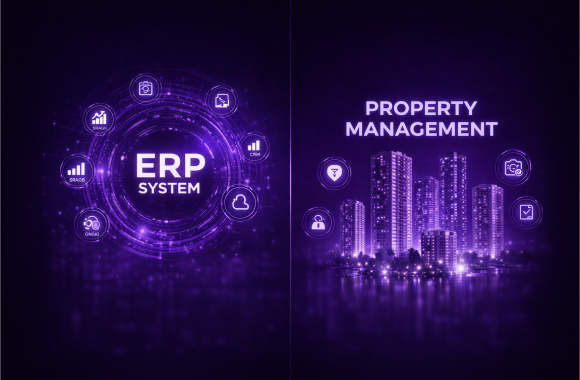
Real Estate ERP vs Property Management Software: What Is the Actual Difference?
By Mayank Pokharna (Coliving Expert)
• 7 min read
Mar 19, 2026
Share


Key Takeaways
- A property management system handles tenancies, maintenance, and inspections. ERP covers the whole business.
- The confusion arises because some property management platforms have added finance or HR modules over time.
- ERP is the right choice when the business needs departmental integration, not just property-level operations.
- A PMS is sufficient for businesses where tenancy operations are the primary management need.
- Some businesses use both: a specialised PMS for operations and an ERP for enterprise-wide reporting and finance.
- The choice depends on business complexity, not portfolio size alone.
If you have been researching software solutions for your property business, you have almost certainly encountered both terms. Real estate ERP. Vs Property management software. Sometimes they seem to be describing the same thing. Sometimes the same product is marketed as both. The confusion is understandable. The two categories overlap in some areas, and vendors on both sides have expanded their feature sets over the years to capture more of the market. This article cuts through the noise and explains clearly what each type of software is built for, where they differ, and how to decide which one your business actually needs.
Why the Confusion Exists
Property management software and real estate ERP have converged in certain areas. Many property management platforms have added basic accounting features. Some ERP systems have developed detailed tenancy management modules. The overlap in feature lists makes it hard to distinguish between the two categories at first glance. The distinction becomes clear when you look not at the feature list but at the architecture: what the system was designed to do at its core, and how the data flows through it.
What a Property Management System Is Built For
A property management system is designed around the operational lifecycle of a tenancy and the management of physical properties. Its core data model is built on properties, units, tenants, and leases. Everything the system does flows from those four entities. The typical functions of a PMS include: listing and vacancy management, tenant application and onboarding, lease creation and renewal, rent collection and arrears management, maintenance request handling and contractor dispatch, inspection scheduling and reporting, and tenant communication. A PMS does its job very well within that scope. For a residential property management company or a commercial landlord with a mid-sized portfolio, a PMS covers the majority of operational needs. What it does not cover well is the rest of the business: HR, enterprise finance, cross-portfolio strategic reporting, multi-entity accounting, supply chain for large maintenance programmes, or integrated payroll.
What a Real Estate ERP System Is Built For
A real estate ERP system is designed around the entire business, not just the property operations layer. Its core data model connects properties, finance, people, and operations as equally weighted domains. The system is built so that an event in one area automatically triggers updates in the others. When a lease is signed, the billing engine generates the payment schedule without manual input. When a contractor completes a job, the cost is allocated to the correct property cost centre in the finance module automatically. When a new employee is onboarded, their access rights, payroll record, and department assignment are all created within the same system. ERP is designed for businesses that need this level of integration across departments, not just within the property operations team.
Where the Two Systems Overlap
The overlap between PMS and ERP is real and worth acknowledging. Both systems handle rent collection and lease management. Both produce financial reports relevant to property operations. Both manage maintenance workflows to some degree. Some advanced PMS platforms have added multi-entity accounting and reporting tools that bring them closer to ERP territory. Conversely, ERP systems built specifically for real estate include detailed tenancy management modules that approach the depth of a standalone PMS. The practical difference emerges at the edges: when a business needs deep tenancy operational features, a purpose-built PMS is usually more capable. When a business needs enterprise-wide integration across finance, HR, operations, and compliance, ERP handles that better.
The Key Differences at a Glance
The clearest way to distinguish the two is by the primary question each system answers. A property management system answers: what is happening with my properties and tenants right now? A real estate ERP answers: how is the entire business performing, and how do all its parts connect? PMS is optimised for operational depth within the property and tenancy domain. ERP is optimised for operational breadth across the whole organisation. PMS data models are built around properties and leases. ERP data models are built around entities, cost centres, and business units. PMS reporting is focused on occupancy, arrears, maintenance, and tenancy performance. ERP reporting spans finance, operations, HR, and portfolio performance simultaneously.
How to Decide Which One Your Business Needs
The right tool depends on where your operational pain is. If your main challenges are in tenancy operations, maintenance management, tenant communication, and lease administration, a property management system is likely the right starting point. It is purpose-built for those problems and will deliver faster, at lower cost. If your challenges span multiple departments, if your finance team is struggling to get consolidated data, if HR and operations are running on disconnected tools, or if leadership needs a single view of the whole business rather than just the property portfolio, ERP is the more appropriate solution. Some businesses at a certain scale choose to run both: a specialist PMS for deep operational management of properties and tenants, integrated with an ERP that handles enterprise finance, HR, and cross-departmental reporting. This is a more complex architecture but can deliver the best of both. Visit our Real Estate ERP Software Development page to understand how we help property businesses evaluate and build the right system for their stage of growth.
Conclusion
The choice between a property management system and a real estate ERP is not a question of which is better. It is a question of which problem you are actually trying to solve. A PMS solves the operational problem: managing tenancies, maintenance, leases, and landlord-tenant relationships with the depth and workflow specificity those functions require. An ERP solves the integration problem: connecting finance, HR, operations, and property management into a single architecture so that the whole business can be run and reported on from one place. If your business is primarily a property operations business and its main challenges live in the tenancy and maintenance layer, a well-chosen PMS will serve you better than an ERP you do not yet need. If your business has grown to the point where disconnected departments, fragmented financial data, and the absence of a whole-business view are the real constraints on performance, ERP is the appropriate response. The businesses that struggle most with this decision are the ones that try to solve an ERP problem with a better PMS, or invest in ERP before they have outgrown what a PMS can do. Getting the diagnosis right before choosing the solution is the only thing that actually matters.
FAQ
When in doubt always ask?
Property management software handles the operational lifecycle of tenancies and properties. ERP covers the entire business, including finance, HR, compliance, and cross-departmental operations. ERP includes property functionality but extends well beyond it.
For smaller property businesses focused primarily on tenancy operations, a PMS can handle most needs. But as a business grows and the complexity of finance, HR, and multi-entity reporting increases, a PMS alone becomes insufficient for managing the whole organisation.
An ERP with a well-developed real estate module can handle most tenancy and property operations. However, for businesses with complex operational needs at the tenancy level, a dedicated PMS often provides greater depth in areas like maintenance workflows, inspection management, and tenant communication.
Yes, and this is a common approach for larger property businesses. A specialised PMS handles day-to-day property and tenancy operations while an ERP manages enterprise finance, HR, and strategic reporting. Integration between the two systems keeps data consistent.
There is no fixed portfolio size that triggers an ERP requirement. The relevant factor is business complexity: the number of departments, the diversity of operations, the need for cross-departmental data integration, and the sophistication of finance and compliance requirements.
If your operational pain is primarily in tenancy management, maintenance, and landlord-tenant communication, improve your PMS. If your pain is in financial reporting accuracy, departmental data silos, HR management, or the inability to get a unified view of the business, ERP is the appropriate solution.