

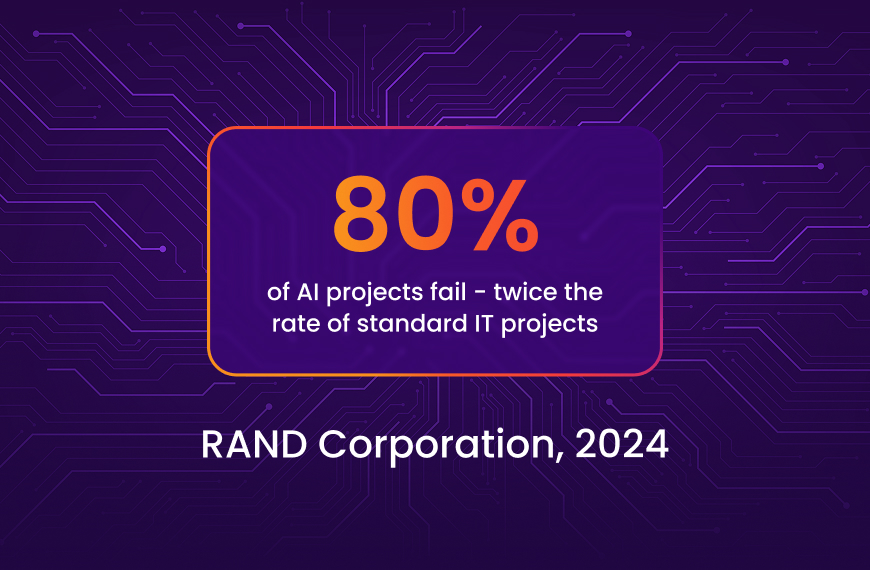
The AI market is worth $244 billion in 2025. By 2030, it is projected to exceed $800 billion. And yet, according to a 2024 RAND Corporation study that interviewed 65 senior data scientists and engineers, more than 80 percent of AI projects fail , twice the failure rate of standard IT projects.
The technology is not the problem. The partner usually is.
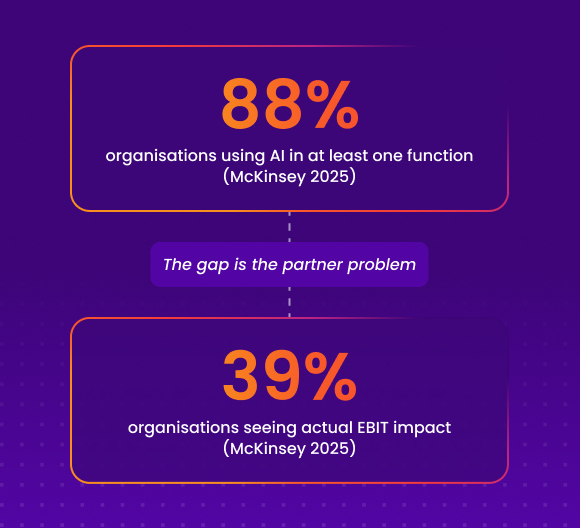
McKinsey’s 2025 State of AI survey found that while 88 percent of organisations are now using AI in at least one business function, only 39 percent report any measurable EBIT impact at the enterprise level. The gap between adoption and outcome is wide – and it widens further when businesses hand their AI ambitions to the wrong development team.
Choosing the wrong AI ML Development company does not just drain a budget cycle. It sets your product roadmap back by 12 to 18 months, creates technical debt that takes years to unwind, and – most damagingly – burns internal confidence in AI before your business has had a real chance to benefit.
This guide is for the people making that decision.
The AI Vendor Problem Nobody Talks About
The vendor market has never been louder or harder to navigate. Every generative AI development company now claims end-to-end capability. Every offshore shop markets itself as a machine learning specialist. Agencies that cannot define model drift are selling “full-stack AI transformation.”
Meanwhile, the stakes are real. According to the RAND study, the most common reason AI projects fail is not technical complexity — it is that business stakeholders and technical teams fundamentally misunderstand or miscommunicate what problem actually needs to be solved. The second most common reason is that the organisation lacks the right data architecture to train an effective model at all.
Both failures are preventable. Both are a direct result of choosing a partner who does not ask hard enough questions before they start building.
What Type of AI ML Development company Do You Actually Need?
Before evaluating vendors, most businesses skip a critical first question: what kind of development partner do you actually need?
A custom AI development company builds proprietary models and pipelines tailored to your specific data, workflows, and business logic. This is the right choice when off-the-shelf tools cannot serve your competitive requirements.
An AI agent development company specialises in autonomous, multi-step AI systems that plan and execute tasks across your operations — inventory, customer service, sales workflows — without constant human oversight.
An AI chatbot development company focuses on conversational AI: customer-facing interfaces for support, sales, and engagement. These are faster to deploy but narrower in scope than full agentic systems.
An AI/ML development company covers the full spectrum — from data engineering and model training through to deployment and monitoring. This is the most comprehensive partner type for businesses building long-term AI capability rather than a single use case.
Understanding which category you need narrows the field immediately and prevents the most common mismatch: hiring a chatbot specialist for an enterprise ML problem, or a research-focused team for a production-scale deployment.
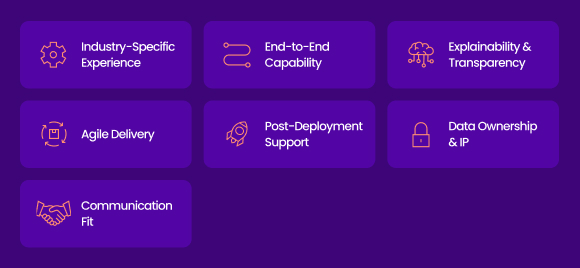
7 Things to Look For When You Hire an AI ML Development company
1. Industry-Specific Deployment Experience
Generic AI portfolios are a red flag. A partner who has built recommendation engines for e-commerce and fraud detection for FinTech does not automatically understand the data structure of a PropTech platform. Ask specifically: what have they deployed in your domain, and is it live in production today? Demos and prototypes are not deployments.
2. End-to-End Capability
Model building represents a fraction of the total work in any AI engagement. The harder problems are data engineering, API integration, cloud infrastructure, and post-deployment monitoring. McKinsey’s 2025 research specifically identifies redesigning workflows and deploying AI agents across multiple business functions — not just building isolated models — as the defining trait of high-performing AI organisations. A partner who handles model training but hands off at deployment is a vendor, not a partner.
3. Explainability and Transparency
Can they walk you through how their models arrive at outputs? In regulated sectors — financial services, insurance, healthcare — explainability is a compliance requirement. McKinsey’s survey found that explainability is one of the most commonly experienced AI risk consequences, yet one of the least mitigated. A partner who cannot explain model logic has no business handling your business-critical data.
4. Agile, Iterative Delivery
AI development is inherently non-linear. Data surprises change requirements. What looks structured in discovery rarely looks structured in production. The RAND report is explicit: organisations should commit to solving a specific problem for at least one year, with patient and iterative cycles. Any AI ML development company offering rigid fixed-scope contracts for AI is either inexperienced or not designing for your success.
5. Post-Deployment Support and Model Retraining
Models degrade over time as customer behaviour shifts and data distributions change. This is called model drift — and it is one of the most underestimated risks in any machine learning solutions for business engagement. Before signing, the question to ask is not “what do you build?” but “what happens six months after deployment?” A credible partner builds monitoring and retraining into the standard engagement, not as an add-on.
6. Data Ownership and IP Clarity
This is the clause most clients miss until it is too late. Will your proprietary data be used to train shared or foundational models that benefit other clients? Who owns the intellectual property of what is built? In a landscape where AI capabilities are a core competitive differentiator, contractual clarity on data ownership is non-negotiable before engagement begins.
7. Communication and Operational Fit
Time zone overlap, documentation standards, sprint cadence, and escalation protocols — these so-called soft factors cause the majority of mid-project breakdowns. McKinsey’s high-performer research shows that senior leadership ownership and well-defined delivery processes are among the strongest contributors to AI success. A technically capable team that communicates poorly will cost more in rework and misalignment than a slightly less advanced team that operates with discipline and clarity.
Red Flags That Tell You to Walk Away
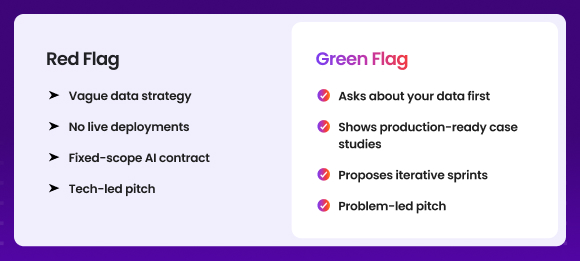
Some signals are easy to miss in early vendor conversations.
Vague or evasive answers about data strategy. No mention of MLOps, model monitoring, or model drift. An inability to show a live deployed product — demos and prototypes are not evidence of delivery capability. A portfolio that reads like a services catalogue rather than a track record of real business outcomes. Pricing that is implausibly low, which almost always means scope has been quietly removed.
RAND’s research is unambiguous on one point: projects that focus more on using the latest technology than on solving a real problem for a real user fail at a significantly higher rate. If a vendor leads with technology buzzwords and follows with business impact as an afterthought, treat that as a warning, not a selling point.
Questions to Ask Before You Commit to a Custom AI ML Development Services
Bring these into every vendor evaluation call, before a proposal is on the table:
What does your model deployment and monitoring process look like post-launch? Can you show us a case where a model underperformed and describe exactly how you responded? How do you handle data drift in the first 12 months after deployment? What does IP ownership and data usage look like in your standard contract? Who on your team has worked in our specific industry, and what did they deliver?
The answers will tell you more than any proposal document.
What a Strong AI Partnership Actually Looks Like
McKinsey’s 2025 data identifies a clear pattern among the 6 percent of organisations they classify as AI high performers — companies reporting EBIT impact of 5 percent or more directly attributable to AI. These organisations have three things in common: they redesign workflows fundamentally rather than layering AI on top of old processes, they scale across multiple business functions rather than running isolated pilots, and they invest more than 20 percent of their digital budgets in AI capabilities.
None of this happens with a vendor who builds a model and disappears.
A strong engagement starts with a discovery sprint, not a proposal. A credible team — whether a custom AI development company, an AI agent development company, or a full-spectrum AI/ML partner — will audit your data before estimating scope. They will push back on your brief if the data does not support it. They will define success metrics before writing a line of code, and they will involve business stakeholders at every review — not just at handover.
By the time a first model goes live, you should know exactly why it is making the decisions it makes, what it will take to improve it, and how it ties to a business outcome you can measure.
The Takeaway
The global AI market will keep growing. The vendor noise will keep increasing. But the businesses that extract real, compounding value from AI in 2026 and beyond will not be the ones who moved fastest. They will be the ones who chose their AI ML development solutions with the same rigour they apply to any strategic hire.
Eight out of ten AI projects currently fail. That number is not a technology problem — it is a partnership problem. Start with the seven criteria. Ask the uncomfortable questions early. And work with a team that treats your data, your IP, and your roadmap as seriously as you do.