

The Question Every Delhi Business Owner Is Asking
If you run a business in Delhi – whether it’s a real estate brokerage, a D2C brand, a local service company, or a growing SaaS startup – you’ve probably had this conversation at least once: “Should we put our money into SEO or Google Ads?”
It’s a fair question. Your budget is limited. Your time is limited. And every rupee you spend on marketing needs to produce something tangible – leads, customers, revenue. Not just impressions on a dashboard.
Here’s the honest answer: both channels work. But they work differently, on different timelines, with very different economics. And if you don’t understand those differences, you’ll either overspend on ads that drain your budget or under-invest in organic search that could have carried you for years.
This guide breaks it down – plainly, with no agency jargon – so you can make a decision that actually fits your business stage, your market, and your goals in Delhi’s hyper-competitive digital landscape.
How Google Ads Actually Work – And What They Really Cost
Google Ads operate on a pay-per-click model. You bid on keywords, your ad shows up at the top of search results, and you pay every time someone clicks. The appeal is obvious – instant visibility, immediate traffic, and measurable results from day one.
But here’s what most business owners don’t fully account for.
The cost per click in Delhi is climbing every year. Competitive keywords in industries like real estate, education, legal services, and healthcare can cost anywhere from ₹50 to ₹300+ per click. And that’s just the click – not the conversion. If your landing page isn’t optimized, or your follow-up process is slow, most of those clicks go nowhere.
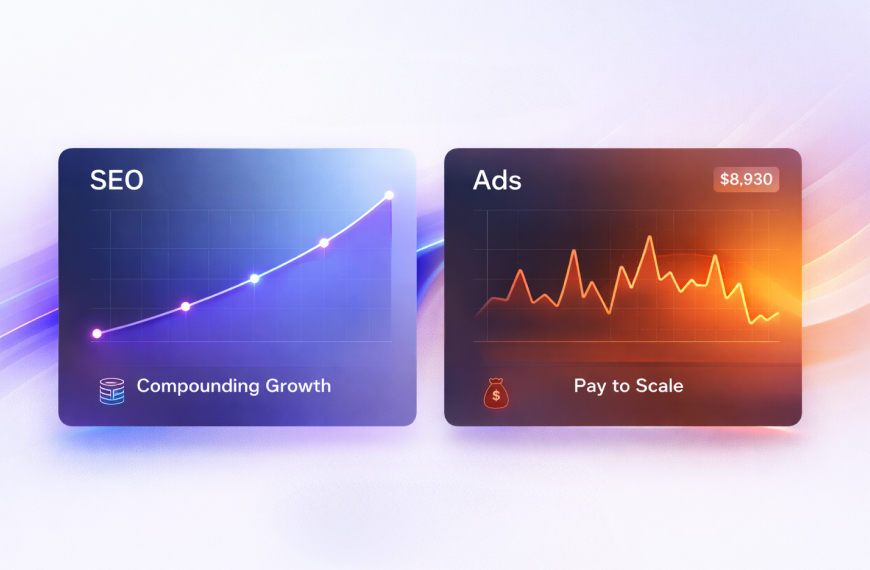
Then there’s the dependency problem. The moment you stop spending, the traffic stops. Completely. There’s no residual value. You don’t build anything that compounds over time. Every month, you’re essentially renting your visibility.
That doesn’t mean Google Ads are bad. They’re a powerful tool for performance marketing – especially when campaigns are built around proper funnel planning, smart segmentation, and conversion-focused design. The issue is when businesses rely on ads as their only source of traffic without building any organic foundation underneath.
How SEO Works – And Why It Takes Longer but Pays More
SEO – search engine optimization – is the process of making your website visible in Google’s organic (non-paid) search results. It involves technical optimization, content creation, keyword strategy, and building your site’s authority over time.
The catch? It takes time. In a competitive market like Delhi, most businesses start seeing meaningful SEO results in four to eight months. Some see early movement in 90 days, but real compounding traction typically builds over six months and beyond.
But here’s the part that changes the math entirely: once your pages rank, they keep generating traffic without ongoing ad spend. That blog post you published six months ago? It can still bring in leads today. That service page you optimized? It can rank for dozens of keyword variations and send you qualified visitors every single day – for free.
SEO builds what marketers call a compounding asset. Unlike ads, where you pay for each visitor individually, organic search delivers traffic whose marginal cost drops over time. The investment is front-loaded, but the returns keep growing.
A solid SEO & content strategy doesn’t just improve rankings. It builds topical authority, strengthens your brand presence in search, and positions your site as a trusted resource – both for human users and for AI-powered search engines like Google SGE and ChatGPT.
The Real Cost Comparison: SEO vs Google Ads in Delhi
Let’s make this concrete. Imagine you’re a Delhi-based business targeting 1,000 qualified visitors per month.
With Google Ads, if your average CPC is ₹80, you’d spend ₹80,000 per month just on clicks. That’s ₹9.6 lakhs per year – and if you stop paying in January, your February traffic is zero. Over two years, you’ve spent nearly ₹20 lakhs with nothing to show for it once the budget dries up.
With SEO, your monthly investment might range from ₹40,000 to ₹1,50,000 depending on the scope and competition level. In the first few months, traffic builds slowly. But by month six or seven, you start seeing organic traffic that didn’t cost you a per-click fee. By month twelve, that traffic is likely growing month over month while your costs stay flat. And by month eighteen, you’re generating those same 1,000 visits – or more – at a fraction of the per-visitor cost compared to ads.
The ROI curve for SEO is slower to start but steeper over time. For ads, it’s immediate but flat – and entirely dependent on continuous spend.
This is why most experienced digital marketing services teams recommend building organic as a long-term foundation, even if paid media is part of the mix.
When Google Ads Make More Sense
There are genuine scenarios where Google Ads deserve your budget – at least in the short term.
If you’re launching a new product or service and need immediate visibility while your SEO catches up, ads give you that instant presence. They’re also effective for time-sensitive campaigns – think seasonal sales, event promotions, or limited offers where waiting four months for organic rankings doesn’t make practical sense.
Google Ads also works well for testing. Before investing months into SEO for a specific keyword, you can run ads against it to see if it actually converts. If people click but don’t buy, maybe the keyword intent isn’t right – and you’ve saved yourself months of misdirected SEO effort.
For businesses in very narrow, high-value niches where there are only a handful of searches per month, paid search can capture that demand quickly and efficiently.
The key is treating ads as a tactical tool, not your entire strategy. When ads are running without any organic search working alongside them, you’re essentially paying full price for every visitor – forever.
When SEO Is the Smarter Investment
For the majority of Delhi businesses – especially those thinking beyond the next quarter – SEO is where the deeper ROI lives. Here’s when it makes the most sense.
When you’re building for the long term. If your business isn’t going anywhere and you want to build a sustainable pipeline of customers, organic search is the foundation. Every month of SEO investment stacks on top of the previous one. The content you create, the technical improvements you make, and the authority you build – all of it compounds.
When your cost per acquisition from ads is too high. If you’re spending ₹500 or more per lead through Google Ads and your margins can’t support it, SEO offers a way to bring that cost down significantly over time. Once ranked, organic traffic has near-zero marginal cost.
When you’re in a content-rich industry. If your customers search for answers, comparisons, how-to guides, or educational content before they buy, SEO lets you meet them at every stage of that journey. Think real estate buyers researching localities, SaaS buyers comparing tools, or e-commerce shoppers reading reviews.
When you want to build brand authority. Showing up consistently in organic results – not just ads – signals trust. Users know the difference between a paid placement and a site that earned its ranking. That perception matters, especially in competitive markets like Delhi NCR.
You can even start by understanding where your site currently stands. Running a quick check through a free SEO audit tool gives you a clear picture of your technical health and what needs fixing before a broader strategy kicks in.
The Best Answer? Use Both – But Lead with SEO
Here’s the nuanced truth that most agencies won’t tell you because it’s harder to sell: the ideal approach for most Delhi businesses is to use both SEO and Google Ads – but with different roles.
SEO should be your core growth engine. It’s what builds your organic pipeline, reduces your long-term cost per acquisition, and creates a moat around your business that competitors can’t easily replicate.
Google Ads should play a supporting role – filling gaps where organic hasn’t caught up yet, amplifying high-performing content, retargeting visitors who didn’t convert, and testing new keywords or markets before committing SEO resources to them.
When these two channels work together with unified analytics and conversions tracking, you get complete visibility into what’s driving results. You can see which keywords convert better from organic versus paid, where your budget is being wasted, and where to double down.
The businesses that win in Delhi’s digital market aren’t the ones spending the most on ads. They’re the ones building organic assets while using paid strategically – and they’re measuring everything.
How to Get Started Without Wasting Budget
If you’re currently spending on Google Ads with no organic strategy, here’s a practical starting path.
First, understand where your website stands right now. Run an SEO audit – either through a tool or with a professional team – to identify technical issues, content gaps, and missed keyword opportunities. Plenty of Delhi businesses are losing rankings not because their content is weak but because their site speed is poor, their pages aren’t indexed properly, or their structure confuses search engines.
Second, identify the keywords that matter most to your revenue. Not just high-volume terms, but keywords with commercial or transactional intent – the ones people search when they’re ready to buy, enquire, or compare options. A strong SEO services in Delhi partner will map keywords to business outcomes, not vanity traffic.
Third, don’t kill your ads overnight. Instead, gradually shift the budget. As organic rankings improve for your target terms, reduce ad spend on those same keywords. Reinvest the savings into more SEO or into paid campaigns targeting newer keywords you haven’t ranked for yet.
Fourth, track everything in one place. Make sure your organic and paid data flows into a single reporting dashboard so you can compare performance, attribution, and ROI side by side. Disconnected data leads to disconnected decisions.
If you want to see how this combined approach has worked for real businesses, take a look at published case studies from teams that have executed both channels together.
Trying to figure out the right mix of SEO and paid marketing for your Delhi business? Talk to the Noseberry Digitals team – we help businesses build organic-first strategies that reduce ad dependency and drive sustainable growth.