

Artificial intelligence has been a buzzword for years. But if you have been paying attention lately, something genuinely different is happening. A new generation of AI is moving beyond answering questions and generating content. It is taking action, making decisions, and completing complex work on its own. This is agentic AI, and it is not a future concept. It is already running inside real businesses, handling real workflows, and delivering real results. Whether you are a business owner, a tech leader, or simply someone trying to understand where AI is headed, this blog will give you a clear, honest picture of what agentic AI is, how it compares to generative AI, where it is being used today, agentic AI development services by Noseberry Digitals and what you need to think about before adopting it.
What Is Agentic AI? (And Why the Definition Matters)
The Simplest Definition
Agentic AI refers to artificial intelligence systems that can pursue goals autonomously. Instead of waiting for a human to type a prompt and then responding, agentic AI perceives its environment, reasons through options, takes action, and learns from the results.
From Reactive to Proactive AI
Most AI tools you have used are reactive. You ask, they answer. Agentic AI is proactive. You give it a goal, and it figures out how to get there. It breaks down tasks, uses available tools, checks data across systems, and delivers outcomes without needing someone to hold its hand at every step.
Think of it less like a search engine and more like a highly capable team member who works around the clock, never forgets context, and gets sharper every week.
Agentic AI vs Generative AI: Understanding the Core Difference
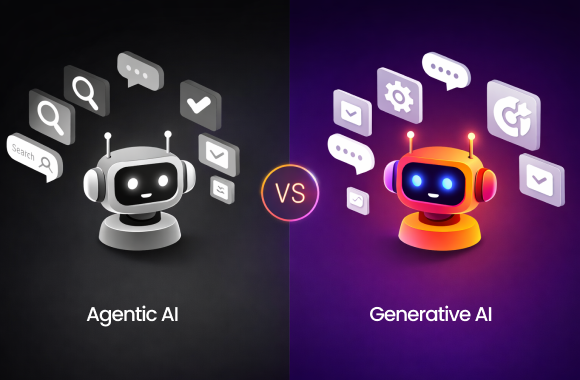
ne of the most searched questions in the AI space right now is agentic AI vs generative AI. They are not the same thing, and confusing the two leads to poor technology decisions.
What Generative AI Does
Generative AI (think ChatGPT, Copilot, Midjourney) produces content based on a prompt. You ask it to write an email, generate an image, or explain a concept, and it does. The interaction ends there. It does not go check your calendar, update your CRM, or follow up on a task tomorrow morning. It is reactive and prompt-bound.
What Agentic AI Does Differently
Agentic AI takes the intelligence of generative models and wraps it in autonomy, memory, and decision-making capability. It does not just produce content. It reasons through multi-step problems, pulls data from multiple sources, executes actions across connected systems, and adapts when something does not go as planned.
Here is a practical comparison:
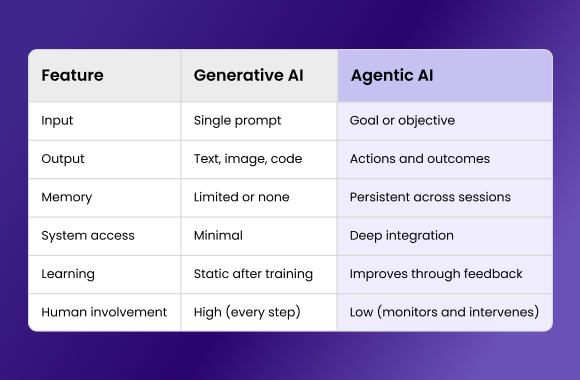
The difference is not incremental. It is a fundamentally new category of AI, and businesses investing in agentic AI development services are building capabilities that generative AI alone simply cannot deliver.
How Agentic AI Actually Works
When you look under the hood, agentic systems rely on four core components working together.
1. The Instruction Layer
This is where you define what the agent is supposed to accomplish and what boundaries it must respect. Think of it like onboarding a new employee. You explain the role, the responsibilities, and the guardrails. The quality of this layer directly determines how well the agent performs.
2. Memory
This is what separates agentic AI from a standard chatbot. These agents retain context across conversations, remember past outcomes, and use that history to make better decisions over time. A support agent that remembers your last three interactions is dramatically more helpful than one starting from scratch.
3. Tools and Integrations
An agent can reason brilliantly, but without access to your databases, APIs, communication platforms, and business systems, it cannot act. The real power of agentic AI shows up when an agent can pull data from one system, make a decision, and push an action into another system without a human in the middle.
4. The Learning Loop
Through reinforcement and feedback mechanisms, agents do not just execute tasks. They get better at them. Every outcome feeds back into the system. Good results get reinforced, poor ones get corrected. Over time, the agent becomes faster, sharper, and more reliable.
Where Businesses Are Using Agentic AI Right Now
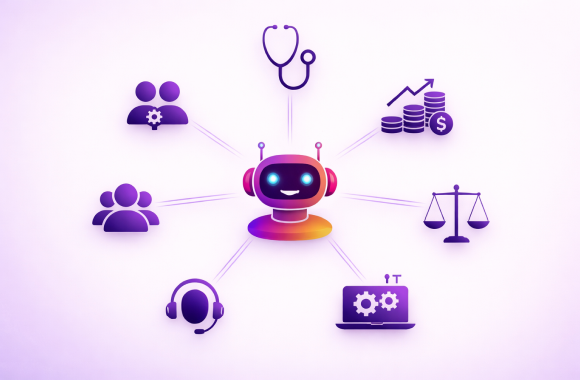
This is not theoretical. Agentic AI is already operating inside organizations across industries, quietly handling work that used to consume human hours every day.
Customer Support
Modern agentic customer service goes far beyond chatbots. An agentic system can detect a shipping delay before a customer notices, send a proactive notification, offer alternatives, and update the internal ticketing system autonomously. When a customer contacts support about a billing error, the agent verifies the charge, identifies the discrepancy, processes the correction, and confirms resolution. No escalation needed. Companies using these systems are seeing significant drops in ticket volume while improving satisfaction scores.
IT Operations
IT support desks are buried in routine tickets that require no human expertise but still consume human hours. Agentic AI handles password resets, software update failures, and network issues automatically. When a genuine problem arises, it escalates intelligently with full context already attached. What once took hours of human triage now happens in minutes.
Human Resources
HR is one of the clearest wins for agentic AI. Screening hundreds of resumes, coordinating interviews across time zones, onboarding new hires across multiple systems, and answering repetitive policy questions are all tasks that are important but do not require a human every time. Agentic systems handle the workflow end to end, freeing HR professionals to focus on talent strategy, culture, and the work that actually needs human judgment.
Security and Fraud Detection
In cybersecurity, speed is everything. Agentic systems continuously monitor network activity, detect anomalies, investigate suspicious behavior, and in some cases take immediate action before damage occurs. They also reduce false positives significantly, which means security teams spend less time chasing phantom threats and more time addressing real ones.
Finance and Compliance
Agentic AI automates expense reporting, monitors transactions in real time, and delivers actionable spending analysis. For businesses in regulated industries, the compliance benefits alone can justify the investment.
Healthcare Administration
Clinicians did not train for years to fill out insurance forms. Agentic AI handles scheduling, billing, and resource allocation so that doctors and nurses can focus on patients. Real-time monitoring of patient vitals with automated alerts to care teams is already in deployment across major health systems.
Software Development
Developers spend enormous time on code reviews, bug fixes, and debugging. Agentic AI is shouldering that burden by scanning codebases for inefficiencies, catching errors in real time, and prioritizing issues by severity. Industry analysts expect the vast majority of enterprise engineers to be working alongside AI agents within the next few years.
The Risks Nobody Wants to Talk About (But Should)
Responsible adoption of agentic AI means facing the risks honestly.
The Explainability Problem
When an agent makes an autonomous decision, can you explain why? In many cases, the answer is not straightforward. For regulated industries and compliance teams, this is a serious challenge that needs to be addressed before deployment, not after.
Bias at Scale
Every AI system reflects the data it was trained on. If that data carries biases, the agent will act on them. But here is the compounding problem: an agentic system does not make one biased decision. It makes thousands of decisions, fast, across your entire operation. A small flaw becomes a systemic issue before anyone catches it.
Expanded Security Surface
Giving an autonomous agent access to your internal databases, email systems, and customer records significantly expands your attack surface. Security needs to be designed into the agent architecture from day one, not bolted on afterward.
Organizational Resistance
The technical challenge of adopting agentic AI is real. But the cultural challenge is often bigger. Employees worry about displacement. Teams resist change. Integration with legacy systems is messy. Underestimating this dimension is one of the most common mistakes organizations make.
How to Get Started Without Getting Burned
If you are considering bringing agentic AI into your organization, here is practical guidance drawn from real implementation experience.
Step 1: Start Small and Specific
Pick one well-defined workflow where the value is clear and the risk is contained. Prove it works before expanding. Trying to overhaul your entire operation at once is a reliable path to failure.
Step 2: Get Your Data Foundation Right
Agentic AI is only as good as the data it can access. Outdated knowledge bases, siloed systems, and messy data will undermine even the most sophisticated agent. Invest in your data infrastructure first.
Step 3: Keep Humans in the Loop Initially
Full autonomy is the long-term direction, but in the near term, human-AI collaboration is the smarter path. Build in review checkpoints for high-stakes decisions until you have established trust in the system.
Step 4: Invest in Monitoring and Audit Trails
You need to understand what your agents are doing and why. Log decisions, build dashboards, and create explainability reports. If you cannot audit an agent’s behavior, you cannot trust it and neither can your customers or regulators.
Step 5: Design Security In From the Start
Access controls, input validation, and anomaly detection should be part of the architecture from day one. Not added later.
What Is Coming Next in Agentic AI
The technology is still maturing, and several trends are shaping where it is headed.
Domain-Specific Agents
Generic AI is useful, but agents trained on the specific nuances of healthcare, finance, logistics, or legal deliver dramatically better results. Expect significant investment in vertical specialization over the next few years.
Multi-Agent Orchestration
Networks of specialized agents working together across departments, each handling their slice of a larger workflow, is where enterprise-scale value is being built. The ability to coordinate dozens of agents reliably is the capability every serious organization is racing toward.
Synthetic Data in Agent Training
Real-world data is limited, expensive, and full of privacy concerns. Synthetic datasets that mimic real patterns allow agents to train on edge cases and rare scenarios without the regulatory complexity.
Conclusion
Agentic AI represents a genuine evolution in how businesses operate, not a marketing trend. The shift from AI as a content tool to AI as an autonomous collaborator is already underway, and the organizations building on it now are establishing advantages that will be difficult to close later.
At Noseberry Digitals, we help businesses navigate this shift thoughtfully. Whether you are exploring your first use case or ready to build a full multi-agent architecture, our agentic AI development services are designed to move you from concept to working system without the guesswork.
The future is not about replacing human judgment. It is about amplifying it with systems that handle the grind, so your people can focus on what actually matters.
Ready to explore what agentic AI can do for your business? Get in touch with Noseberry Digitals today.