


E-commerce has always been a speed game. The business that restocks faster, responds faster, personalises faster, and prices smarter wins. For the past decade, automation tools and basic AI have helped operators move quicker than manual processes ever could. But there is a ceiling to what reactive technology can achieve — and most e-commerce businesses are already hitting it.
Agentic AI for e-commerce breaks that ceiling entirely.
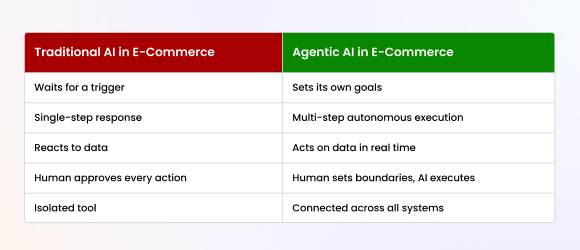
Where traditional AI waits for a trigger and returns a response, agentic AI systems plan, reason, and act across multi-step workflows without waiting for a human decision at every junction. They do not assist operations — they run them. From inventory replenishment to fraud detection to personalised customer journeys, agentic systems are restructuring how e-commerce businesses operate at their core.
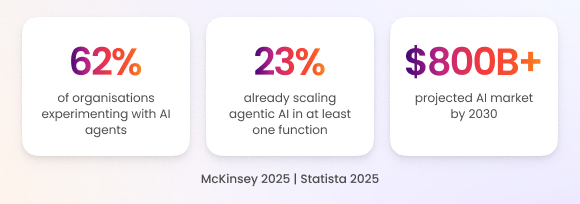
According to McKinsey’s 2025 State of AI survey, 62 percent of organisations are already experimenting with AI agents, and 23 percent are actively scaling agentic systems in at least one business function. In retail and e-commerce, where margin and velocity are everything, the operators moving now are building advantages their competitors will find very difficult to close.
Market Overview: Where Agentic AI Fits in the E-Commerce AI Landscape
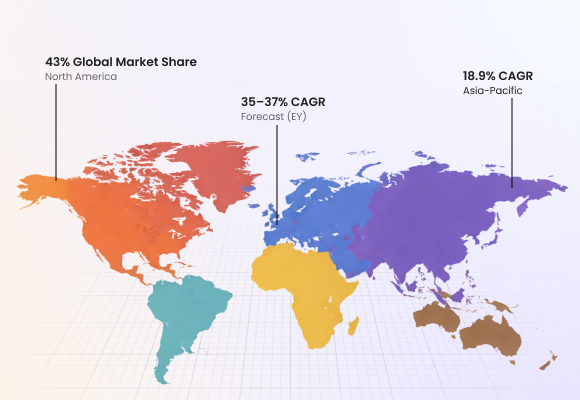
The broader AI market is valued at $244 billion in 2025 and is projected to exceed $800 billion by 2030, according to Statista. Within that growth, generative AI in ecommerce has already demonstrated significant commercial traction — with North America holding a 43 percent share of the global retail AI market and Asia-Pacific expanding at an 18.9 percent CAGR through the decade.
But generative AI, as powerful as it is, remains largely a content and personalisation tool. It generates, suggests, and creates. Agentic AI goes further — it executes.
Agentic AI in ecommerce represents the next structural layer on top of everything the generative AI wave already built. It connects insights to actions, eliminates the human bottleneck between decision and execution, and operates continuously across the full operational surface of a retail business.
The businesses that have already moved from generative AI pilots to agentic AI deployment are not just more efficient — they are operationally faster in ways that compound over time.
Beyond Automation: What Makes Agentic AI Different
Most e-commerce businesses already have some form of AI solutions for ecommerce in place — recommendation engines, search ranking models, email automation, basic chatbots. The distinction between these tools and agentic AI is not a matter of degree. It is a matter of architecture.
Traditional AI tools are reactive. They take an input, apply a model, and return an output. An agentic system is goal-driven. It receives an objective, breaks it into sub-tasks, coordinates across multiple systems to execute them, monitors outcomes in real time, and adjusts its approach mid-execution when conditions change.
The RAND Corporation’s 2024 study on AI project failure — based on interviews with 65 senior data scientists — identifies two leading root causes: organisations focus on the technology rather than the problem, and they lack the infrastructure to deploy models into production effectively. For agentic AI in e-commerce, this translates directly into a readiness question. Agents are only as capable as the data architecture, integrations, and operational infrastructure beneath them. The businesses seeing the strongest results are the ones who built that foundation first.
Key Applications Transforming E-Commerce Operations
Inventory Management and Supply Chain Intelligence
Inventory miscalculation remains one of the most expensive recurring costs in retail. Overstocking locks up working capital. Understocking drives customers to competitors and erodes long-term loyalty. Traditional forecasting models fail when demand shifts suddenly — during viral social moments, supply disruptions, or unexpected weather events.
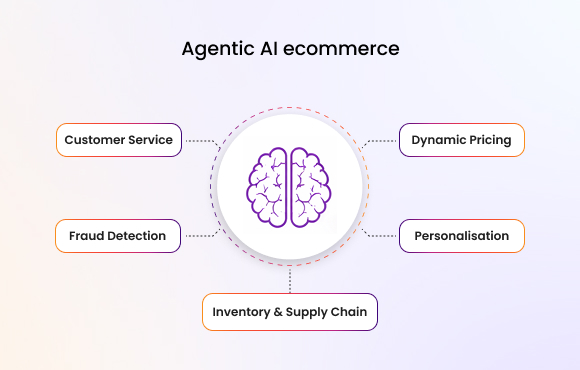
Agentic AI systems monitor sales velocity, supplier lead times, warehouse capacity, and external demand signals simultaneously. When a threshold is crossed, they do not just generate an alert. They act — placing purchase orders, rerouting shipments, updating product availability across channels, and adjusting safety stock parameters in real time.
AI automation in retail at this level eliminates the latency between data and action that has historically cost retailers millions in preventable margin loss each year. It also removes the cognitive load from operations teams who previously had to process these signals manually.
Dynamic Pricing and Promotional Execution
Competitive pricing in e-commerce is no longer a weekly meeting. It is a continuous, multi-variable calculation that changes by the hour. Agentic AI systems evaluate competitor pricing feeds, real-time stock levels, demand elasticity models, customer segment behaviour, and margin thresholds simultaneously — and execute pricing updates, apply promotional rules, and trigger or withdraw campaigns without a human approval cycle for each decision.
This is where generative AI in ecommerce and agentic AI intersect most powerfully. Generative models create the promotional content. Agentic systems decide when to deploy it, to whom, at what price point, and for how long — based on live conditions rather than pre-scheduled rules.
Operators using agentic pricing systems report materially faster responses to market shifts and significant reductions in revenue leakage from static, manually managed promotional calendars.
Customer Service and Resolution Workflows
Customer service is where most e-commerce businesses first feel operational strain as they scale. Volume grows faster than headcount. Response time expectations have shortened to minutes. And the cost of a poor experience — measured in returns, negative reviews, and lost repeat purchase — is immediate and trackable.
Agentic AI agents handle the complete resolution lifecycle for the majority of customer queries — order tracking, return initiation, refund processing, complaint escalation, product recommendations — without human intervention at every step. Unlike basic chatbots that follow decision trees, agentic systems maintain context across a full conversation, understand customer sentiment, access live order and account data, and adapt their resolution approach accordingly.
McKinsey’s 2025 research identifies contact-centre automation as one of the most widely scaled and cost-effective AI use cases across industries. In e-commerce, where service volume can triple during peak seasons with no proportional increase in team capacity, agentic customer service is no longer a competitive advantage. It is a baseline operational requirement.
Hyper-Personalisation at Every Touchpoint
Personalisation has been a commercial priority in e-commerce for over a decade. The technology has historically delivered segment-level approximations — broad recommendation logic, retargeting audiences, and email content based on past purchase categories.
Agentic AI creates genuinely individual experiences at scale. These systems build and continuously update a real-time model of each customer — browsing behaviour, purchase intent signals, price sensitivity, preferred categories, channel preference — and use that model to adjust homepage layout, search ranking, email content, push notification timing, and promotional offers dynamically. No human editorial team can operate at this granularity across a customer base of any meaningful size.
Fraud Detection and Risk Management
Fraud patterns in e-commerce evolve faster than rule-based detection systems can be updated. Agentic AI addresses this structurally. These systems monitor transaction data streams continuously, build behavioural baselines for each account, and flag or act on anomalies in real time — blocking suspicious transactions, triggering secondary verification, and flagging accounts for review without waiting for a human to notice a pattern.
The speed advantage is decisive. Fraud windows close in seconds. Human review cycles operate in minutes or hours. Agentic systems operate in the same timeframe as the threat itself.
Choosing the Right AI Agent Company in E-Commerce
As demand for agentic AI capability grows, the vendor landscape has expanded rapidly — and not all of it is equipped for the complexity of e-commerce operations. Choosing the right AI agent company in ecommerce requires a different evaluation lens than selecting a traditional software vendor.
The questions that matter most are specific. Does the partner have live, production-deployed agentic systems — not demos or proof-of-concepts? Can they integrate agents with your existing commerce infrastructure: your OMS, ERP, CRM, and logistics systems? Do they have a governance and monitoring framework that makes autonomous agent decisions auditable? And do they understand the data realities of your specific business — SKU complexity, seasonal demand patterns, return rates, customer segmentation?
Retailers using AI solutions for ecommerce who have selected partners based on technology capability alone — without interrogating operational readiness and integration depth — consistently report longer deployment timelines, higher rework costs, and narrower returns than those who treated vendor selection as a strategic decision.
Global Market Dynamics
North American Leadership
North America continues to lead in agentic and generative AI adoption in retail, supported by mature cloud infrastructure, deep venture capital investment in AI tooling, and large enterprise retailers willing to commit meaningful budget to AI transformation. The 43 percent global market share reflects both early adoption and the concentration of AI development capability in the region.
Asia-Pacific: The Growth Engine
Asia-Pacific is expanding fastest, driven by high mobile commerce penetration, social commerce growth, and the willingness of both enterprise and mid-market retailers to deploy AI at scale without the legacy infrastructure constraints that slow adoption in more established markets.
India: Scale and Complexity
India presents a distinctive opportunity within the global picture. EY India forecasts a 35-37 percent CAGR in retail AI adoption through the coming years. Major platforms including Flipkart, Myntra, and Amazon India have implemented AI capabilities across discovery, personalisation, and customer service — and the Open Network for Digital Commerce (ONDC) is creating a framework that could accelerate AI deployment across India’s broader, fragmented retail ecosystem.
The challenges are real: infrastructure gaps, fragmented data across languages and regions, and a shortage of AI-ready technical talent. But the scale of the market and the pace of mobile commerce growth mean India will be one of the defining arenas for agentic AI in ecommerce deployment over the next five years.
Implementation Roadmap for E-Commerce Operators
Deploying agentic AI effectively requires a sequenced, infrastructure-first approach. Operators who attempt to deploy agents on top of fragmented data and disconnected systems replicate the failures that the RAND research identifies as the leading cause of AI project cancellation.
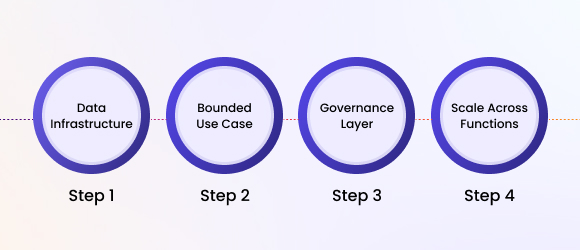
A practical implementation sequence looks like this:
Data infrastructure first. Unified, real-time access to inventory, order, customer, and pricing data is the non-negotiable foundation. Agents cannot act on data they cannot access.
Start with a bounded use case. Inventory management or customer service resolution — both high-frequency, high-impact, measurable — are the most effective starting points. Define success metrics before deployment, not after.
Build the governance layer in parallel. Define the boundaries within which agents operate autonomously, the thresholds at which human review is triggered, and the monitoring infrastructure that keeps agent behaviour visible and auditable.
Scale across functions once the foundation holds. The compounding value of agentic AI comes from agents operating across inventory, pricing, and customer service simultaneously — not from a single isolated deployment.
The Takeaway
Agentic AI for e-commerce is not a pilot project for 2027. It is in production today, at scale, in businesses that decided not to wait for conditions to be perfect. The gap between those businesses and the ones still running evaluations is widening every quarter.
From inventory intelligence to dynamic pricing, from autonomous customer service to real-time personalisation, agentic AI in ecommerce is rewriting the operational logic of how retail businesses run. The technology is no longer the question. The question is whether your data architecture, your integration infrastructure, and your development partner are ready to deploy it at the pace the market now demands.
Explore Noseberry’s AI & ML Solutions →