


 Our Work


Real Estate
What Is Property Finance Automation and What Does It Actually Do?
By Mayank Pokharna (Coliving Expert)
• 7 min read
Mar 18, 2026
Share


Key Takeaways
- Property finance automation replaces recurring manual billing, reconciliation, and reporting tasks with system-driven workflows.
- The core value is eliminating the time cost and error risk of manual financial processes at scale.
- Key automated processes include rent invoicing, payment matching, arrears escalation, service charge calculation, and period-end reporting.
- Finance automation is distinct from general accounting software: it is built around property-specific financial workflows.
- The return on investment is most visible in reduced finance team hours and faster monthly close.
- Custom-built platforms can accommodate non-standard lease structures and multi-entity financial models that off-the-shelf tools cannot.
Every property business reaches a point where its financial processes stop scaling. What worked when the portfolio was small, a spreadsheet here, a manual invoice there, a reconciliation run at month end, becomes an operational burden as the portfolio grows. The finance team spends increasing time on tasks that should be automatic: generating invoices on a schedule, chasing overdue payments, matching receipts to the correct lease records, calculating service charges across shared buildings, and assembling the financial reports that management needs to make decisions. Property finance automation is the category of software built to replace those manual tasks with system-driven workflows. This article explains what it covers, how it works, and who benefits most from it.
The Finance Problem That Grows With the Portfolio
The financial management of a property portfolio is deceptively complex. On the surface, it looks straightforward: tenants pay rent, expenses are recorded, and the difference is the income. In practice, the reality is considerably more involved. A mid-sized residential portfolio generates hundreds of financial events each month: rent invoices, payment receipts, maintenance invoices, contractor payments, deposit transactions, service charge adjustments, arrears notices, and refunds. Each of these needs to be recorded accurately, allocated to the correct property and cost centre, and reflected in the period-end accounts. When these tasks are handled manually, the finance team’s time is consumed by the mechanics of recording rather than the analysis of the numbers. Reconciliation takes days. Reporting is delayed. Errors accumulate through re-entry. The team is always behind. Finance automation addresses this by handling the mechanics automatically, leaving the finance team’s time for the tasks that genuinely require human judgment.
What Property Finance Automation Actually Means
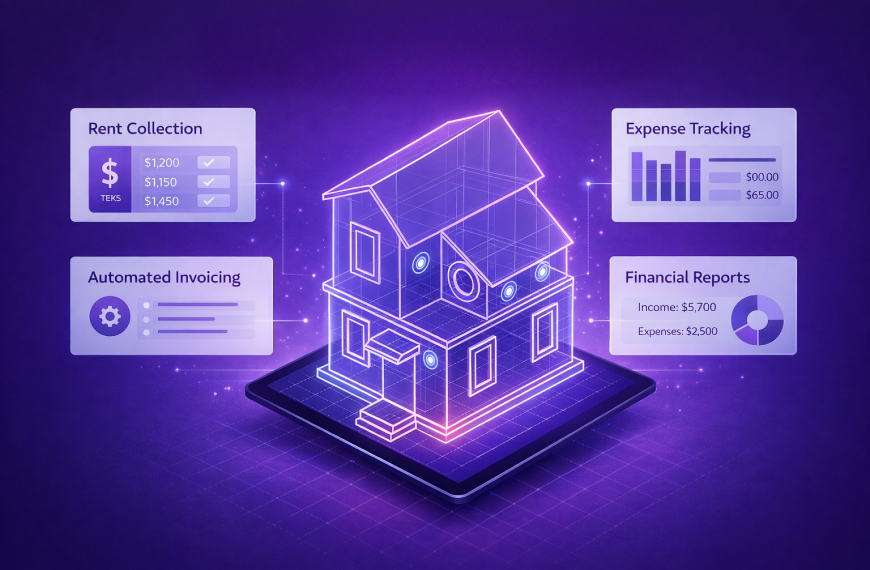
Property finance automation is not a single feature. It is a connected set of workflows that handle the financial lifecycle of a property portfolio without requiring manual intervention at each step. At its core, it means that financial events which are predictable and recurring, such as monthly rent invoices, are generated automatically on the correct schedule for each lease. Payments received are matched to their invoices automatically. Discrepancies are flagged for review rather than discovered during a manual reconciliation run. Beyond the transactional layer, finance automation extends to: arrears escalation triggered by missed payments, service charge calculations distributed across tenants based on configured allocation rules, period-end reporting compiled from the live financial data without manual assembly, and owner disbursements processed on the correct schedule for properties managed on behalf of third-party landlords. The result is a finance function that runs continuously in the background, keeping the books accurate and current, rather than a function that operates in bursts of intensive manual effort at billing and reporting times.
The Core Processes It Automates
Rent invoicing and billing generates invoices on the schedule defined by each lease: monthly, quarterly, or annually, with the correct amount, the correct tenant details, and the correct due date. Invoices are delivered to the tenant through the configured channel without manual generation. Payment matching and reconciliation identifies incoming payments and matches them to their corresponding invoices and tenancy records in real time. Unmatched payments are flagged for review. The financial record for each property and tenancy is updated immediately rather than at the end of the month. Arrears management triggers a defined escalation sequence when a payment is missed: automated reminder, formal notice, property manager alert, and formal arrears process. Each stage runs at the correct interval without manual scheduling. Service charge management calculates each tenant’s share of shared costs according to the allocation method defined in the lease, generates service charge invoices, tracks payments, and reconciles the service charge account at the end of the service charge period. Supplier invoice processing manages the approval and payment of contractor and supplier invoices, with cost allocation to the correct property and cost centre and integration to the accounts payable function. Owner disbursement calculates and processes the payment of net rental income to property owners on the defined schedule, after deducting management fees, maintenance costs, and other agreed deductions. Period-end reporting compiles the income, expenditure, and balance position for each property, portfolio segment, and legal entity from the live financial data, producing management accounts without a manual data assembly step.
Who Benefits Most From Finance Automation
The benefit of finance automation scales with portfolio size and financial complexity. Residential property managers handling more than 50 units find that the manual billing and reconciliation process becomes a significant overhead. At this scale, automation pays for itself in finance team time within the first year. Commercial property managers with complex lease structures, quarterly rent schedules, turnover rent clauses, and detailed service charge accounts benefit from automation that handles these structures without requiring manual calculation for each period. Build-to-rent and multi-family operators managing hundreds of units within a single development have the highest volume of recurring financial events and the most to gain from automated processing. Property management companies acting on behalf of third-party landlords need robust owner statement generation and disbursement automation as a core business function. Multi-entity portfolios with properties held across different legal entities or ownership structures need finance automation that can maintain separate books for each entity while providing consolidated reporting across the portfolio.
Finance Automation vs Accounting Software
This distinction is frequently confused, and it is worth being precise. General accounting software, whether a small business package or an enterprise platform, is designed to record financial transactions and produce accounts. It can do this for any type of business. It handles invoicing, bank reconciliation, and financial reporting at a generic level. Property finance automation is built around the specific financial workflows of a property business. It knows that a lease generates a recurring invoice schedule. It knows that a service charge is distributed across multiple tenants according to floor area or another allocation metric. It knows that an owner disbursement requires specific deductions in a specific order before the net amount is paid. General accounting software can be configured to handle some of these requirements, but the configuration is often complex and fragile, and the result is a workaround rather than a purpose-built solution. Property finance automation handles these workflows natively because it was designed specifically for them. Many property businesses use both: a property finance platform that handles property-specific workflows and passes summarised data to a general accounting package for statutory accounts. This architecture allows each tool to do what it does best.
What to Look For When Evaluating Options
When evaluating property finance automation options, the questions that matter most are: Does it handle your specific lease structures? Residential monthly tenancies, commercial quarterly leases, turnover rent, peppercorn rent, break clauses, and index-linked rent reviews all require different treatment. Confirm that the platform handles the structures in your portfolio before committing. Does it integrate with your existing accounting software? The connection between your property finance platform and your statutory accounts needs to be clean and reliable. Confirm the integration approach and the data mapping before selection. Does it support multi-entity accounting? If your portfolio is held across multiple legal entities, the platform needs to maintain separate entity records while providing consolidated reporting. Does it offer a configurable service charge module? Service charge management is one of the most complex and litigation-prone areas of property finance. A platform with a flexible, auditable service charge module is a significant operational asset. Can it be customised to non-standard workflows? Off-the-shelf platforms cover standard processes well. Businesses with complex ownership structures, non-standard lease types, or bespoke reporting requirements frequently find that a custom-built platform serves them more effectively over the long term. Our Property Finance and Billing Automation Software page covers how we design and build custom finance automation platforms for property businesses.
Conclusion
The manual finance workflows that hold property businesses back are not the result of poor decisions. They are the result of growth outpacing the tools that were in place when the portfolio was smaller. The question at that point is not whether automation would help. The answer to that is almost always yes. The question is which platform handles the financial structures your portfolio actually contains, integrates cleanly with the tools your team already uses, and can be configured or built to match the workflows that are specific to your business. A generic accounting package with property workarounds will keep working until the workarounds outnumber the workflows. A purpose-built property finance platform removes that ceiling and gives the finance team what it should have had all along: a system that runs the routine work automatically so that the people running it can focus on the analysis and decisions that actually move the business forward.
FAQ
When in doubt always ask?
Property finance automation is software that handles the recurring financial workflows of a property portfolio without manual intervention at each step. It covers rent invoicing, payment matching, arrears escalation, service charge management, supplier payments, owner disbursements, and period-end reporting.
General accounting software records transactions and produces accounts for any business type. Property finance automation is built around property-specific workflows: lease-driven billing schedules, service charge distribution, owner disbursement, and property-level cost allocation. It handles these natively rather than through complex configuration of a generic tool.
Residential property managers handling more than 50 units, commercial property managers with complex lease structures, build-to-rent operators, property management companies acting for third-party landlords, and multi-entity portfolio owners all have strong use cases for finance automation.
Yes. Most property finance platforms are designed to pass summarised transaction data to a general accounting package for statutory reporting. The quality of that integration varies by platform, and it should be confirmed and tested before a platform is selected.
Service charge automation calculates each tenant’s share of shared building costs according to the allocation method defined in the lease, generates service charge invoices, tracks payments, and reconciles the service charge account at period end. It replaces a manual calculation and invoicing process that is time-consuming and error-prone at scale.