


 Our Work


Real Estate
Warning Signs Your Property Software Has Become a Legacy Problem
By Mayank Pokharna (Coliving Expert)
• 8 min read
Mar 19, 2026
Share


Key Takeaways
- Most real estate businesses wait too long to modernise, compounding the cost of delay.
- Loss of vendor support is the clearest signal that a system has become a liability.
- When staff develop workarounds, the system is no longer doing its job.
- Manual reporting that takes days to compile is a symptom of a disconnected data architecture.
- Inability to integrate with newer tools is a growth ceiling as much as a technical problem.
- Multiple warning signs appearing together indicate that modernisation is urgent, not optional.
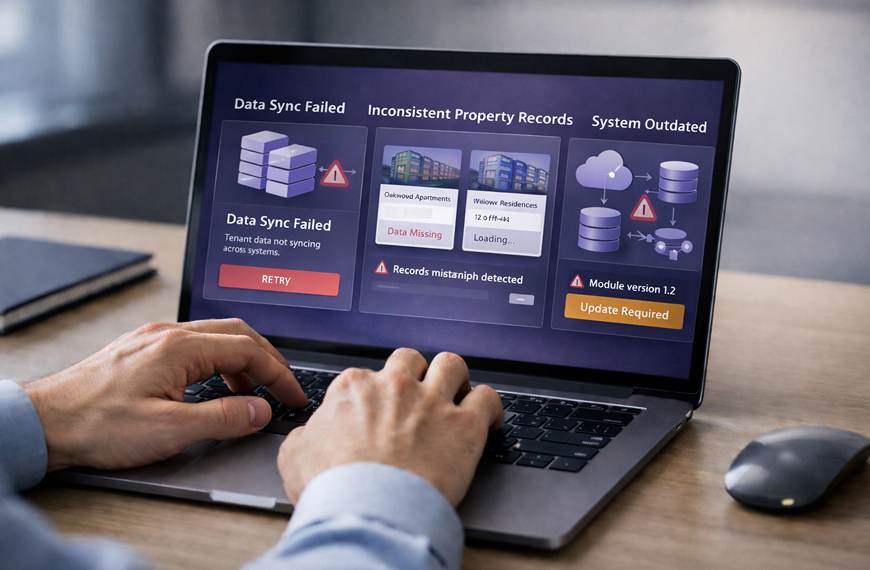
Most real estate businesses do not decide to modernise their systems because they woke up one day and decided it was time. They decide because the signals have been building for months or years and eventually become impossible to ignore. The challenge is that legacy systems rarely fail dramatically. They degrade gradually. Each limitation, each workaround, each manual process added to compensate for something the system cannot do, feels manageable on its own. Collectively, they represent a significant drag on the business. This article identifies the clearest warning signs that your property software has crossed the line from imperfect to genuinely problematic.
The Cost of Staying With a Failing System
Before the warning signs, it is worth naming the cost that accumulates when modernisation is deferred. Staff time spent on manual processes that a modern system would automate. Error rates that result from double data entry between systems that cannot connect. Delays in financial reporting that slow down decision-making. Security vulnerabilities in software that is no longer receiving updates. Developer time consumed by maintaining and patching an ageing codebase rather than building new capability. None of these costs appear as a line item on the P&L. They are absorbed into the operational overhead of the business and accepted as normal. They are not normal. They are the cost of a system that no longer fits.
Warning Sign 1: No Vendor Support
If the company that built or supplied your property management software is no longer actively maintaining it, your system is operating without a safety net. Software that is not actively maintained does not receive security patches when vulnerabilities are discovered. It does not receive updates for compatibility with new operating systems, browsers, or device types. When something breaks, there is no support line to call. In practice, this means your business is exposed to security risk and operational fragility with no route to resolution other than building fixes yourself or switching to a new system. For custom-built systems, the equivalent signal is when the original development team is no longer available and the codebase has no documentation. If no one in the business or its technology partners can confidently maintain and extend the system, it has effectively become unsupported.
Warning Sign 2: Integration Is Impossible
Modern real estate operations depend on a connected technology stack. Your property management system should be able to share data with your accounting software, your CRM, your listing portals, your payment gateway, and your reporting tools. If your current system cannot do this, or if connecting it to any external tool requires a significant custom development project just to move data between two systems, you are experiencing a compounding integration problem. The cost of poor integration is not just the time spent on manual data transfer. It is the decisions made on incomplete or outdated data because the system that holds the relevant information cannot share it in real time with the tools where decisions are being made. A system that cannot integrate is a system with a growth ceiling. Every new tool or process you want to adopt has to work around the legacy system rather than connecting to it.
Warning Sign 3: Staff Are Working Around It
This is one of the most reliable indicators that a system has become a legacy problem, and it is also one of the easiest to miss because the workarounds become normalised over time. Workarounds look like: maintaining a separate spreadsheet that tracks information the system cannot store in a useful format; copying data from the system into another tool before it can be used; building reports manually because the system’s reporting function does not produce what management needs; or sending data by email between team members because the system has no way to route it automatically. Every workaround is evidence that the system is no longer doing the job it was implemented to do. When workarounds become embedded in daily operations, staff stop expecting the system to help them and start expecting to work around it. This lowers morale, increases error rates, and creates institutional knowledge that lives in people’s heads rather than in the system.
Warning Sign 4: Reporting Is Manual and Slow
In a well-functioning property technology environment, management reports should be a few clicks away. Occupancy rates, arrears positions, maintenance backlogs, financial performance by property or portfolio segment: a modern system surfaces these in real time from the data it already holds. If producing these reports currently involves exporting data from the system, cleaning it in a spreadsheet, and manually combining it with data from other sources before it is usable, your system has a fundamental data architecture problem. The delay between business events and the availability of management information has a direct cost. Decisions made on data that is a week or a month old are decisions made without the full picture. In a portfolio environment where vacancies, arrears, and maintenance costs change constantly, slow reporting is a competitive disadvantage.
Warning Sign 5: The System Cannot Scale
A system built for a portfolio of 200 units may work well at that scale. At 500 units, performance degrades. At 1,000, it becomes operationally unviable. Scaling problems manifest in several ways: the system becomes noticeably slower as the data volume grows; the database structure does not support the kind of multi-entity or multi-location reporting the business now needs; user licence costs on the existing platform become prohibitive as the team grows; or the system simply does not have the features required to manage the more complex operational scenarios that come with a larger portfolio. A system that cannot scale with the business is not just a current operational problem. It is a constraint on how fast the business can grow.
When Multiple Signs Appear Together
Each of these warning signs on its own is a reason to have a serious conversation about modernisation. When multiple signs appear together, the case for action becomes urgent. A system that has no vendor support, cannot integrate with modern tools, is being worked around by staff, produces slow manual reports, and is struggling to scale is not just imperfect. It is actively costing the business in time, risk, and opportunity every day it continues to operate. The question at that point is not whether to modernise but how to do it in a way that minimises disruption and preserves the data and operational continuity the business depends on. Our Legacy System Modernisation page covers the assessment process we use to evaluate legacy property systems and identify the right modernisation approach for each situation.
Conclusion
Legacy systems do not announce themselves. They accumulate. Each warning sign described in this article is, on its own, something most businesses find a way to live with. Together, they describe a system that is no longer serving the business it was built for. The moment to act is not when the system fails completely. By that point, the disruption and cost of an unplanned migration are significantly higher than a transition managed on the business’s own terms. The moment to act is when the warning signs are visible and the cost of staying is clearly outweighing the cost of change. That assessment is not always straightforward. Legacy systems are embedded deeply into daily operations, and the risk of disruption during a transition is real. But the risk of staying with a system that cannot integrate, cannot scale, and is no longer supported is not static. It grows every month the decision is deferred. If several of the warning signs in this article describe your current situation, the right next step is a structured assessment, not a procurement process. Understand what you have, what it is costing you, and what your options are before committing to a path. The businesses that modernise successfully are the ones that went into the process with a clear picture of the problem before they started evaluating solutions.
FAQ
When in doubt always ask?
The clearest indicators are: no active vendor support, inability to integrate with modern tools, staff maintaining workarounds to compensate for missing functionality, manual and time-consuming reporting, and performance or capability problems as the portfolio scales.
No. Depending on the nature of the problem, a targeted modernisation approach such as adding an API layer, re-platforming to modern infrastructure, or refactoring specific modules may be sufficient. Full replacement is the right choice only when incremental improvement is not economically viable.
An unsupported system receives no security patches, no compatibility updates, and no bug fixes. This creates growing security vulnerabilities and operational fragility over time. When something breaks, there is no recourse other than self-repair or migration.
There is no fixed timeline, but deferral compounds the problem. Legacy systems accumulate technical debt, and the longer they run without investment, the more complex and expensive the eventual modernisation becomes. Businesses that act earlier typically face a less disruptive and less costly transition.
Commission a structured assessment. This involves auditing the current system’s capabilities, integration gaps, data quality, and support status, and mapping those findings against the business’s current and future operational needs. The assessment produces a clear picture of the options and their respective costs and timelines