


 Our Work


Real Estate
How to Build a Tenant Self-Service App That Tenants Will Actually Use
By Mayank Pokharna (Coliving Expert)
• 9 min read
Mar 27, 2026
Share


Key Takeaways
- Tenants increasingly expect to manage their tenancy from their phone without calling an office.
- Self-service apps reduce inbound support volume by handling routine requests digitally.
- Maintenance request tracking is the single highest-impact feature for tenant satisfaction.
- Payment integration must support the tenant’s preferred method to drive adoption.
- Adoption depends on the app being genuinely useful from day one, not just functional.
- Property managers save significant time when tenants can self-serve routine tasks.
Property management teams spend a significant portion of their day handling requests that tenants could manage themselves: payment confirmations, maintenance submissions, lease renewal queries, move-in instructions. A tenant self-service app shifts those interactions from your support inbox to a digital interface that works around the clock. Done well, it reduces staff workload, improves response consistency, and gives tenants the kind of experience they have come to expect from modern consumer apps. Done badly, it becomes another app nobody opens after the first week. This article covers what makes the difference.
Why Tenant Self-Service Matters Now
Tenant expectations have shifted in line with broader consumer behaviour. People who can check a delivery status, book a GP appointment, and manage their bank account from their phone expect the same level of convenience from their landlord or property manager. When those expectations are not met, the result is higher support volume, slower resolution times, and lower tenant satisfaction scores. All of these affect retention. A self-service app does not just automate tasks. It positions your property business as one that takes tenant experience seriously, which has a measurable effect on renewal rates and word-of-mouth referrals.
What Tenants Actually Want to Do Themselves
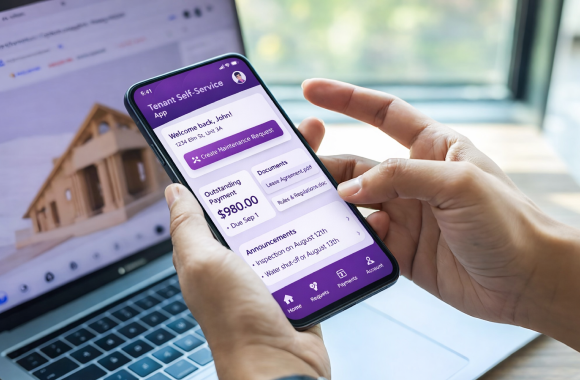
The most-used features in tenant self-service apps, based on consistent patterns across property management platforms, are: Maintenance request submission is the top feature. Tenants want to report an issue, attach a photo, and track its status without calling or emailing. Rent payment is close behind. Tenants want to pay on their schedule, view their payment history, and receive automated receipts. Lease document access covers move-in packs, tenancy agreements, and renewal letters. Tenants want these available on demand without having to request them. Move-in and move-out coordination including inspection scheduling, key collection, and utility setup guidance. Communication with the property team through in-app messaging rather than email threads that get lost. These five areas account for the vast majority of tenant-to-management interactions. A self-service app that handles them well can transform the day-to-day for both tenants and property managers.
The Features a Self-Service App Needs to Work
Beyond the tenant-facing functions listed above, a self-service app needs a backend that keeps things running reliably. Push notifications keep tenants informed when a maintenance request is updated, when a payment is due, or when a message requires a response. Without notifications, tenants do not return to the app. Real-time sync with the property management system ensures that what a tenant sees in the app matches what your team sees in their back office. Discrepancies in payment records or maintenance status erode trust immediately. Document management that stores leases, inspection reports, and correspondence in a searchable, downloadable format that tenants can access from any device. Multi-property support for tenants who rent across more than one unit or building under the same management group. Accessibility features including adjustable text size, high-contrast mode, and screen reader compatibility, which matter both for usability and for meeting accessibility standards.
How to Handle Maintenance Requests Properly
Maintenance is the area where self-service apps have the greatest impact on satisfaction and the greatest risk of failure. A well-designed maintenance request flow looks like this: Tenant selects the category (plumbing, electrical, appliance, structural, etc.) Tenant describes the issue and attaches a photo The request is logged with a reference number and expected response time The property team assigns a contractor, and the tenant is notified The tenant tracks the status in real time: submitted, assigned, scheduled, resolved After resolution, the tenant can confirm the issue is fixed or flag it as ongoing The critical element is transparency at every step. Tenants do not mind waiting if they can see that something is happening. They do mind if they submit a request and hear nothing for days. Automated status updates at each stage, even if they are simple (“your request has been assigned to a contractor”), eliminate the majority of follow-up calls to your support team.
Payments and Lease Management in the App
Payment functionality needs to go beyond a basic pay button. Tenants expect to see their full payment history, upcoming due dates, and any outstanding balances in a clear ledger view. They want automatic receipts sent to their email after each payment. They want to set up recurring payments without calling the office. Lease management in the app should include: Access to the current tenancy agreement at all times Renewal notifications sent in advance with the ability to indicate intent within the app Viewing confirmed move-out dates and any associated obligations Downloading previous inspection reports These features reduce queries to your team significantly because tenants can find answers themselves.
The Adoption Problem and How to Solve It
The most common reason tenant self-service apps fail is low adoption. If tenants do not use the app, none of the operational benefits materialise. Adoption depends on two things: a good first experience and a reason to return. The onboarding flow should be fast. A tenant should be able to log in, see their property details, and complete at least one action within three minutes of downloading the app. Any barrier at this stage, including a complicated registration process, kills adoption before it starts. Reasons to return are created by push notifications and by making the app genuinely necessary. If a tenant can only pay through the app, or can only track maintenance requests through the app, they will open it regularly. If the app duplicates options they already have by email or phone, they will revert to those channels. Our Real Estate Mobile App Development page covers how we design tenant apps with adoption built into the product strategy from the start.
Conclusion
A tenant self-service app is not a feature. It is an operational decision about how the tenant relationship is managed at scale. The property management teams that benefit most from these apps are not the ones with the most sophisticated technology. They are the ones that built the app around what tenants actually need to do, made adoption frictionless from the first session, and gave tenants a genuine reason to return by making the app the fastest path to getting things done. When that is achieved, the operational return is consistent and compounding. Support volume falls because tenants are not calling to chase maintenance updates or confirm payment receipts. Property managers have time for the work that requires them because the routine interactions are handled digitally. And tenants who feel well-served by a property management team that is responsive, organised, and easy to deal with are tenants who renew. The app is the mechanism. The outcome is a tenancy experience that retains people.
FAQ
When in doubt always ask?
A tenant self-service app is a mobile application that allows tenants to manage their tenancy without calling or emailing the property management team. Common functions include maintenance request submission, rent payment, lease document access, and in-app communication.
The most important features are maintenance request tracking, digital rent payment with receipt history, lease document storage, in-app messaging, move-in and move-out coordination tools, and push notifications for status updates.
By handling routine interactions digitally, the app removes the need for staff to respond to maintenance status calls, payment confirmation requests, document queries, and basic lease questions. This frees property managers to focus on issues that genuinely require human involvement.
Low adoption is usually caused by a friction-heavy onboarding process, a lack of push notifications to bring tenants back to the app, or features that duplicate what tenants can already do by phone or email. Apps succeed when they are faster and easier than the alternative.
Yes. A well-built tenant app connects to your existing property management system via API so that data, including maintenance records, payment histories, and lease details, is always synchronised between the app and your back office.
A mid-complexity tenant app with the core features described typically takes four to six months to design, build, and launch. The timeline varies depending on the complexity of the integration with existing systems and the number of platforms (iOS and Android) being built simultaneously.