


 Our Work



Real Estate
AI Implementation Roadmap for Real Estate Firms
Mar 02, 2026
Share


Quick Overview
The 5-Phase AI Implementation Framework for Real Estate
- Data Foundation – Audit, clean, and centralize your property, tenant, and transaction data.
- Infrastructure Setup – Build the cloud architecture, pipelines, and storage layers AI models require.
- Pilot Use Case – Deploy one high-impact AI application on a controlled dataset.
- Integration & Scaling – Connect the AI system to your platforms and expand across your portfolio.
- Optimization & Governance – Monitor performance, retrain on new data, and establish governance protocols.
Table of Contents
- Why Real Estate Needs AI Now
- The 5-Phase Implementation Framework
- High-Impact AI Use Cases
- Data Readiness Checklist
- Common Pitfalls and How to Avoid Them
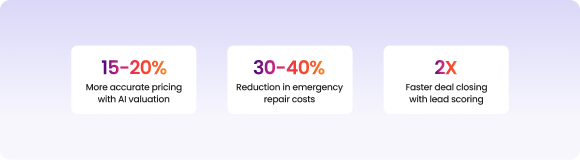
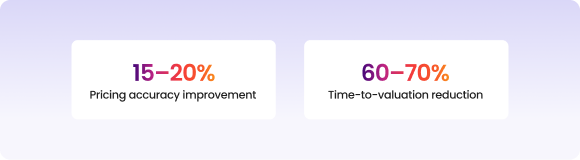
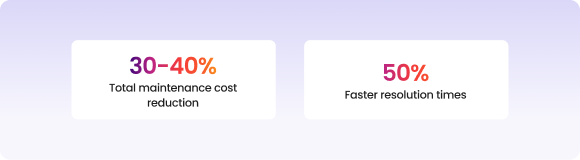
Artificial intelligence is no longer an experimental luxury for real estate firms with venture-backed budgets. In 2026, AI is a competitive baseline. Firms using machine learning for property valuation are pricing with 15–20% greater accuracy than manual appraisals. Operators with predictive maintenance systems are cutting emergency repair costs by 30–40%. Sales teams equipped with AI lead scoring are closing deals twice as fast by focusing on the right prospects instead of chasing cold leads.
But the gap between knowing AI is valuable and actually implementing it successfully is where most real estate firms stall. They buy a tool, plug it into broken data, get unreliable outputs, and conclude that AI doesn’t work for their business. The problem was never the AI – it was the implementation sequence.
This guide provides the exact roadmap that real estate software development companies use to deploy AI systems that actually deliver measurable results. No theoretical frameworks. No vendor-agnostic platitudes. Just the phase-by-phase process that works.
Why Real Estate Needs AI Now
The real estate industry generates enormous volumes of data – lease records, tenant interactions, maintenance histories, transaction logs, market comparables, foot traffic patterns, energy consumption readings, and financial performance metrics. Historically, this data sat in spreadsheets, siloed software, and filing cabinets. The operational value was close to zero.
AI changes that equation entirely. Machine learning models can process millions of data points across hundreds of properties and extract patterns that no human analyst could identify manually – rental pricing trends that shift by neighborhood block, maintenance failures that correlate with building age and weather patterns, tenant churn signals that appear 60–90 days before a lease expiration.
Three market forces are making AI implementation urgent rather than optional in 2026.
The question is no longer whether your firm needs AI. The question is how fast you can implement it without wasting budget on false starts.
The 5-Phase AI Implementation Framework
This framework is sequential by design. Skipping phases – especially the first two – is the primary reason AI projects fail in real estate. Each phase builds the foundation that the next phase depends on.
Phase 1: Data Foundation
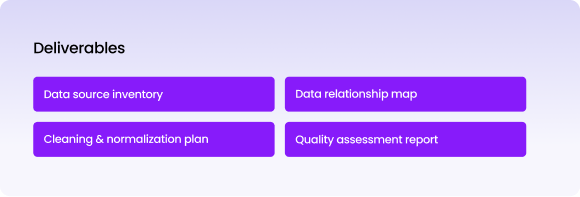
Every AI system is only as reliable as the data feeding it. Phase 1 is a comprehensive audit of every data source your firm touches – property management software, CRM records, accounting systems, tenant communication logs, maintenance histories, and market data feeds.
The goal is not to collect more data. The goal is to assess the quality, completeness, consistency, and accessibility of the data you already have. Most real estate firms discover that 30–50% of their existing data has quality issues – duplicate records, missing fields, inconsistent formatting across properties, and orphaned data trapped in systems nobody actively uses.
During this phase, you identify your primary data sources, map the relationships between them, flag quality gaps, and define the data cleaning and normalization work required before any AI model can be trained. This is also where you determine whether your current data infrastructure can support real-time data flows or whether migration to a modern data stack is needed.
Phase 2- Infrastructure Setup
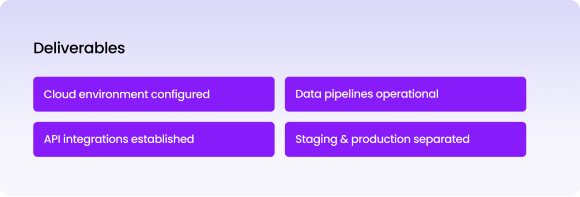
AI models require computational infrastructure that most legacy property management systems were never designed to support. Phase 2 builds the technical environment – cloud compute resources, data pipelines, storage layers, and API connections that allow data to flow from operational systems into AI models and back.
For most real estate firms, this means establishing a cloud-native architecture on AWS, Google Cloud, or Azure with dedicated environments for data processing, model training, and production deployment. It also means building ETL (Extract, Transform, Load) pipelines that pull data from your existing systems automatically – not through manual CSV exports.
If your firm is still running on-premise servers or fragmented SaaS tools without API connectivity, this phase also includes cloud migration planning to ensure your infrastructure can handle AI workloads without performance degradation.
Phase 3: Pilot Use Case
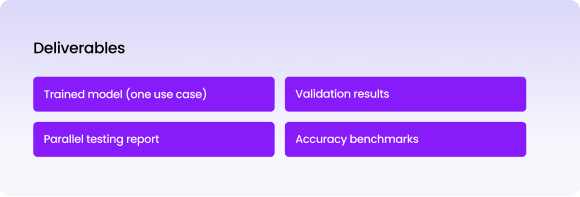
Phase 3 is where AI becomes tangible. You select one high-impact use case, train a model on your cleaned data, validate its accuracy, and deploy it in a controlled environment. The keyword is “one.”
Firms that try to implement AI valuation, lead scoring, and predictive maintenance simultaneously in their first deployment almost always fail. Each use case requires different data inputs, different model architectures, different success metrics, and different operational integration points. Picking one use case with a clear success metric allows your team to learn the deployment process end-to-end before expanding.
The pilot should run against a subset of your portfolio – 5–10 properties or a single market – where you can compare AI outputs against manual processes running in parallel. This parallel testing period typically lasts 4–6 weeks and gives you the evidence needed to build internal confidence and secure budget for scaling.
Phase 4: Integration & Scaling
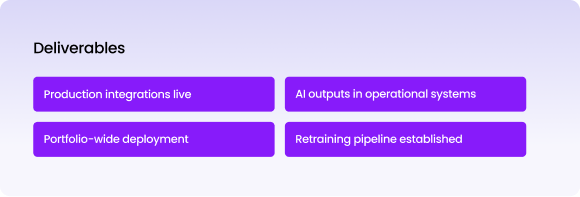
Once the pilot proves accuracy and operational value, Phase 4 connects the AI system to your production platforms and expands coverage across your full portfolio. The AI valuation model starts feeding directly into your pricing engine. The lead scoring model pushes prioritized leads into your CRM automatically. The maintenance prediction model triggers work orders before failures occur.
Integration is the phase where most technical complexity lives. AI outputs need to match the data formats, workflows, and permission structures of your operational systems. API architecture, error handling, fallback logic for edge cases, and user-facing interfaces all get built during this phase.
Scaling also means retraining models on larger datasets as you expand from pilot properties to a full portfolio. Models that performed well on 10 properties may need recalibration when exposed to the variance across 200 properties in different markets with different tenant profiles.
Phase 5: Optimization & Governance
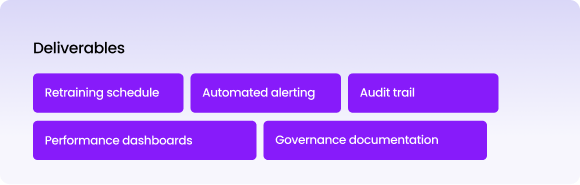
AI is not a one-time deployment. Models degrade over time as market conditions shift, tenant demographics evolve, and property portfolios change. Phase 5 establishes the monitoring, retraining, and governance systems that keep AI reliable long-term.
This includes automated model performance monitoring that flags accuracy drops before they impact operations. It includes scheduled retraining cycles – typically quarterly – using fresh data. It includes governance protocols defining who can modify models, how decisions are audited, and how bias is detected and corrected.
Firms that skip governance eventually face a scenario where an AI model makes a pricing or tenant screening decision that cannot be explained or justified. In regulated markets, this creates legal exposure. In all markets, it erodes trust.
High-Impact AI Use Cases for Real Estate Firms
AI-Powered Property Valuation
Traditional property valuation relies on manual comparable analysis: an appraiser reviews 3–5 similar properties and adjusts for differences. This process is slow, subjective, and limited by the appraiser’s local knowledge.
AI valuation models analyze thousands of comparables simultaneously, incorporating transaction history, neighborhood-level price trends, proximity to amenities, school ratings, crime data, seasonal patterns, and macroeconomic indicators. They produce valuations in seconds rather than days and eliminate subjective variance between individual appraisers.
Intelligent Lead Scoring
Real estate sales teams waste 40–60% of their time on leads that will never convert. AI lead scoring models analyze behavioral signals – website engagement patterns, property search filters, communication response times, return visit frequency, and financial pre-qualification data – to assign conversion probability scores to every lead in real time.
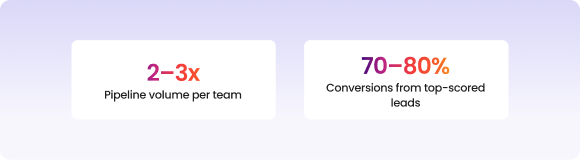
Sales teams focus exclusively on the top 20–30% of leads by score, which typically account for 70–80% of actual conversions. The result is a fundamental restructuring of sales operations where the same team size handles 2–3× more pipeline volume with higher conversion rates.
Predictive Maintenance
Reactive maintenance – fixing things after they break – is the most expensive maintenance strategy. Emergency repairs cost 3–5× more than planned maintenance, create tenant dissatisfaction, and require after-hours vendor coordination at premium rates.
Predictive maintenance AI uses sensor data from IoT devices, historical maintenance records, equipment age profiles, weather data, and usage patterns to forecast failures before they occur. A planned repair gets scheduled at standard rates instead of an emergency call at 2 AM on a Sunday.
Data Readiness Checklist
Before investing in AI models, run your organization through this readiness assessment. Each item directly impacts whether your AI deployment will succeed or produce unreliable outputs.
1- Data Centralization
Is your property, tenant, financial, and maintenance data accessible from a single source or connected system? If critical data lives in disconnected spreadsheets, you need a data engineering foundation before AI work begins.
2- Data Quality
What percentage of tenant records have complete contact information? How many properties have accurate square footage? If more than 20% of your data has quality issues, Phase 1 will need extended timelines.
3- Data Freshness
Are your operational systems capturing data in real time or near-real time? AI models trained on stale data produce stale predictions. If your last data update was a manual quarterly export, real-time pipelines are a prerequisite.
4- Data Governance
Do you have clear ownership over who can access, modify, and export your data? Are there audit trails? Are tenant data handling practices compliant with local privacy regulations?
5- Technical Capabilities
Does your team include anyone with experience in data science, machine learning, or advanced analytics? If not, you need either a dedicated hire or an implementation partner.
6- Score yourself honestly.
Firms that pass 4 out of 6 criteria are ready for Phase 1. Firms passing fewer than 3 should prioritize data foundation work before any AI investment – otherwise, you’re building on sand.
Common Pitfalls and How to Avoid Them
AI implementation in real estate fails in predictable ways. Every pitfall below has been observed repeatedly across the industry – and every one is avoidable with proper planning.
Starting with AI before fixing data.
The most common failure mode. A firm purchases an AI valuation tool, connects it to a CRM with 40% incomplete records and inconsistent property data, and gets wildly inaccurate outputs. Always sequence data readiness before model deployment.
Trying to build AI in-house without the right team.
Property management firms are operations businesses, not machine learning companies. Partner with a real estate software development company that has domain-specific AI deployment experience instead of assembling a team from scratch.
Deploying too many use cases simultaneously.
The excitement of AI possibilities leads firms to launch valuation, lead scoring, chatbots, and predictive analytics all at once. Start with one use case that ties directly to a revenue or cost metric. Prove value. Then expand.
Ignoring change management.
AI systems change how people work. Budget time and effort for training, documentation, and a parallel-run period where teams can verify AI outputs against their own judgment before full handover.
No performance monitoring after deployment.
AI models are not static software features. They degrade as data distributions shift. Without automated monitoring that tracks prediction accuracy over time, a model can silently become unreliable.
Treating AI as a cost center instead of an operational lever.
Firms that budget AI under “IT expenses” miss the point. AI should be measured by operational outcomes – reduction in vacancy days, improvement in rent collection rates, decrease in maintenance costs, and increase in lead conversion. Tie every AI deployment to a business KPI from day one.
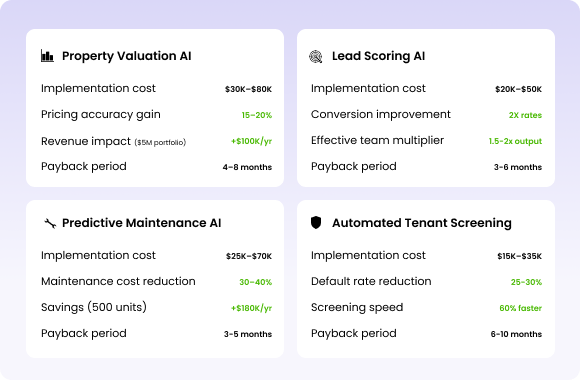
ROI Benchmarks from AI in Real Estate
AI implementation costs are meaningless without context on what that investment returns. These benchmarks reflect observed outcomes from real estate firms that followed structured implementation processes – not vendor marketing claims.
Ready to Start Your AI Implementation?
Noseberry has spent 11+ years building technology exclusively for real estate, including AI systems live across portfolios, managing 4,000+ properties. Whether you’re in Phase 1 or Phase 3, we meet you where you are, or explore our full real estate software development capabilities to see what’s possible.