
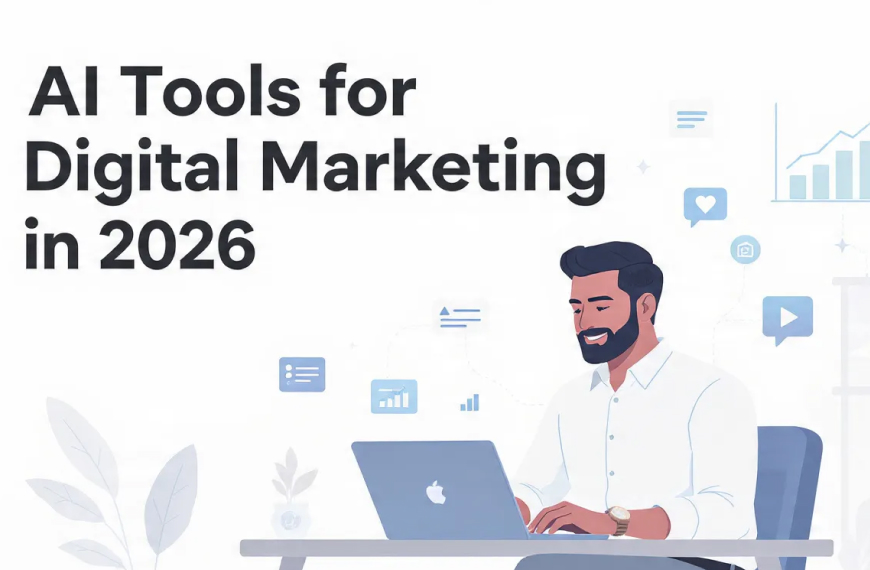
Why AI Tools Matter for Digital Marketing in India in 2026
If you are running a business in India today, you have probably noticed something. Marketing is getting faster, more competitive, and more data-heavy than ever before. And behind most of the brands winning online right now, there is one common thread: they are using AI tools.
In 2026, artificial intelligence is not some futuristic concept anymore. It is sitting inside the tools Indian marketers use every single day. From writing blog posts and running Google Ads to setting up email sequences and tracking conversions, AI is involved at every step.
India is one of the fastest-growing digital markets in the world. With over 900 million internet users and digital ad spending crossing new records every quarter, the competition is intense. Small businesses, D2C brands, SaaS startups, and even traditional companies are all fighting for the same eyeballs online.
The businesses pulling ahead are the ones using AI smartly. Not to replace their teams, but to help them do more with less time and fewer resources.
This blog will walk you through the best AI tools for digital marketing in India in 2026. We will cover every important area, including SEO, content, paid ads, CRM, analytics, social media, and the emerging fields of Generative Engine Optimization and Answer Engine Optimization. Whether you are a startup founder, a marketing manager, or a business owner, this guide is written in simple language so you can actually use it.
What Are AI Tools in Digital Marketing?
Before we jump into the tools, let us understand what we mean by AI tools in digital marketing.
AI tools are software products that use artificial intelligence, machine learning, natural language processing, or deep learning to automate, optimize, or assist with marketing tasks. These tools can analyze large amounts of data, predict outcomes, generate content, personalize customer experiences, and even run campaigns with minimal human input.
Here is a simple way to think about it. If you have ever used Google’s Smart Bidding in your ad campaigns or let a tool like Grammarly fix your email copy, you have already used AI in your marketing.
In 2026, AI tools for digital marketing have become much more powerful and accessible. Many of them are designed specifically for Indian businesses with pricing that works for the Indian market, support for regional languages, and features built around the way Indian consumers behave online.
The key areas where AI tools help in digital marketing include content creation and writing, search engine optimization, paid advertising and campaign management, customer relationship management and automation, data analytics and reporting, social media scheduling and content design, and conversion rate optimization.
How Indian Businesses Are Using AI in Marketing Right Now
Let us look at what is actually happening on the ground in India. This is not a theory. Indian businesses across every sector are using AI tools every day.
D2C and E-Commerce Brands: Indian D2C brands are using AI for product description writing, dynamic pricing, personalized email campaigns, and predictive analytics for inventory. Tools like ChatGPT and Jasper are helping small e-commerce teams produce hundreds of product descriptions in a fraction of the time it used to take. If you are in this space, understanding how AI is transforming e-commerce operations can give you a real edge.
Real Estate Companies: Real estate firms in India are using AI-powered CRM systems to score leads, automate follow-ups, and predict which prospects are most likely to convert. Many are combining CRM implementation with marketing and sales automation to create a complete digital sales pipeline.
SaaS and Tech Startups: Indian SaaS companies are using AI to optimize landing pages, write ad copy, run A/B tests, and personalize onboarding flows. AI-driven analytics and conversion tools are helping them understand user behavior at a level that was previously impossible.
Local and Service-Based Businesses: Even local businesses like clinics, coaching centers, and restaurants are using AI chatbots, automated review management, and affordable local SEO services to get found in their area.
The point is simple. AI is not just for the big companies anymore. It is for everyone.
Best AI Tools for SEO and Content Strategy in India
SEO remains one of the most important channels for sustainable growth in India. And AI has completely changed how SEO is done. Here are the tools Indian marketers are relying on in 2026.
ChatGPT (OpenAI): ChatGPT is the most widely used AI tool among Indian marketers. It helps with keyword research, content ideation, writing blog drafts, creating meta descriptions, generating FAQ sections, and even building topical content clusters. The key to using ChatGPT well is to treat it as a writing partner, not a replacement for your expertise.
Surfer SEO: Surfer SEO uses AI to analyze top-ranking pages for any keyword and gives you a content score, recommended word count, keyword density, and heading structure. Indian SEO teams use it to make sure every blog post is optimized before it goes live.
Semrush Copilot: Semrush has added AI-powered features that give you personalized SEO recommendations based on your website data. The Copilot feature summarizes your most important SEO issues and suggests what to fix first. If you are serious about SEO and content strategy, this tool saves a lot of time.
Clearscope: For content optimization, Clearscope helps Indian content teams create articles that match search intent. It grades your content in real time and suggests terms you should include.
Frase: Frase is popular among Indian agencies because it combines content research, brief creation, and AI writing in one tool. It also has an answer engine optimization feature that helps you structure content for AI-driven search results.
Noseberry SEO Intelligence Tool: If you want a quick, AI-powered audit of how your website is performing, Noseberry’s SEO Intelligence Tool gives you actionable insights without the complexity of enterprise tools. It is built for Indian businesses and works great alongside a free SEO audit.
The best approach to SEO in 2026 is not to rely on a single tool. Use a combination that covers research, writing, optimization, and tracking.
AI Tools for Performance Marketing and Paid Ads
Running paid ads in India has become more competitive and more expensive. AI tools help you spend your budget more smartly and get better returns.
Google Ads AI (Performance Max and Smart Bidding): Google’s own AI is now at the center of most paid search campaigns in India. Performance Max campaigns use machine learning to place your ads across Search, Display, YouTube, Gmail, and Maps automatically. Smart Bidding adjusts your bids in real time based on hundreds of signals. For Indian businesses running Google Ads, understanding and using these AI features is essential.
Meta Advantage+ (Facebook and Instagram Ads): Meta’s AI-powered ad system automatically tests different creative combinations, audiences, and placements to find what works best. Indian D2C brands and local businesses are seeing significantly better results with Advantage+ compared to manual campaigns.
Adzooma: Adzooma uses AI to manage and optimize Google, Facebook, and Microsoft ad campaigns from a single dashboard. It identifies wasted spend, suggests new keyword opportunities, and automates routine tasks. It is popular among Indian agencies managing multiple client accounts.
Revealbot: For automating ad rules and scaling campaigns based on performance, Revealbot is a go-to tool for Indian performance marketing teams.
Optmyzr: This tool uses AI to automate Google Ads management, including bid adjustments, budget allocation, ad copy testing, and reporting. It is especially useful for agencies and businesses with large ad accounts.
The key insight here is that AI does not just help you run ads. It helps you run them profitably. And in a market like India, where cost per click is rising in competitive niches, that efficiency matters a lot.
AI Tools for CRM and Marketing Automation
One of the biggest shifts in Indian digital marketing is the move toward automation. Businesses are realizing that manually managing leads, follow-ups, and customer communication is not scalable. AI-powered CRM and automation tools are solving this.
HubSpot AI: HubSpot has integrated AI across its entire platform. In 2026, it can draft emails, score leads, predict deal closure probability, summarize customer interactions, and create automated workflows based on natural language instructions. For Indian businesses looking at CRM implementation and integration, HubSpot remains one of the strongest choices.
Zoho CRM with Zia AI: Zoho is an Indian company, and Zoho CRM is widely used by businesses across the country. Its AI assistant, Zia, can predict lead conversions, suggest the best time to contact prospects, detect anomalies in sales data, and automate repetitive tasks. It is very well-suited for Indian SMBs.
Salesforce Einstein: For larger enterprises in India, Salesforce Einstein provides AI-driven insights across sales, marketing, and customer service. It predicts which leads will convert, recommends next best actions, and automates complex workflows.
ActiveCampaign: This tool combines email marketing, CRM, and marketing automation with AI-powered features like predictive sending, lead scoring, and content personalization. It is gaining popularity among Indian startups.
Freshsales (by Freshworks): Another Indian product, Freshsales uses AI for lead scoring, deal insights, and workflow automation. It is affordable and designed for growing businesses.
The combination of a good CRM with AI-powered marketing and sales automation can transform how you manage your customer pipeline. Instead of chasing leads manually, the system works in the background, nurturing prospects and alerting you when someone is ready to buy.
AI Tools for Analytics and Conversion Optimization
Data is only useful when you can turn it into action. AI analytics tools help Indian marketers understand what is working, what is not, and what to do next.
Google Analytics 4 with AI Insights: GA4 now uses machine learning to surface insights automatically. It can predict purchase probability, identify unusual changes in traffic patterns, and suggest audience segments you might be missing. Every Indian business should have GA4 set up with its AI features activated.
Hotjar AI: Hotjar now uses AI to analyze heatmaps and session recordings, summarizing user behavior patterns so you do not have to watch hundreds of recordings manually. It tells you where users are getting stuck and what you should change.
VWO (Visual Website Optimizer): VWO is an Indian company that offers AI-powered A/B testing and personalization. It helps you test different versions of your pages and automatically identifies the winner faster.
Microsoft Clarity: This free tool from Microsoft uses AI to highlight rage clicks, dead clicks, and areas where users are struggling. For Indian businesses on a budget, it is an excellent addition to your analytics stack.
Mixpanel: For product-led businesses and SaaS companies in India, Mixpanel uses AI to track user journeys, predict churn, and identify which features drive retention.
Having the right analytics and conversion setup is not just about collecting data. It is about having AI help you make sense of it so you can improve your website, ads, and funnels continuously.
AI Tools for Social Media and Creative Work
Social media moves fast in India. AI tools help marketers keep up with content creation, scheduling, and engagement.
Canva AI (Magic Design and Magic Write): Canva has become the default design tool for Indian marketers. Its AI features can generate social media graphics, presentations, and even short videos from a simple text prompt. Magic Write helps with captions and copy.
Buffer AI Assistant: Buffer now includes an AI tool that helps you write social media posts, repurpose content for different platforms, and suggest the best posting times based on your audience data.
Lately: Lately uses AI to break long-form content like blogs and podcasts into dozens of short social media posts. It is very useful for Indian content teams that need to maintain a consistent posting schedule.
Pictory: This AI tool turns blog posts and articles into short videos with captions, which is perfect for Indian audiences on Instagram Reels and YouTube Shorts.
Adobe Firefly: For brands that need original, high-quality images and visuals, Adobe Firefly generates creative assets using AI. Indian agencies are using it for campaign visuals, product mockups, and social media content. If you want to elevate your brand design, combining AI tools with professional UI/UX design and branding expertise delivers the best results.
Predis.ai: This Indian AI tool is built specifically for social media content creation. It generates posts, carousels, and videos from a single idea. It supports multiple Indian languages, which is a big advantage for brands targeting regional audiences.
Generative Engine Optimization and AI: The New SEO Frontier
This is one of the most important sections if you are thinking about the future of search in India.
In 2026, people are not just searching on Google anymore. They are asking questions on ChatGPT, Perplexity, Google AI Overviews, and other AI-powered search platforms. These platforms do not show a list of 10 blue links. They generate direct answers by pulling information from the most authoritative and well-structured sources.
This is where Generative Engine Optimization (GEO) comes in. GEO is the practice of optimizing your content so that AI models cite or reference your brand when generating answers. It is different from traditional SEO in several important ways.
Traditional SEO focuses on ranking on search engine result pages. GEO focuses on being included in AI-generated responses. Traditional SEO relies heavily on backlinks and keyword density. GEO relies on topical authority, structured data, clear factual claims, and being a recognized source.
For Indian businesses, this shift matters because AI search adoption is growing fast in India. If your competitor shows up in a ChatGPT answer and you do not, you lose visibility in a channel you cannot buy your way into with ads.
Generative Engine Optimization services are still new, but early adopters are seeing significant advantages. The brands investing in this now will be the ones that dominate AI search results later.
Similarly, Answer Engine Optimization focuses on structuring your content so it becomes the direct answer in voice search, featured snippets, and AI-driven results. Both GEO and AEO are natural extensions of a solid SEO and content strategy.
How to Choose the Right AI Tool for Your Business
With so many AI tools available, it is easy to feel overwhelmed. Here is a simple framework Indian businesses can use to choose the right tools.
Start with your biggest pain point. If you are spending too much time writing content, start with an AI writing tool. If your ads are not performing, look at AI-powered ad optimization. Do not try to adopt everything at once.
Check pricing for the Indian market. Many AI tools offer India-specific pricing or have free tiers that are generous enough for small teams. Tools like Zoho, Predis.ai, and VWO are built in India and priced accordingly.
Look for integrations. The best AI tool is one that works with your existing stack. If you are using HubSpot for CRM, make sure your AI tools integrate with it. If you are on WordPress, check plugin compatibility.
Consider language support. India is a multilingual market. If you are targeting audiences in Hindi, Tamil, Bengali, or other regional languages, choose AI tools that support content generation in those languages.
Do not ignore the learning curve. Some tools are simple to use from day one. Others need training and onboarding. Be honest about your team’s capacity to learn new tools.
Get expert guidance. Sometimes the smartest move is to work with a team that already knows which tools work best for your industry and budget. Noseberry Digitals works with businesses across India to build AI-powered marketing strategies that actually deliver results. If you are unsure where to start, choosing the right AI and ML development partner can save you months of trial and error.
Common Mistakes Indian Marketers Make with AI Tools
AI tools are powerful, but they are not magic. Here are the most common mistakes we see Indian marketers making.
Using AI output without editing. AI-generated content often lacks brand voice, local nuance, and factual accuracy. Always review and refine before publishing. Google values helpful, people-first content, and raw AI output rarely meets that standard.
Ignoring data quality. AI tools are only as good as the data you feed them. If your CRM data is messy, your AI-driven lead scoring will be inaccurate. Clean your data before plugging in AI.
Chasing every new tool. There is a new AI tool launching almost every day. Instead of jumping on every trend, master two or three tools that align with your actual marketing needs.
Forgetting the strategy. AI tools are execution accelerators. They do not replace the need for a clear marketing strategy. You still need to define your target audience, messaging, positioning, and goals before any tool can help.
Not measuring results. Many marketers adopt AI tools but never track whether those tools are actually improving performance. Set clear KPIs for every AI tool you use and review results regularly.
Over-automating customer communication. Automation is great, but Indian consumers still value a personal touch. Do not let chatbots and automated emails completely replace human interaction, especially in high-value sales.
The Future of AI in Digital Marketing for India
Looking ahead, here is what Indian marketers should prepare for.
AI agents will manage more of the marketing workflow. In 2026, we are already seeing the rise of agentic AI that can handle complex, multi-step marketing tasks autonomously. By 2027, AI agents will likely manage end-to-end campaign execution for many Indian businesses.
Regional language AI will improve dramatically. As AI models get better at understanding and generating content in Hindi, Marathi, Telugu, Bengali, and other Indian languages, we will see a huge shift in how brands reach non-English speaking audiences.
AI-powered personalization will become the norm. Every website, email, and ad will be dynamically personalized based on user behavior, preferences, and intent. Indian e-commerce and retail brands will lead this shift.
Data engineering will become a core marketing capability. The brands that invest in clean, structured data pipelines will get the most out of AI. Data engineering and analytics will move from being a tech team responsibility to a marketing priority.
Voice and visual search will grow. AI is making voice search and visual search more accurate. Indian marketers will need to optimize for these channels alongside traditional text-based search.
AI regulation will shape the landscape. India is likely to introduce more guidelines around AI usage, data privacy, and content labeling. Staying compliant while leveraging AI tools will be a key skill for marketing teams.
AI tools are reshaping digital marketing in India at a speed nobody expected. The opportunity is massive, but only for those who approach it with the right mindset.
The goal is not to use every AI tool available. The goal is to find the ones that solve your real problems, integrate them into your workflow, and combine them with human creativity and strategic thinking.
Final Thought
If you are a business owner in India, start small. Pick one or two areas where AI can save you time or improve results. Test, learn, and scale from there.
And if you want a team that understands both the technology and the Indian market, Noseberry Digitals can help you build and execute an AI-powered digital marketing strategy tailored to your business. From SEO services and performance marketing to AI and ML solutions and custom software development, we bring everything together under one roof.
The future of digital marketing in India belongs to those who combine AI with strategy. And that future is already here.