
Scaling a telehealth or RPM platform means fixing three things at once. You need reliable data flow, stable device connections, and uptime under load. Most teams solve one of these well and let the other two rot. That's usually why growth stalls right after a platform looks "done."
In my decade building healthcare software, I've watched a solid remote patient monitoring architecture buckle under its own success more than once. A pilot with 50 patients works fine on a laptop-grade setup. The same design at 5,000 patients starts dropping vitals, missing alerts, or timing out during video visits. This guide covers what actually breaks first. It uses real numbers from platforms that scaled past that point, and shows where to focus if you're planning healthcare software growth this year.
What Is Remote Patient Monitoring Architecture and Why Does Scaling It Break Things?
Remote patient monitoring architecture is the set of systems that move vital sign data from a patient's device into a clinician's workflow. It breaks under scale because each layer, device, network, pipeline, and EHR, was often built to handle dozens of patients, not thousands.
RPM adoption exploded fast enough to outpace a lot of first-generation architecture. RPM procedure claims volumes rose nearly 1,300% between 2019 and 2022, according to connectivity research from Eseye. Around 30 million US patients used RPM in 2024, up from 23 million in 2020, and that number is projected to reach 70.6 million by the end of 2025, per HealthArc's RPM statistics report. Growth at that pace punishes any shortcut you took at the start.
How Should Data Flow From an RPM Device to the EHR?
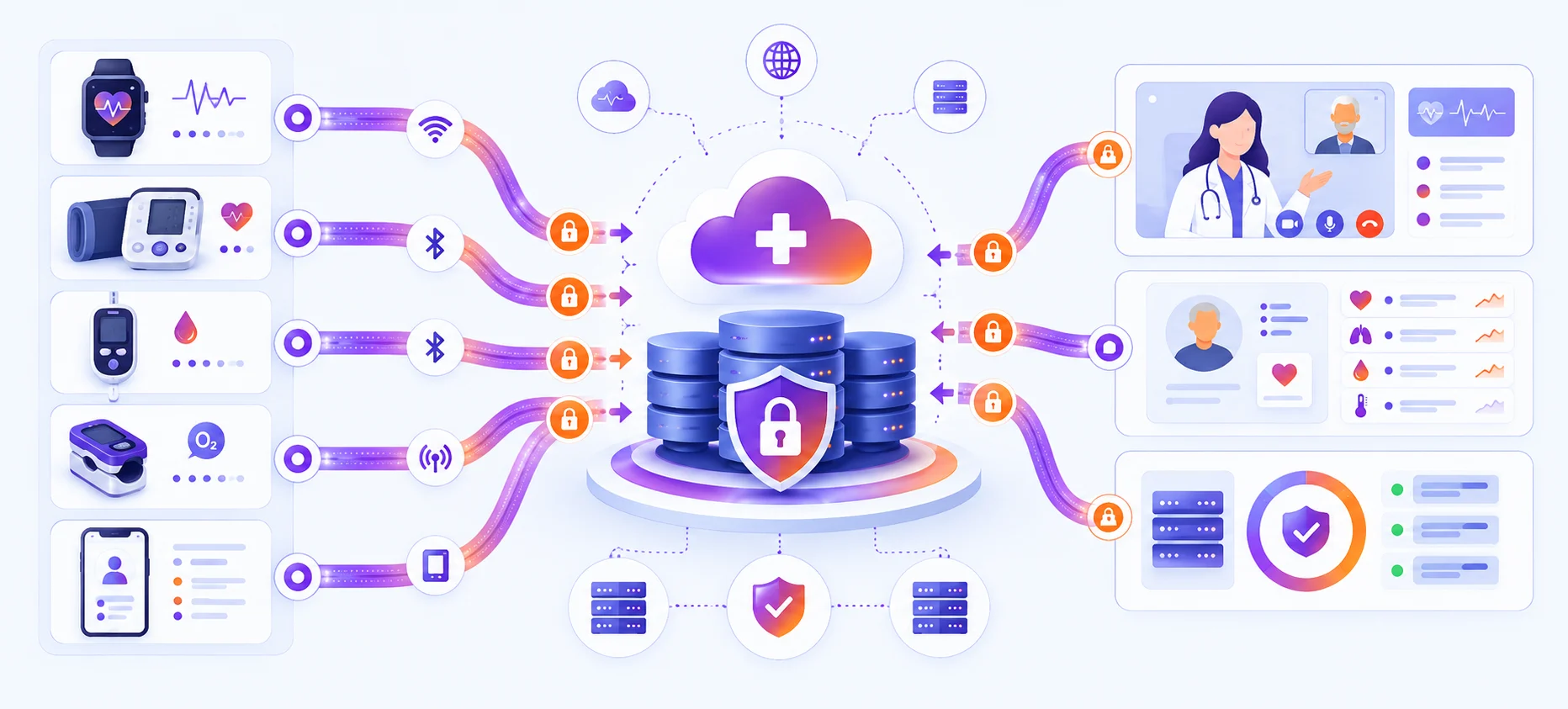
Data should flow through five stages: device ingestion, normalization, FHIR mapping, validation, and EHR submission. Skipping normalization or validation is the single most common reason RPM data arrives in the EHR as noise instead of something a clinician can act on.
Here's the pipeline that holds up at scale:
Device ingestion. Readings land in a vendor cloud or your own ingestion layer, often through a gateway device or cellular hub.
Normalization. Raw signals get cleaned and standardized, since two blood pressure cuffs rarely report units or timestamps the same way.
FHIR mapping. Cleaned readings map to FHIR R4 resources. Blood pressure typically uses the US Core Blood Pressure Profile, while single values use the Observation resource.
Validation. The system checks the reading against expected ranges, patient identity, and device pairing before anything touches a clinical record.
EHR submission. Only clinically relevant events and summaries reach the EHR. Raw waveform data usually stays in a separate data store, not the chart itself.
Our data engineering team builds this separation early on every RPM project. Collapsing raw signals and clinical summaries into one pipeline is what causes performance problems later.
Bluetooth vs Cellular: Which Connectivity Model Scales Better for RPM Devices?
Cellular connectivity scales better than Bluetooth for most RPM programs, mainly because it removes the gateway device as a point of failure. Bluetooth still works fine for smaller, tech-comfortable populations, but it adds setup steps that hurt adherence at scale.
Factor | Bluetooth (gateway-based) | Cellular (direct) |
Setup complexity | Higher, needs pairing and a gateway | Lower, often works out of the box |
Points of failure | Device, gateway, and home Wi-Fi | Device only |
Range | Short, tied to the gateway | Wherever cellular coverage exists |
Best fit | Tech-comfortable, stable-home patients | Elderly, mobile, or low-tech patients |
A gateway that loses power or Wi-Fi silently stops transmitting data. Nobody notices until a clinician asks why a patient's readings went quiet for three days. Cellular devices remove that failure mode entirely, since the device talks straight to the network.
Why Does Telehealth Platform Scaling Break Video and Alerting at the Same Time?
Telehealth platform scaling breaks video and alerting together because both depend on the same infrastructure layer holding up under load. When media servers get overloaded, video calls degrade first, and RPM alert processing often slows down right behind them.
A few architecture choices prevent this. Deploy redundant media servers and clustered signaling services instead of a single point of failure. This approach is detailed in WebRTC.ventures' guide to scaling telehealth video. Position infrastructure across multiple regions too, since latency is the number one enemy of real-time video. Autoscale on application-level metrics, like connected users per media server, not just raw CPU usage. A "drain-to-terminate" approach during scale-down also stops sessions from dropping mid-visit.
What Uptime and SRE Practices Actually Prevent Telehealth Outages?
The uptime practices that matter most are clear SLOs, real observability, and blameless incident response. Telehealth platforms that treat these as optional tend to discover their outage costs the hard way, often during their busiest hour.
Downtime in healthcare settings costs roughly $7,900 per minute on average. The 2024 CrowdStrike outage alone cost the healthcare industry an estimated $1.94 billion, according to DevOps.com's telehealth reliability playbook. Numbers like that make the case for investment on their own.
A few practices consistently pay off:
Set concrete SLOs: 99.95% uptime, video join times under 5 seconds, call drop rates below 2%
Instrument every service from day one, not after the first outage
Build graceful degradation, like falling back from video to audio or chat
Run chaos engineering drills that simulate real failure modes
Use blameless postmortems so root causes get fixed, not hidden
Cleveland Clinic reduced critical incidents by 40% and cut mean time to resolution by 60% after adopting these SRE practices, per the same DevOps.com playbook. Our cloud DevOps team builds toward these same targets on every telehealth engagement. A platform that's technically live but frequently degraded loses trust just as fast as one that's actually down.
How Do You Handle High-Volume Waveform Data Without Losing Fidelity?
You handle high-volume waveform data by storing it separately from summarized clinical events. Stream it through a pipeline built for volume, not through your main EHR integration path. Continuous ECG or SpO2 waveforms generate far more data per patient than a daily blood pressure reading ever will.
This is the part most RPM guides skip entirely. A single continuous cardiac monitor can generate more raw data points in one day than a hundred manual blood pressure checks combined. Pushing that volume through the same pipeline built for occasional vital signs will choke it. The fix is architectural. Keep raw waveform data in a purpose-built time-series store, and run signal processing there. Forward only clinically meaningful events, like a detected arrhythmia, into the EHR-facing pipeline. Our AI product assurance team tests this separation specifically. A waveform pipeline that silently backs up under load is one of the hardest failures to catch before it affects patient safety.
What Are the Biggest Non-Technical Barriers to Scaling a Telehealth Platform Nationally?
Licensure complexity and clinician shortages are the biggest non-technical barriers, and they slow scaling just as much as any architecture decision. A platform can handle a million patients technically and still stall because clinicians can't legally treat patients across state lines without the right license.
The American Association of Medical Colleges projects a national shortage of nearly 122,000 physicians by 2032, according to Wheel's analysis of telehealth scaling challenges. Multi-state licensure exists, but managing it across a growing clinical team adds real operational weight. Demand forecasting adds another layer of difficulty. Patient volume varies by state regulation, season, and local broadband access, not just population size.
RPM Architecture Patterns Compared: Direct FHIR API vs SMART on FHIR vs Middleware
Three integration patterns cover most RPM-to-EHR needs, and picking the wrong one early is expensive to unwind later. Direct FHIR R4 API integration works best for a single EHR relationship. SMART on FHIR fits embedded clinician dashboards. Middleware handles multi-vendor complexity that neither of the first two options was built for.
Direct FHIR R4 API. Simplest to build and approve when you're only integrating with one EHR vendor.
SMART on FHIR. Best when clinicians need RPM data inside their existing EHR workflow, launched with patient context already loaded.
Middleware-based integration. Necessary once you're routing data to multiple EHRs, since it handles HL7 v2 fallback and complex routing logic in one place.
Most platforms start with pattern one, then add middleware once they sign their second or third major health system client. Planning for that transition early saves a painful rebuild later.
What Should You Look for in an RPM or Telehealth Development Partner?
Look for a partner who has shipped RPM pipelines that separate raw data from clinical summaries. That's more valuable than a team that can only integrate one FHIR API. This distinction determines whether your platform survives its first real growth spurt.
Specifically, look for:
Experience handling both Bluetooth and cellular device fleets, not just one connectivity model
A track record of setting and hitting real uptime SLOs, not just claiming "high availability"
Direct experience with waveform data pipelines, if your platform handles continuous monitoring
A clear plan for multi-EHR middleware, even if you only need one integration today
Security practices built around HIPAA and BAA requirements across every vendor in the chain
Our case studies page includes RPM and telehealth platforms built with exactly this separation in mind. Our AI consultancy team can review your current architecture before you commit to a major scaling push.
Conclusion
Scaling a telehealth or RPM platform comes down to three things holding up together: the data pipeline, device connectivity, and platform uptime. Most platforms that stall under growth got one of these right and ignored the other two.
Here's the single takeaway worth remembering. Separate raw device data from clinical summaries early. That one architecture decision determines whether your pipeline, your EHR integration, and your uptime all scale together, or all break together.
If you're planning to scale past your current patient count, don't wait for an outage to find your weak point. Our digital engineering team can review your current RPM or telehealth architecture and flag what will break first. Get in touch and let's map out your scaling plan together, before your growth outpaces it for you.