
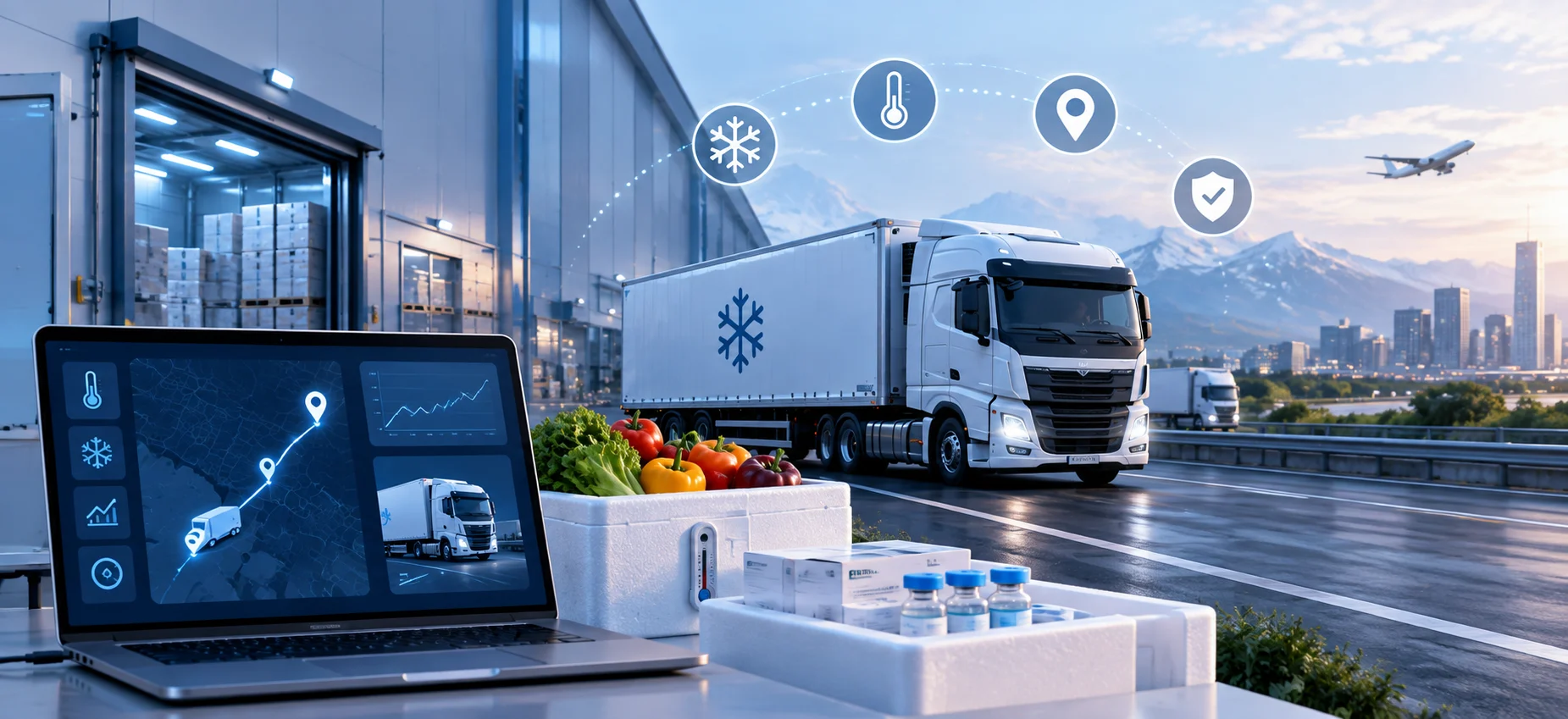
Cold chain visibility software tracks temperature, location, and custody of perishables and pharma shipments in real time. It flags problems before they turn into losses. A single unmonitored excursion can spoil a vaccine batch or trigger a food recall. Get visibility right and you cut waste, pass audits faster, and catch problems while a truck can still be rerouted.
In my decade building software for logistics and healthcare supply chains, I've watched the same pattern play out again and again. A company buys a temperature logger, plugs it into a dashboard, and calls the job done. Then a regulator asks for a full chain-of-custody record, or a customer disputes a spoiled shipment. The gaps show up fast. This guide covers what a real visibility platform needs to do for both perishables and pharma, and where most current tools still fall short.
What Is Cold Chain Visibility Software and Why Does It Matter for Perishables and Pharma?
Cold chain visibility software is a platform that combines IoT sensor data, carrier milestones, and compliance records into one live view of a temperature-sensitive shipment. It matters because temperature data alone doesn't prove compliance. You also need to show who touched the shipment, when, and what they did about any excursion.
Pharma and food companies both answer to regulators who want proof, not promises. A pharma distributor has to satisfy EU Good Distribution Practice guidelines and FDA rules like DSCSA and 21 CFR Part 11. A food company handling items on the FDA's Food Traceability List has to satisfy FSMA 204. The right platform makes both possible without building two separate systems from scratch.
Why Are Cold Chain Failures So Expensive for Pharma and Food Companies?
Cold chain failures cost the pharmaceutical industry tens of billions of dollars every year. Most of that loss comes from spoiled biologics and vaccines that never reach a patient. Food companies pay a similar price through discarded perishables, failed audits, and recalls. That financial risk is why visibility has become a board-level conversation, not just an IT purchase.
The numbers back this up. Industry estimates cited by Sensos put annual pharma cold chain losses between $20 billion and $35 billion. A separate 2026 analysis from Paxafe puts the figure closer to $40 billion. Fragmented systems drive most of that gap, not a lack of available technology. Biologics make up roughly 30% of prescription drug sales, worth about $326 billion a year, according to Sensos. These are exactly the products most vulnerable when cold storage slips. Sensos also cites industry estimates that up to 50% of vaccines worldwide are discarded due to storage outside safe temperature limits.
A German logistics study analyzed 153,000 shipment measurements, cited in IntuitionLabs' 2026 GDP compliance guide. Its conclusion was blunt: no transport is fully safe without active temperature control. That single line sums up why passive shipping and after-the-fact reporting no longer cut it.
What Compliance Rules Does Cold Chain Visibility Software Need to Support?
A strong platform needs to support several overlapping rulebooks at once, not just one. Getting this wrong means building separate systems for food and pharma shipments. That doubles your maintenance cost for no real benefit.
For pharma, the software needs to handle:
EU GDP Guidelines (2013/C 343/01), which require proof that temperature stayed within acceptable limits throughout transport
FDA 21 CFR Part 11 for electronic records and electronic signatures
DSCSA package-level traceability requirements
WHO TRS 961 Annex 9 and TRS 1025 Annex 7 for time and temperature-sensitive products
For food and perishables, FSMA 204 is now the anchor rule. Its compliance date landed on January 20, 2026. It requires companies on the FDA's Food Traceability List to record specific data at each critical tracking event, from harvest through retail. Angela Fernandez, Senior Vice President of Market Development at GS1 US, described the scale of this shift plainly: "By convening food safety, supply chain logistics and data management experts across many food segments, the new Collaboration aims to share best practices for meeting Food Traceability Rule requirements." That collaboration exists because most companies can't solve FSMA 204 with spreadsheets anymore.
How Does Cold Chain Visibility Software Actually Work?
A modern platform pulls data from four connected stages of a shipment's life. It unifies that data into one record. Skip any one stage and you lose the audit trail regulators actually ask for.
Lane qualification. Before a shipment ships, the software checks planned routes against carrier history, seasonal weather, and past excursion data for that lane.
Real-time monitoring. IoT loggers stream temperature, humidity, and sometimes light or shock data throughout transit. This gets matched against carrier milestones like pickup and delivery scans.
Exception response. When a reading crosses a threshold, the system alerts a human or triggers an automated workflow, like rerouting or notifying a receiving site.
Product release. At delivery, the software calculates a full temperature-of-record. It either releases the shipment automatically or flags it for manual review.
Manual disposition used to take five to twelve hours per shipment, according to Paxafe's 2026 research. Automated, rules-based release compresses that down to minutes. That matters enormously when a warehouse is holding a truckload of temperature-sensitive product, waiting on a decision.
Comparing the Top Cold Chain Visibility Platforms for Pharma and Perishables
No single platform dominates every use case. The right pick depends heavily on what you're shipping and which rulebook applies. Here's how a few established names stack up.
Platform | Best fit | Compliance focus |
Sensitech | Pharma and biologics | 21 CFR Part 11, GDP audit documentation |
Controlant | Global pharma and vaccine distribution | Enterprise-scale real-time alerting |
Tive | One-way perishable shipments | Lane risk scoring for produce and seafood |
SmartSense | Retail and foodservice cold storage | Built-in FSMA 204 reporting |
None of these platforms was built to solve both pharma GDP compliance and FSMA 204 food traceability from a single dashboard. That gap is exactly why companies shipping both categories, or working with a logistics partner who understands both, tend to end up stitching two systems together instead of running one.
How Do You Choose Software That Works for Both Perishables and Pharma?
Pick a platform that treats compliance as a first-class feature, not an add-on report. Most vendors were built for one vertical first, so ask hard questions before you commit budget.
Look for a platform that can show you:
Native support for both FSMA 204 critical tracking events and pharma GDP or DSCSA record formats
A sortable, exportable record that can be produced within 24 hours if a regulator asks, which is the FSMA 204 standard
Automated exception workflows, not just alerts that land in someone's inbox
Integration with existing ERP and carrier systems without a custom build for every new data source
A track record with shipments similar to yours, whether that's frozen produce, biologics, or both
When I worked with a client shipping both refrigerated food and temperature-sensitive diagnostics, we treated compliance rules as configuration, not hardcoded logic. That single choice saved months of rework once FSMA 204 rules were finalized.
What Does Implementation Actually Look Like, and How Long Does It Take?
A single-facility rollout typically takes eight to sixteen weeks. Multi-site or multi-carrier deployments take longer. The timeline depends less on the software itself and more on how many existing systems it has to connect to.
Most implementation gaps come from three sources. Legacy carrier systems often don't expose clean APIs. Warehouse teams need training on new exception workflows. Data migration from years of paper or spreadsheet-based temperature logs also eats time. Our data engineering team usually spends the first two to three weeks just mapping existing data sources before writing a single integration.
Budget for a parallel-run period too. Running the new system alongside your old process for two to four weeks catches configuration mistakes early. That's a much cheaper place to catch them than during a live compliance audit.
What Role Does AI Play in Modern Cold Chain Visibility?
AI mainly does two jobs here: predicting risk before a shipment leaves, and speeding up disposition after it arrives. Neither replaces human judgment. Both cut the time it takes to catch a problem or approve a shipment.
Before departure, risk scoring checks a planned shipment against lane history, carrier compliance records, and weather forecasts. It then flags high-risk routes for extra monitoring. This works well, but for regulated pharma shipments, every AI recommendation has to trace back to a validated standard operating procedure to satisfy 21 CFR Part 11. That's a meaningfully different bar than general logistics AI. It's where a lot of otherwise good platforms stumble. Our AI consultancy team builds this traceability in from day one, rather than bolting it on after an audit finding.
What Should You Look for in a Logistics Software Development Partner for Cold Chain Systems?
The right partner has shipped compliance-heavy systems before, not just generic tracking dashboards. Cold chain work punishes shortcuts. A missing audit trail can mean a failed inspection months after the software went live.
At Noseberry, we've learned that the best software for logistics in this space treats compliance logic as configurable, not hardcoded. That way, a rule change from FDA or the EU doesn't mean months of redevelopment. Look for a partner who can show you:
Direct experience with FSMA 204, GDP, or DSCSA compliance logic, not just IoT integration work
A cloud infrastructure approach built for the audit trail requirements regulators actually check
Testing practices that specifically probe compliance edge cases; our AI product assurance team has caught more compliance gaps in QA than in production
Real case studies involving temperature-sensitive shipments, not just general supply chain software
Noseberry's portfolio includes cold chain builds that combine food and pharma compliance requirements in one system. That combination is rarer than it should be, given how much overlap exists between the two rulebooks.
Conclusion
Cold chain visibility software has moved from a nice-to-have dashboard to a compliance requirement. The companies treating it that way are the ones avoiding six and seven-figure losses from spoiled biologics and recalled food. Here's the single takeaway worth remembering: visibility only counts as compliance if it produces an audit-ready record within hours, not just a temperature graph that looks fine after the fact.
If you're shipping perishables, pharma, or both, don't wait for a failed audit or a spoiled shipment to force the decision. Noseberry's logistics and compliance teams can review your current setup and show you exactly where the gaps sit, before a regulator finds them for you. Get in touch and we'll walk through your specific compliance requirements together.