


Insurance companies are under constant pressure to process more policies, claims, and customer requests without increasing operational costs or risk. Yet much of the industry still relies on manual, repetitive tasks that slow teams down and introduce errors. This is where robotic process automation in insurance has moved from a “nice-to-have” to a practical necessity. RPA helps insurers automate routine work, improve accuracy, and free up human teams to focus on judgment-driven decisions that truly matter. This guide explains how insurance robotic process automation is actually used in the insurance sector, where it delivers the most value, and what insurers should realistically expect when adopting automation.
What Is RPA and Why It Fits the Insurance Industry So Well
Robotic Process Automation uses software bots to mimic human actions across digital systems. These bots log into applications, move data, perform calculations, trigger workflows, and generate reports, all without changing existing IT systems. This makes RPA in insurance particularly effective because insurers often operate on complex legacy platforms that are expensive and risky to replace.
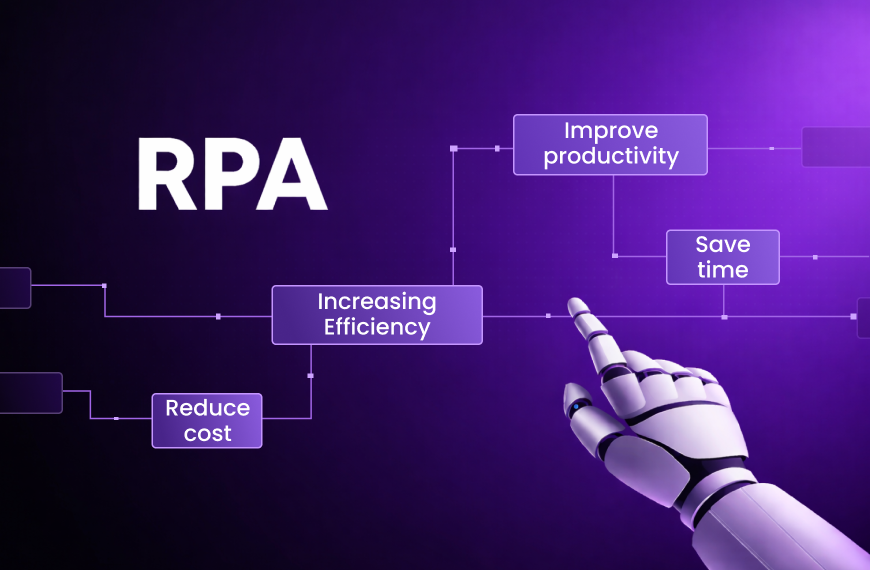
The insurance industry runs on rules, forms, validations, and structured data flows. These characteristics make it an ideal environment for automation. When implemented correctly, insurance robotic process automation initiatives reduce cycle times, improve compliance, and stabilize operations during peak workloads such as renewals or catastrophe events.
Core Insurance Robotic Process Automation That Benefit Most from RPA
Not every insurance process should be automated. RPA delivers the strongest results when applied to high-volume, rule-based tasks that require consistency.
Policy Administration and Underwriting Support
RPA bots can extract customer data, validate documents, populate policy systems, and perform eligibility checks. Underwriters still make the final decisions, but automation removes the administrative load that slows them down. This shortens policy issuance timelines and reduces backlogs.
Claims Processing and Settlement
Claims involve repetitive steps like data entry, document verification, status updates, and payment initiation. RPA in insurance industry workflows can automate these steps while flagging exceptions for human review. Faster processing improves customer satisfaction and reduces operational costs without compromising control.
Customer Onboarding and KYC
Bots can collect data from multiple sources, perform identity checks, and update internal systems in real time. This ensures compliance while delivering a smoother onboarding experience for customers and agents.
Finance, Accounting, and Compliance
RPA is widely used for premium reconciliation, commission calculations, regulatory reporting, and audit preparation. Automation improves accuracy and creates consistent audit trails, which is critical in a highly regulated environment.
Robotic and Agentic Process Automation in Insurance: Key Use Cases
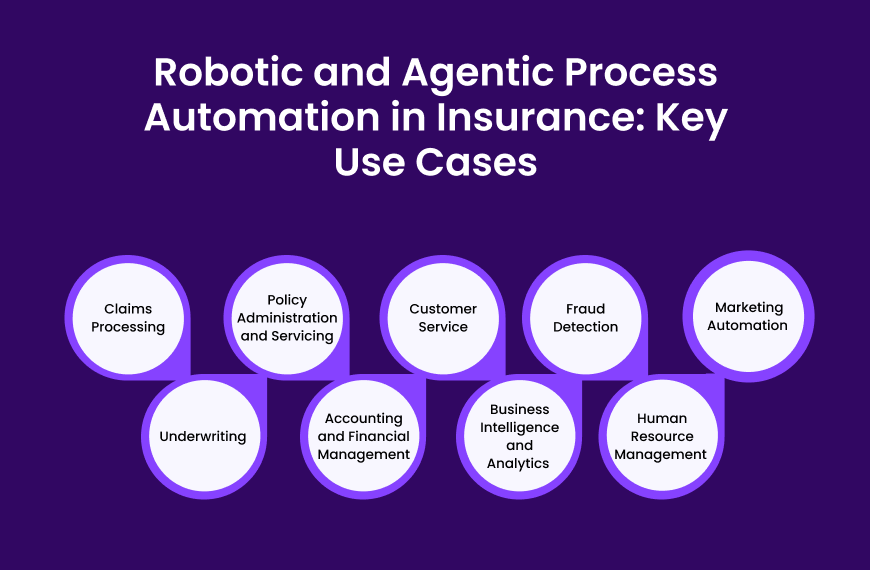
Robotic Process Automation handles rule-based execution, while agentic automation adds decision-making, orchestration, and context awareness. Together, they are reshaping how insurers operate across the value chain.
1. Claims Processing
Claims processing is one of the most mature and impactful areas for automation. RPA bots handle data extraction, document validation, claim registration, and status updates across systems. Agentic automation goes further by assessing claim context, prioritizing cases, and routing exceptions to the right teams. This combination reduces claim turnaround time while maintaining accuracy and compliance.
2. Underwriting
In underwriting, automation supports data collection, risk scoring, and eligibility checks. RPA gathers applicant data from internal and external sources, while agentic systems help underwriters by highlighting risk patterns, missing information, or anomalies. Human underwriters remain in control, but automation significantly reduces manual workload and speeds up decision cycles.
3. Policy Administration and Servicing
Policy issuance, renewals, endorsements, and cancellations involve repetitive system updates. RPA ensures consistency by automating these transactions across policy management platforms. Agentic automation can proactively trigger renewals, identify servicing issues, and manage complex policy changes across multiple products. This improves operational efficiency and customer experience.
4. Accounting and Financial Management
Insurance finance teams rely on accurate, timely data for premium reconciliation, commission calculations, and regulatory reporting. RPA automates repetitive accounting tasks, reducing errors and manual effort. Agentic automation helps monitor financial anomalies, flag discrepancies, and support forecasting by analyzing trends across financial data.
5. Customer Service
Automation enhances customer service by handling routine inquiries such as policy status, claim updates, and payment confirmations. RPA executes backend actions, while agentic systems interpret customer intent and guide interactions across channels. This enables faster response times and allows service teams to focus on complex, high-value customer interactions.
6. Business Intelligence and Analytics
RPA automates data extraction from multiple systems to feed dashboards and reports. Agentic automation adds intelligence by identifying trends, generating insights, and suggesting actions based on data patterns. Together, they enable near real-time visibility into operational performance and business outcomes.
7. Fraud Detection
Fraud detection benefits from the combination of automation and intelligence. RPA monitors transactions and applies predefined rules to flag suspicious activity. Agentic systems analyze behavior patterns, context, and historical data to prioritize fraud investigations. This layered approach improves detection accuracy while reducing false positives.
8. Human Resource Management
In HR, RPA automates onboarding, payroll processing, compliance reporting, and employee data updates. Agentic automation supports workforce planning by analyzing attrition trends, skills gaps, and performance metrics. This helps HR teams shift from administrative tasks to strategic talent management.
9. Marketing Automation
Marketing teams use automation to manage campaigns, customer segmentation, and performance tracking. RPA executes repetitive campaign operations, while agentic automation adapts messaging based on customer behavior and engagement patterns. This enables more personalized, data-driven marketing without increasing manual effort.
The real power of robotic and agentic process automation in insurance lies in combining execution with intelligence. RPA delivers speed and consistency, while agentic automation brings adaptability and context. Insurers that apply both strategically across these use cases achieve not only efficiency gains, but also smarter decision-making and stronger customer outcomes.
Real-Life Examples of Agentic Automation and RPA in Insurance
Leading insurers are already combining robotic process automation with agentic capabilities to streamline operations, improve decision-making, and enhance customer experience. Below are real-world examples that show how automation is applied beyond theory.
HUB International
One of the world’s largest insurance brokerage firms faced a growing challenge as its operations expanded rapidly across regions and departments. Manual and fragmented back-office workflows were slowing down finance, underwriting, and compliance teams.
To address this, the company adopted a combination of automation and generative AI to standardise internal processes. AI-driven document handling streamlined mail and document routing, while intelligent email automation enabled contextual understanding, categorisation, and seamless data transfer into ERP systems.
This shift helped the organisation improve operational efficiency, reduce manual effort, and support scalable growth without increasing administrative overhead.
Hiscox
As a global specialist insurer, Hiscox relied heavily on manual email handling and rigid rule-based systems to manage incoming communications. This approach consumed significant employee time and frequently resulted in misclassified requests.
By implementing an AI-powered communications automation solution, the company was able to automatically analyse and classify claims-related messages and route them to the appropriate experts—without human intervention.
The outcome was transformative: a substantial portion of message volume became fully automated, allowing service teams to focus more on customer engagement rather than operational triage.
Nsure.com
Nsure was processing an overwhelming volume of customer interactions every month across calls, emails, and text messages. The manual nature of this work made the process slow and prone to data inconsistencies.
To overcome this, the company implemented a Insurance robotic process automation (RPA) solution enhanced with generative AI and natural language processing.
The system now interprets incoming messages, understands user intent, routes queries to the right departments, and even suggests next best actions for agents. As a result, the majority of customer requests are handled automatically, significantly improving response speed and accuracy.
ADNIC
This Abu Dhabi–based insurance provider identified inefficiencies in its quote generation and policy registration processes, which were consuming several hours of manual effort per case.
By deploying an AI-integrated RPA bot, ADNIC automated these workflows end-to-end. The automation freed up valuable agent time, allowing teams to shift focus toward real-time customer engagement through platforms like WhatsApp Business.
The result was not only improved internal productivity but also a noticeable enhancement in overall customer service quality.
A Practical Framework for Implementing RPA in Insurance
One common mistake insurers make is starting automation without a clear structure. Successful RPA programs typically follow a disciplined approach.
Process Selection First
Start with processes that are stable, repetitive, and measurable. Automating broken or frequently changing workflows only amplifies inefficiencies.
Rule Clarity Over Speed
Bots work best when rules are unambiguous. Documenting decision logic upfront prevents failures later.
Human-in-the-Loop Design
RPA should handle routine work while humans manage exceptions. This balance maintains trust and operational resilience.
Governance and Monitoring
Bots need monitoring just like human teams. Logging, performance metrics, and error handling are essential for long-term success.
This framework helps insurers move from isolated pilots to scalable, enterprise-grade automation.
Benefits of Robotic Process Automation in Insurance
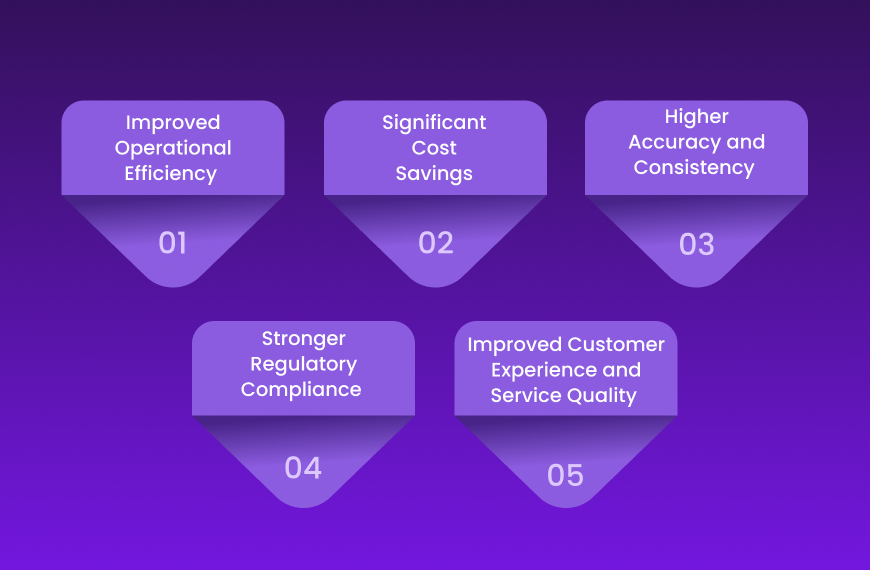
When aligned with the right processes, robotic process automation in insurance delivers measurable outcomes rather than abstract efficiency claims.
Improved Operational Efficiency
Agentic automation and RPA solutions can operate continuously without fatigue, handling both structured, rule-based processes and more complex workflows that involve decision-making. By automating repetitive operational tasks, insurers can significantly accelerate turnaround times while allowing employees to focus on higher-value activities that require human judgment and expertise.
Significant Cost Savings
Automation reduces the dependency on manual labour for time-intensive tasks such as data entry, document processing, and policy administration. This leads to lower operational costs, fewer errors that require rework, and reduced expenses related to hiring, training, and employee turnover. Over time, agentic automation delivers measurable cost efficiency across insurance operations.
Higher Accuracy and Consistency
Manual insurance processes are often vulnerable to errors, especially when dealing with large volumes of unstructured data from multiple sources. Agentic automation and RPA follow predefined rules and workflows consistently, minimising errors caused by fatigue, distraction, or manual oversight. This ensures more reliable outcomes in claims processing, underwriting, and policy management.
Stronger Regulatory Compliance
Insurance companies operate in highly regulated environments where compliance failures can be costly. Automation helps insurers stay compliant by continuously monitoring regulatory requirements, processing policy and legal updates, and maintaining accurate audit trails. Automated reporting and validation mechanisms also support audit readiness and reduce the risk of compliance gaps.
Improved Customer Experience and Service Quality
Automation enables faster response times and more personalised customer interactions. Intelligent bots can analyse customer queries, recommend appropriate responses, and provide agents with relevant customer data in real time. This allows insurers to resolve issues more quickly, communicate more effectively, and deliver a smoother, more responsive customer experience across digital channels.
Why Insurance Robotic Process Automation (RPA) Matters for Modern Insurers
By combining agentic automation with RPA, insurance organisations gain not only operational efficiency but also strategic agility. These technologies help insurers scale operations, adapt to regulatory changes, and meet rising customer expectations – without compromising accuracy or compliance.
Challenges of Process Automation in the Insurance Industry
While process automation brings significant efficiency gains, insurance organisations often face practical challenges during implementation. Understanding these challenges and how to address them – is critical for long-term success.
1. Workflow Disruptions During Implementation
Challenge
Introducing agentic automation or RPA into an established insurance environment can disrupt existing workflows and internal operations. Even when automation delivers long-term benefits, the transition phase may impact productivity, employee confidence, and organisational culture. Poorly planned rollouts can create bottlenecks instead of eliminating them.
Solution
To ensure a smooth transition, insurers should adopt structured change management strategies alongside automation initiatives. This includes conducting workflow impact assessments, rolling out automation in phases, and offering role-based training. Clear communication, pilot programs, and continuous onboarding help teams adapt faster and reduce resistance to change.
2. Data Security and Regulatory Compliance Risks
Challenge
Insurance automation systems frequently handle sensitive customer information, including personal, financial, and health-related data. Any data breach or compliance failure can lead to serious financial penalties, reputational damage, and loss of customer trust.
Solution
Insurance companies must ensure that their automation platforms comply with global and regional regulations such as GDPR, HIPAA, and industry-specific data protection standards. Secure automation solutions should include end-to-end encryption, audit trails, role-based access controls, and continuous compliance monitoring to safeguard sensitive information.
3. Inaccurate or Misleading Automation Outcomes
Challenge
AI-driven automation systems, particularly those using machine learning or generative AI, may occasionally produce inaccurate outputs. In insurance workflows, even small errors in claims processing, underwriting, or customer communication can lead to compliance issues and operational delays.
Solution
A balanced automation approach is essential. Rule-based RPA bots should handle structured and predictable tasks, while AI agents can be used for unstructured data such as emails, documents, and images. For high-risk or decision-critical workflows, human oversight should remain part of the process. Choosing transparent AI models and implementing validation checkpoints further reduces error risks.
Successful insurance automation is not just about deploying technology—it requires thoughtful implementation, strong governance, and a human-in-the-loop approach. When challenges are addressed proactively, automation becomes a powerful enabler of efficiency, accuracy, and better customer experiences.
How RPA Complements AI and Advanced Analytics
A common misconception is that RPA and AI compete with each other. In reality, they work best together. RPA handles execution, while AI handles interpretation. For example, AI models can assess claim severity or detect fraud patterns, and RPA can then trigger downstream actions such as document requests, payments, or alerts. This combination allows insurers to move toward intelligent automation without disrupting existing systems.
Conclusion
Robotic Process Automation has proven its value in insurance by delivering efficiency without sacrificing control or compliance. When applied thoughtfully, RPA in insurance industry operations reduces manual effort, improves consistency, and supports scalable growth. The real advantage lies in how automation reshapes daily work, not just in cost savings.
Ready to modernize your insurance operations? Partner with Noseberry Digitals to build secure, compliant, and high-performance insurance solutions. Talk to our experts today.