
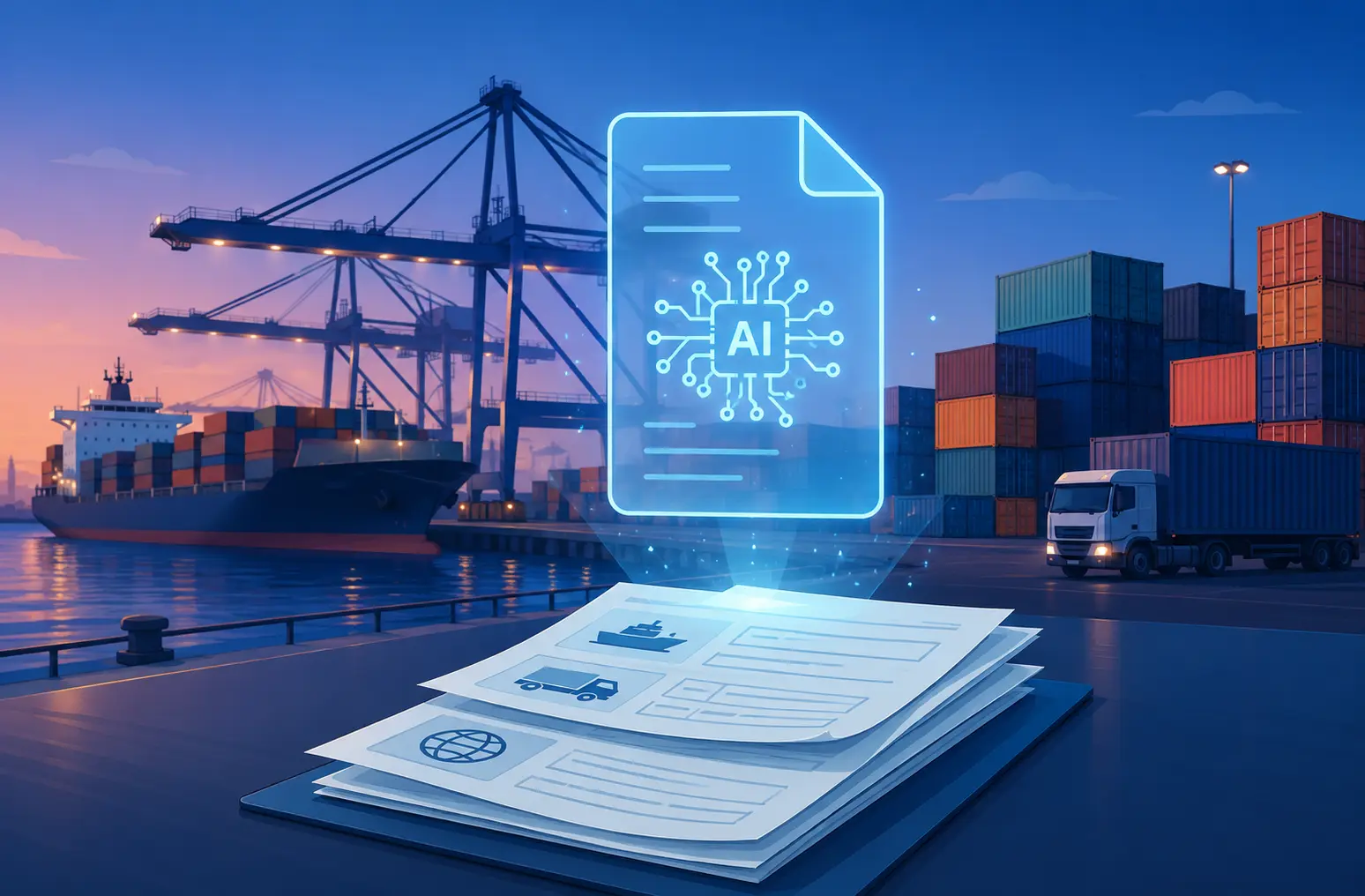
LLM agents automate freight paperwork by reading a bill of lading, a delivery form, or a customs form the way a trained coordinator would. Then they act on what they find, instead of just scanning text into a field. That's the real shift in AI-in-logistics right now. Plain OCR reads characters. An LLM agent reads meaning, checks it against your shipment data, and flags what doesn't add up.
Freight paperwork has always been the boring part of logistics that quietly costs the most money. A missing signature on a proof of delivery, a mismatched weight on a bill of lading, or a wrong HS code on a customs form can hold up a shipment for days. Noseberry has spent the last few years helping logistics teams move past basic OCR tools toward something that actually understands freight documents. This guide walks through how that shift works, document by document, and where the real gaps in older tools show up.
What's Wrong With Using OCR Alone for Freight Paperwork?
OCR alone struggles with freight paperwork because it reads characters without understanding what a bill of lading or customs form actually means. It can pull text off a page, but it can't tell you if that text makes sense for the shipment it belongs to.
Freight documents are messy by nature. They get faxed, photographed on a warehouse floor, stamped, and signed by hand. A 2026 benchmark from Parsli found that on scanned and degraded documents, a common OCR tool dropped to just 40% accuracy on table extraction, while handwriting recognition on older OCR engines scored "near-zero" on cursive text. Bills of lading and proof of delivery slips are full of both tables and handwritten notes.
This is exactly why the gap matters. Traditional OCR tools also can't apply judgment. They don't know that a container weight of 45,000 kg on a bill of lading contradicts the 4,500 kg listed on the packing list. A human catches that eventually, often after the shipment has already moved. An OCR tool just extracts both numbers and moves on.
What Do LLM Agents Actually Do Differently From OCR?
An LLM agent is software that reads a document, checks it against other data sources, decides what to do next, and takes that action, because it combines reading with reasoning instead of just extraction. That's the core difference between an agent and a scanning tool.
A typical freight document agent works in three stages. First, it extracts the text and structure from a document, using vision-capable models that handle scans, handwriting, and stamps far better than older OCR engines. Second, it checks that data against your shipment record, purchase order, or customs form. Third, it either approves the document, flags a specific mismatch for a human, or updates your system automatically once the check passes.
That same 2026 benchmark found LLM-based reading held a 10 to 15 point accuracy edge over traditional OCR on scanned, real-world documents. That's the kind of document most freight paperwork actually is. On clean, born-digital PDFs, the gap nearly disappears. Real freight documents are rarely clean.
How Do LLM Agents Automate Bills of Lading (BOLs)?
An LLM agent automates a bill of lading by reading shipper, consignee, weight, and cargo details, then matching those fields against the booking and purchase order before anything moves forward in your system. It catches mismatches an OCR tool would miss entirely.
Bills of lading vary wildly in layout between carriers, freight forwarders, and regions. A template-based OCR tool breaks the moment a new carrier's format shows up. An agent built on a language model reads the document the way a person would, by understanding labels and context rather than fixed positions on a page. If a BOL lists a different consignee address than the one on file, the agent flags it before the shipment gets released to the wrong party.
How Do LLM Agents Automate Proof of Delivery (POD) Documents?
An LLM agent automates proof of delivery by reading the date, the signature, and any handwritten notes about damage or missing items. It then updates your system, so billing and claims move without anyone re-typing the form. This step alone removes one of the most repetitive tasks in freight operations.
PODs are often the messiest documents in the entire shipment lifecycle. They get signed on a phone screen, scribbled on with a pen, or stamped by a receiving dock worker in a hurry. Because vision-capable LLM agents handle handwriting far better than older OCR engines, they can pick up a note like "2 pallets damaged" and route that POD straight to a claims workflow instead of letting it sit in a folder until someone notices weeks later.
How Do LLM Agents Handle Customs Documentation?
An LLM agent handles customs paperwork by checking codes, values, and country-of-origin details against your product list and current trade rules. It then flags anything likely to trigger a hold or a fine. This is where paperwork mistakes get the most expensive.
Customs forms carry real financial risk. A wrong HS code can trigger a customs hold, an audit, or a fine, not just a delay. Industry analysis from Digicust notes that automating 70 to 90% of routine declaration prep frees up a customs team to focus on the exceptions that actually need judgment. An LLM agent can handle that first pass. It checks declared values against your product data and flags odd classifications before a filing goes out, not after a customs officer catches it.
OCR vs LLM Agents: Side-by-Side Comparison
Here's how the two approaches actually compare on the documents that matter most in freight operations.
Factor | Traditional OCR | LLM Agent |
|---|---|---|
Clean, born-digital PDFs | Strong, 95%+ accuracy | Strong, marginal difference |
Scanned or photographed documents | Drops sharply, as low as 40% on tables | 10 to 15 points higher accuracy |
Handwriting and signatures | Near-zero on cursive text | Handles most handwriting reliably |
Cross-checking against other data | Not possible on its own | Built into the workflow |
New carrier or document format | Often breaks templates | Adapts without retraining |
Cost per document, high volume | Lower | Higher, though gap is shrinking |
Neither approach wins on every row. For a single, standardized, high-volume document type, OCR still holds a cost edge. For the mixed, messy reality of BOLs, PODs, and customs forms, LLM agents close a gap that OCR alone cannot.
What Does Human-in-the-Loop Review Look Like With LLM Agents?
Human-in-the-loop review means the agent handles routine documents on its own and routes only the flagged, uncertain, or high-risk ones to a person, so your team reviews exceptions instead of every single form. That balance is what makes this practical at scale.
A well-built system logs its own confidence level on each document. High-confidence matches move straight through to your TMS or ERP system. Anything the agent isn't sure about gets queued for a person, along with a clear note on exactly what looks off, like a weight mismatch or an unreadable signature. Noseberry's AI product assurance team builds this review layer into every logistics project. A fully autonomous system with no human checkpoint is how small errors turn into expensive ones.
Integration matters just as much as accuracy here. An agent that extracts perfect data but can't push it into your existing TMS or ERP just creates another spreadsheet to manage. Noseberry's data engineering team usually spends the first few weeks mapping how documents should flow into systems you already use. The goal is to fit in, not replace what you have.
How Much Does Freight Document Automation Cost, and What's the ROI?
Freight document automation usually costs more per document than plain OCR. But it pays for itself through fewer delays, since paperwork errors are a real driver of demurrage and detention charges that can run into the thousands per container. The math usually favors automation once you count the downstream cost of paperwork mistakes.
Consider the scale of what's at stake. The US Federal Maritime Commission tracked $15.4 billion in detention and demurrage charges across nine major carriers between April 2020 and March 2025. Individual container delays can carry demurrage bills of $6,300 to $12,600 once a container sits past its free time, and paperwork errors are a common trigger for exactly that kind of delay.
Frontier LLM agents can run up to five times more expensive per document than a basic OCR API for simple, high-volume forms, though lighter models are closing that gap fast. For freight paperwork specifically, that extra per-document cost is usually small next to a single avoided demurrage bill. Noseberry typically scopes a pilot on one document type first, like PODs, to prove the numbers before expanding across a whole freight operation. You can see this staged approach in our portfolio of AI builds.
What Should You Look for in an AI-in-Logistics Partner Like Noseberry?
A good AI-in-logistics partner should show real work on freight documents, not just generic invoice tools. It should also explain, in plain terms, how its system handles exceptions and connects to your existing TMS or ERP. If they can't answer both, that's a red flag.
Run through this checklist before committing to a build:
Have they automated BOLs, PODs, or customs docs specifically, not just generic paperwork?
Can they show case studies with real outcomes, not just a product demo?
Do they support human-in-the-loop review for flagged or low-confidence documents?
Will the system integrate with your current TMS or ERP without a full rebuild?
Do they have a security and compliance plan for handling shipment and customs data?
Can they start with one document type as a pilot before a full rollout?
Noseberry's AI consultancy team walks new logistics clients through exactly this checklist before recommending a build, since the wrong scope wastes budget fast in this space. We cover this scoping process in more depth in our implementation guides.
Conclusion
Moving beyond OCR isn't about replacing every tool your freight team already uses. It's about adding judgment to the parts of the process that have always needed a person to catch the mismatch, the smudged signature, or the wrong code.
The core takeaway is simple: LLM agents don't just read freight paperwork faster, they catch the errors that cost real money in demurrage, holds, and rework.
If your team is still manually keying in bills of lading, proof of delivery forms, or customs declarations, start by picking the one document type causing the most rework today. That single choice will tell you more about where automation actually pays off than any product demo will. Noseberry can review your current freight documentation workflow and show you exactly where an LLM agent would catch what OCR misses. Get in touch, and we'll map out a pilot built around your actual paperwork, not a generic template.