
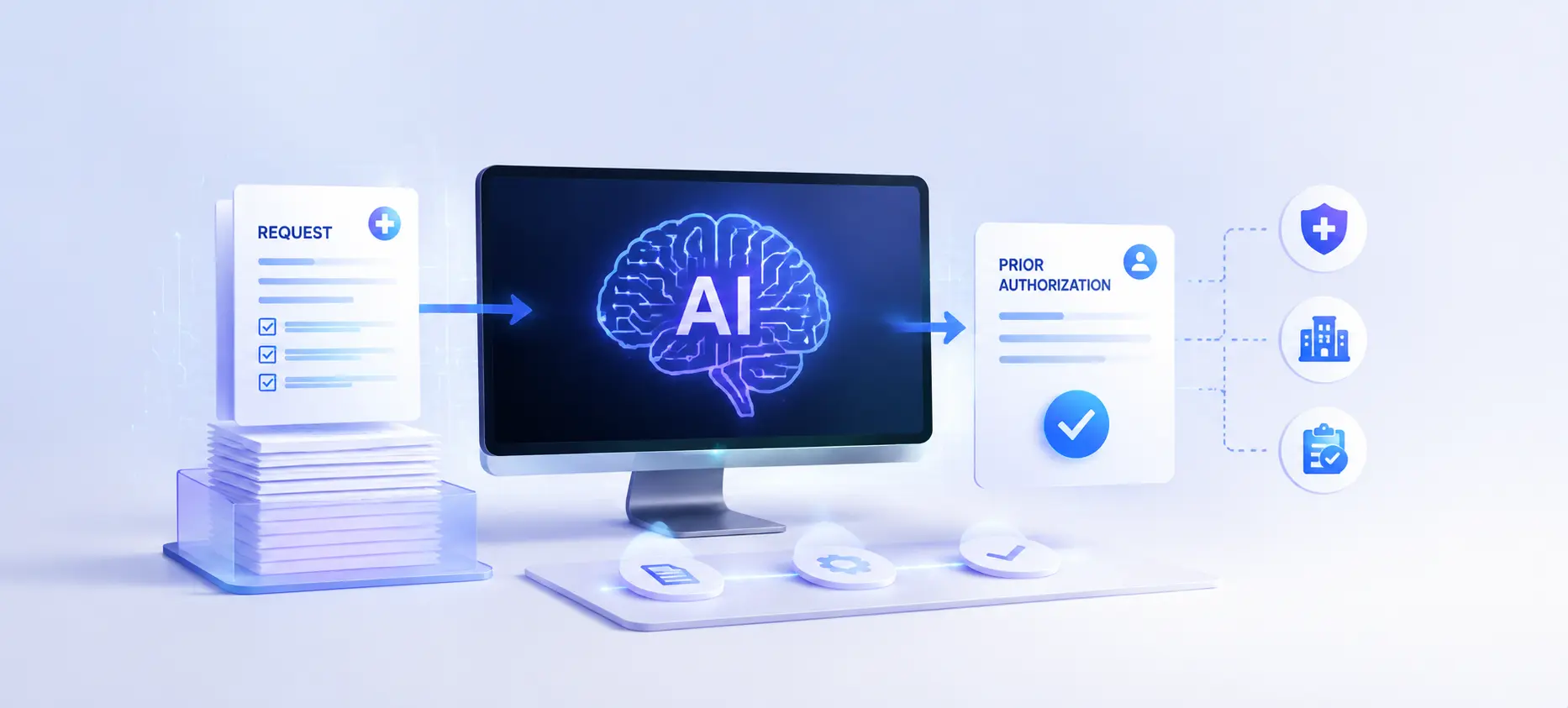
Automating prior authorization with AI means using software, not staff, to draft, validate, and submit payer approval requests. Only the hard cases get flagged for human review. Done right, it cuts cycle time from days to hours. Done wrong, it creates the exact denial problems regulators are now racing to stop.
In my decade building healthcare software, I've watched two very different versions of this project succeed and fail. This guide covers the architecture that actually works. It covers how payer integration really happens under the new CMS rules. It also covers pitfalls that have already drawn scrutiny from the AMA and state regulators. If your healthcare team is scoping this project, a good build and a risky one usually differ on just a handful of design choices, covered below.
What Does It Mean to Automate Prior Authorization with AI?
Automating prior authorization with AI is the practice of using large language models and structured data pipelines to handle the repetitive parts of a PA request. It works because most of that work is pattern matching, not judgment. A well-built system still routes any ambiguous case to a human specialist.
Physicians currently spend an average of 13 hours a week on prior authorization work, according to the American Medical Association. That's not paperwork anyone chose. It's the tax every specialty practice pays to get patients approved treatment. Prior authorization automation targets exactly that bottleneck. It pulls chart data and maps it against payer policy criteria. Then it drafts a justification a specialist can review in minutes, instead of writing one from scratch.
Why Are Healthcare Teams Automating Prior Authorization Right Now?
Two forces are pushing this now: unsustainable staff workload and a hard regulatory deadline. The CMS Interoperability and Prior Authorization Final Rule requires impacted payers to support FHIR-based prior authorization APIs. Most provisions were due by January 1, 2026. Full API requirements follow by January 1, 2027.
The workload numbers explain the urgency:
Physicians spend roughly 13 hours a week on prior authorization tasks
Over 90% of physicians say prior authorization delays necessary care
82% report that prior authorization leads some patients to abandon treatment altogether
94% say prior authorization has a negative impact on clinical outcomes
Those numbers come from AMA physician surveys. They explain why AI prior auth tools have moved from a nice-to-have to a budget priority in the last two years. The same automation that helps a practice submit faster requests is also what payers now use to review them. That's where this story gets more complicated.
What Does a Prior Authorization Automation Architecture Actually Look Like?
A working prior authorization automation architecture has seven layers, not one clever LLM prompt. Skipping any of them is usually where hallucinated justifications and rejected submissions come from.
Chart ingestion. Pull structured clinical data from the EHR, ideally via FHIR. This covers diagnosis codes, prior treatments tried, and relevant labs or imaging.
Payer policy retrieval. Use retrieval-augmented generation over the specific payer's policy documents. Criteria vary by plan and by contract, not just by payer name.
Justification drafting. Have the model draft a criterion-by-criterion justification, mapping each policy requirement to specific chart evidence.
Validation layer. Verify every clinical claim in the draft against the actual chart before it goes anywhere near a submission. This is the step most vendors underbuild.
Code and policy checks. Confirm CPT, HCPCS, and ICD-10 codes are current and that the payer policy version cited hasn't changed.
Revenue cycle integration. Connect the approved request into billing and scheduling systems so approval status stays visible downstream.
Denial handling. Auto-draft an appeal letter when a request is denied, routed back to a human for review before resubmission.
Our AI consultancy team treats step four, validation, as non-negotiable. A justification that cites a lab result the patient never had is worse than no automation at all. It can trigger a fraud flag on top of a denial.
How Do You Integrate with Payers for Automated Prior Authorization?
Payer integration for automated prior authorization happens at three levels, and most healthcare systems end up using all three at once. Direct EHR PA modules cover the payers with mature APIs. Third-party PA platforms fill gaps. RPA bridges to payer portals cover everyone else, at least until 2027.
CMS-0057-F requires impacted payers to expose FHIR-based prior authorization APIs. The National Standards Group has also granted enforcement discretion here. Covered entities can use FHIR-based PA APIs without also complying with the older X12 278 standard right away. That's a meaningful gap for teams building payer integration today. Plan your architecture around FHIR, but keep an X12 fallback path ready for payers still catching up.
Our data engineering team maintains a separate payer-policy corpus per institution, not a shared one. Contracted policies vary by health system even with the same payer. A generic policy corpus will draft justifications against the wrong criteria more often than teams expect.
AI Prior Auth Automation vs Manual Prior Authorization: What Changes?
Here's what shifts when a practice moves from manual prior authorization to AI-assisted automation. These numbers reflect build patterns from Taction Software's 2026 AI prior authorization guide.
Factor | Manual process | AI-automated process |
Justification drafting time | 30 to 90 minutes per request | 2 to 5 minutes, plus specialist review |
Monthly staff time (5,000 PAs) | Full-time equivalent heavy | Roughly 50% time reduction |
Approval-rate improvement | Baseline | 5 to 15 percentage points, in tested deployments |
Build investment | N/A | $45,000 discovery to $200,000 to $450,000 full rollout |
The time savings are real, but so is the risk if validation gets skipped to hit those numbers faster. Speed and accuracy have to improve together, not one at the other's expense.
What Are the Biggest Pitfalls in Automating Prior Authorization with AI?
The biggest pitfall in automating prior authorization with AI isn't a technical bug. It's using the same technology to deny care that you use to request it, without adequate human review on either side. That's precisely what's drawing regulatory attention right now.
Michelle Mello, professor of health policy and law at Stanford, put it directly: "A major worry is that wrongful denials may be occurring as a result of a lack of meaningful human review of recommendations made by AI," she told Stanford Report. AMA President Bruce A. Scott, MD, made a similar point about payer-side use: "Using AI-enabled tools to automatically deny more and more needed care is not the reform of prior authorization physicians and patients are calling for," he said in a statement covered by the American Medical Association.
A few concrete numbers back up the concern. Reported AI-driven denial rates ran roughly 16 times higher than typical rates, per 2024 Senate committee figures. Separately, 61% of physicians say unregulated payer AI is increasing prior authorization denials. On the provider side, an NAIC survey found 84% of insurers already use AI or machine learning for utilization management. This isn't a future risk. It's a current one on both sides of the request.
What Do State and Federal Regulations Require for AI in Prior Authorization?
Federal oversight of AI prior auth automation is still fragmented. Medicare Advantage rules already require that algorithms cannot be the sole decisionmaker for medical necessity determinations, though. Several states have gone further with their own laws.
As of 2026, states with enacted AI-specific prior authorization laws include:
Illinois: only licensed healthcare providers may issue denials; AI cannot be the sole decisionmaker
Alabama: determinations must account for individual clinical circumstances, not just algorithmic scoring
Utah: insurers must publicly disclose their use of AI to providers and enrollees
California: periodic performance audits are required for accuracy and reliability
Maryland: restrictions apply on using patient data beyond its intended purpose
Texas: regulators have inspection rights over the algorithms and systems used
Washington: protections against discriminatory outcomes are written into law
If your automation architecture touches multiple states, plan around one common thread: human review in the loop, from day one. Retrofitting it later costs far more.
How Do You Build in Human Oversight Without Losing the Speed Gains?
You keep the speed gains from prior authorization automation by making human review fast, not by skipping it. Route only genuinely ambiguous cases to a specialist. Let the system pre-fill everything routine, so the review takes minutes, not the original 30 to 90.
A few practical patterns work well here. Give reviewers a side-by-side view of the AI-drafted justification next to the source chart evidence. That way, verification doesn't mean re-reading the whole record. Log every override a specialist makes too; override rates are one of the clearest signals that a policy corpus has gone stale. Route anything touching a denial straight to a human before an appeal goes out. An AI-drafted appeal with a wrong citation can hurt a case more than a slower, correct one.
Our AI product assurance team builds override logging into every prior authorization automation project by default now. It's simply the fastest way to catch a drifting model before it produces a wave of denials.
What Should You Look for in a Prior Authorization Automation Partner?
The right partner for this work has shipped a validation layer that actually gets used, not just described in a sales deck. Ask for their hallucination rate and override rate from a real deployment, not a lab benchmark.
Look for a partner who can show you:
A validation step that checks every clinical claim against the chart before submission
Institution-specific payer-policy corpora, not one generic policy library
A clear plan for CMS-0057-F's FHIR API requirements and the 2027 deadline
Built-in human review for every denial and every high-risk approval request
Audit logging detailed enough to satisfy state-level algorithm inspection rights
Our case studies page includes examples of this kind of clinical AI work. Our portfolio shows the broader pattern across healthcare builds.
Conclusion
Automating prior authorization with AI genuinely works when the architecture treats validation and human oversight as core features. They can't be afterthoughts bolted on to satisfy regulators. The teams getting real ROI, faster cycle times and better approval rates, are the ones keeping specialists in the loop on every single denial.
Here's the single most important takeaway. Build your validation layer before you build your speed. Every regulatory action so far, from CMS-0057-F to the growing list of state AI laws, points the same direction. Automation that skips human review on denials is a liability, not a feature.
If you're scoping a prior authorization automation project, don't start with the LLM. Start with the payer-policy corpus and the validation layer instead. Our AI consultancy team can help you map that architecture against your specific payer mix. Get in touch and we'll walk through what a compliant build looks like for your practice.