

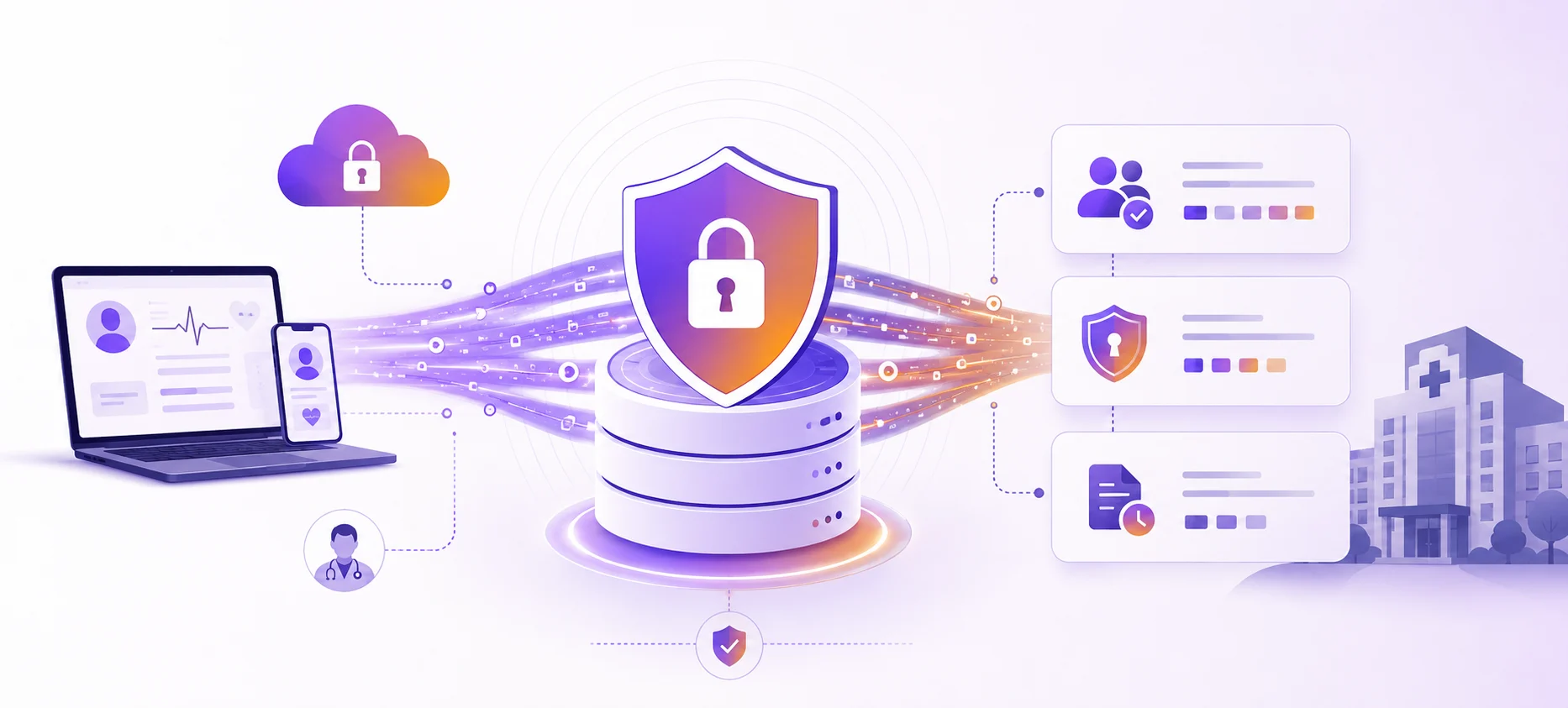
A HIPAA compliant architecture protects patient data through encryption, strict access control, and immutable audit logs. It's built in from day one, not bolted on later. Skipping this at the design stage is the single most expensive mistake a health-tech founder can make. Retrofitting compliance later can cost 20 to 40 times more than building it right the first time.
In my decade auditing health-tech systems, I've seen founders treat compliance as a legal checkbox instead of an engineering discipline. It's not. Get the architecture wrong and you're not just risking a fine. You're risking your healthcare product's ability to exist at all. This guide gives you the checklist competitors leave half-finished. It covers the technical safeguards, the cloud provider tradeoffs, the multi-tenant PHI isolation problem, and a phased rollout plan that actually holds up under audit.
What Is HIPAA Compliant Architecture and Why Does It Matter in 2026?
HIPAA compliant architecture is a system design that enforces encryption, access control, and auditability by default. That covers storage, transit, backups, and logs, everywhere patient data touches your system. It matters because HIPAA doesn't certify software. It only judges whether your actual deployment protected data when something went wrong.
No cloud platform is automatically compliant. As one 2026 cloud architecture guide puts it, "AWS, Azure, and GCP provide the infrastructure and tools to build HIPAA-compliant systems. Whether your actual deployment is compliant depends entirely on how you configure and use that infrastructure," according to Taction Software's 2026 HIPAA cloud architecture comparison. That single sentence explains why so many funded startups still fail audits.
How Much Does a HIPAA Violation Actually Cost?
A single HIPAA violation can cost anywhere from $145 to over $2.19 million, depending on culpability tier. Healthcare data breaches now average $6.64 million per incident. The financial risk isn't hypothetical. It shows up in real OCR settlements every year.
Here's what 2026 enforcement actually looks like, based on HIPAA Journal's 2026 penalty guide:
Tier 1 (lack of knowledge): $145 to $36,505 per violation
Tier 2 (reasonable cause): $1,461 to $73,011 per violation
Tier 3 (willful neglect, corrected): $14,602 to $73,011 per violation
Tier 4 (willful neglect, uncorrected): $73,011 to $2,190,294 per violation
Real settlements show these numbers aren't theoretical. OSF Healthcare paid $552,250 after a breach affecting 53,907 people. Warby Parker paid $1.5 million over 198,470 affected records. Solara Medical Supplies paid $3 million after more than 114,000 records were exposed.
The breach volume behind these fines is climbing too. There were 772 large healthcare breaches in 2025 alone, affecting 138.5 million individuals, according to HIPAA Journal's healthcare data breach statistics. Over 80 percent of these came from hacking, not lost laptops or paper records. That shift matters for architecture decisions: your biggest risk today is a compromised system, not a stolen device.
What Are the Core Technical Safeguards Every HIPAA Compliant Architecture Needs?
Every compliant architecture needs four non-negotiable technical safeguards. These are encryption everywhere, immutable audit logging, strict per-user access control, and signed BAAs with every vendor touching PHI. Miss any one of these and the rest of your compliance work doesn't hold up under audit.
Encryption that actually protects data
Use TLS 1.2 or higher for everything in transit and AES-256 for everything at rest, with customer-managed, rotated keys rather than provider defaults. Add field-level encryption for especially sensitive data like HIV status, mental health notes, or substance use records. Never let PHI leak into URL query strings, client-side caches, or application logs.
Audit logs you can actually trust
Audit logs need to be append-only and encrypted, capturing who accessed what data, when, from where, and what they did with it. Retain them for at least six years. Even system administrators shouldn't be able to edit or delete these records after the fact.
Access control that assumes breach
Give every human a unique login. No shared accounts, ever. Enforce multi-factor authentication and role-based access built on the minimum necessary principle. Set short session timeouts: 15 minutes for standard use, 5 minutes on shared devices. Build a break-glass emergency access role too, one that triggers an alert every time someone uses it.
Melanie Fontes Rainer, then Director of the HHS Office for Civil Rights, put the stakes plainly. "Failure to conduct a HIPAA Security Rule risk analysis leaves health care entities vulnerable to cyberattacks, such as ransomware," she said, according to HIPAA Journal. Architecture without a documented risk analysis behind it is exactly what OCR investigators go looking for first.
AWS vs Azure vs GCP: Which Cloud Fits Your HIPAA Software Checklist?
All three major clouds can support this kind of architecture once you sign a BAA and use only HIPAA-eligible services. The right choice usually comes down to your existing stack and your analytics needs, not raw compliance capability.
Cloud | Strongest for | Watch out for |
AWS | Largest catalog of HIPAA-eligible services; dominant US healthcare footprint | Easy to accidentally use a non-eligible service without noticing |
Azure | Deep compliance tooling through Azure Policy and Defender; strong fit for Microsoft-based teams | Licensing complexity across compliance add-ons |
GCP | Cloud Healthcare API with built-in FHIR, HL7v2, and DICOM support; strong for AI and analytics | Smaller HIPAA-eligible service catalog than AWS |
Whichever you pick, the same mistakes sink deployments every time. Watch for public storage buckets holding PHI, disabled database encryption, missing audit logs in secondary regions, and overly broad IAM roles left over from testing.
How Do You Handle PHI Isolation in a Multi-Tenant SaaS Architecture?
Multi-tenant HIPAA compliant architecture needs PHI isolated at the database row level, not just at the application layer. Application bugs are exactly how cross-tenant data leaks happen. This is the part most generic HIPAA checklists skip entirely, and it's where a lot of health-tech SaaS products quietly fail audit.
Row-level security enforced by the database itself, not by application code, is the safest pattern. Every query should carry a tenant identifier that the database validates independently of what your application layer claims. Our data engineering team builds this as a default constraint on PHI tables, not an optional filter. A single missed WHERE clause in application code is enough to expose one customer's patients to another.
Test this boundary directly, not just in code review. Write automated tests that attempt cross-tenant reads and confirm they fail every time, on every release, not just at launch.
What Should Your Phase-by-Phase HIPAA Software Checklist Look Like?
A realistic HIPAA software checklist runs in six phases, roughly matching your build timeline rather than treating compliance as one final step before launch.
Repository and environment setup. Encrypted secrets management, no PHI in seed data or version control, separate environments for dev, staging, and production.
Data model and encryption design. Field-level encryption decisions, key rotation policy, and a documented data flow map showing everywhere PHI travels.
Access control and authentication build. Unique identifiers, MFA, role-based permissions, and session timeout logic, tested against real user roles.
Audit logging implementation. Append-only logs wired into every PHI read and write, with automated alerts on anomalous access patterns.
Vendor and BAA review. Every third-party service touching PHI, cloud, analytics, email, AI tools, gets a signed BAA before go-live, not after.
Risk analysis and audit readiness. A documented HIPAA Security Rule risk analysis, penetration testing, and a rehearsed incident response plan before you accept your first real patient record.
Our AI product assurance team runs phase four and six together on most engagements. Audit logging gaps are almost always what a real security review finds first.
Which Vendors Need a Signed BAA Before They Touch Your Data?
Any vendor that could see, store, or process PHI needs a signed Business Associate Agreement first. Get it signed before you send them a single real patient record, no exceptions. This applies far beyond your cloud provider.
Check every vendor in this list before integration, not after:
Cloud infrastructure and hosting providers
Analytics and product usage tracking tools
Email and SMS notification services
Customer support and ticketing platforms
Error tracking and application monitoring tools
AI and large language model providers, including any third-party API you call with patient context
If a vendor won't sign a BAA, don't send them PHI. De-identify the data first using Safe Harbor or Expert Determination methods, or find a different vendor entirely.
How Do You Build an Incident Response Plan That Actually Works?
A working incident response plan names specific people, specific timelines, and specific communication steps. It's not just a generic "detect and respond" policy sitting in a compliance binder nobody reads. Most checklists mention this requirement and stop there.
Your plan needs three things. A clear detection path: who gets alerted first when audit logs flag anomalous access. A containment step: who has authority to pull a system offline. And a notification sequence that matches HIPAA's 60-day breach notification deadline. Run a tabletop exercise at least twice a year with the actual people who would respond, not just the security team on paper. Our case studies page includes examples of teams that built this muscle before they needed it. That's the only time it's cheap to build.
What Should You Look for in a HIPAA Compliance Engineering Partner?
The right partner has shipped production HIPAA compliant architecture before. They'll have the audit logs and risk analysis documentation to prove it, not just a slide about "compliance expertise."
Look for a partner who can show you:
Documented risk analyses from real client engagements, not templates
Experience with row-level PHI isolation in multi-tenant systems specifically
A clear phase-by-phase plan that treats compliance as part of the build, not a final review
Familiarity with BAA negotiation across cloud, analytics, and AI vendors
Honest cost estimates that separate day-one compliance work from expensive retrofits
Our AI consultancy team reviews architecture decisions against this exact list before any client signs a statement of work.
Conclusion
Building a HIPAA compliant architecture from day one costs a fraction of what retrofitting it costs later. The 2026 enforcement numbers make the stakes concrete: fines up to $2.19 million per violation, breach costs averaging $6.64 million, and 772 large breaches in a single year.
Here's the single biggest takeaway. Treat encryption, audit logging, access control, and PHI isolation as core architecture decisions from your first sprint, not compliance tasks you handle after the product works. Teams that build this way pass audits faster. They never face the multi-hundred-thousand-dollar retrofit bill that catches up with teams who don't.
If you're scoping a health-tech build right now, don't guess at what "HIPAA compliant" actually requires from a vendor's marketing page. Our cloud DevOps and healthcare engineering teams can review your specific architecture against a real audit checklist before you write your first line of code. Get in touch and we'll walk through your build together.