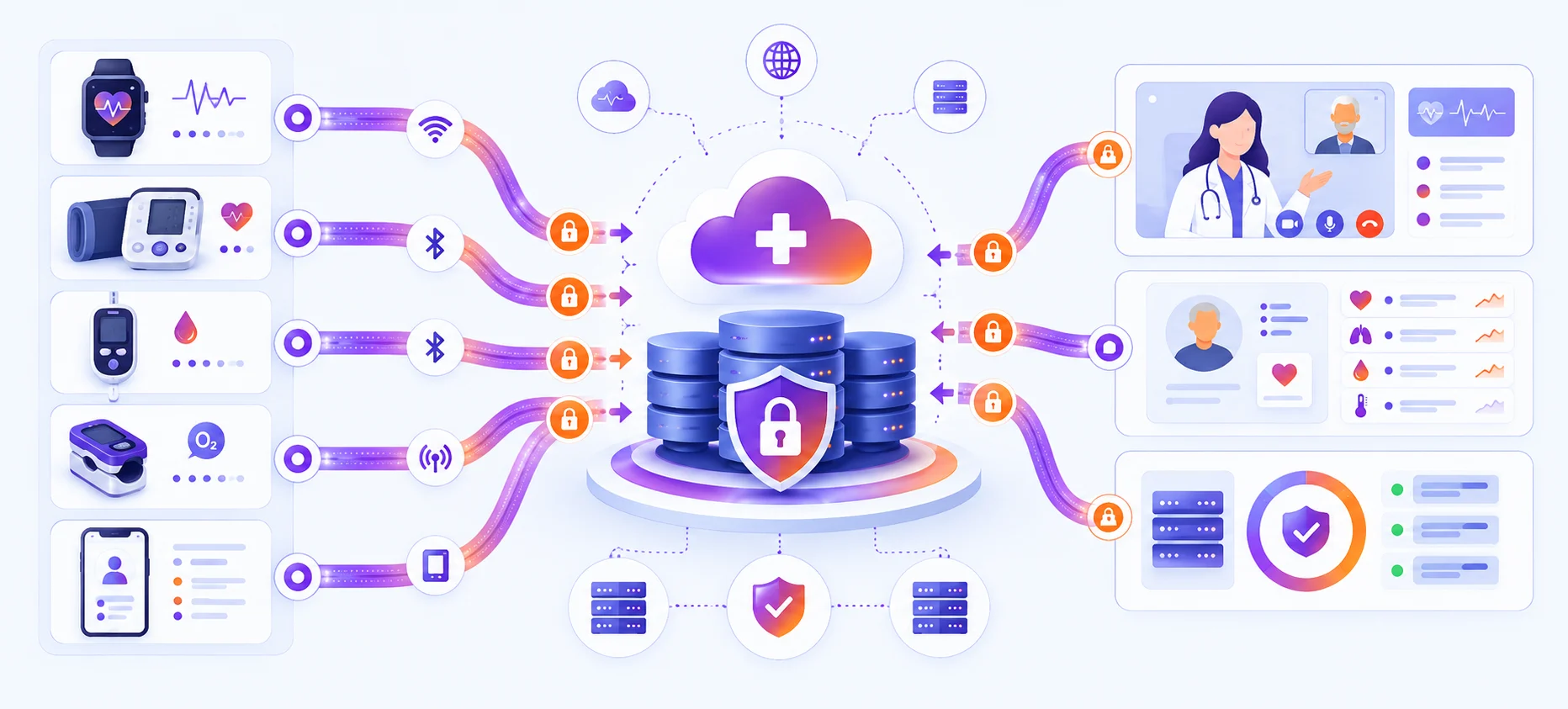


Cloud modernization for health-tech means rebuilding your MVP's infrastructure so it can pass enterprise security reviews, handle real patient volume, and support the next funding round. Most health tech companies build their MVP fast and a little loose on compliance. That's fine until a hospital system's security team asks for your SOC 2 report.
In my decade helping funded health tech teams rebuild their stack, the pattern repeats constantly. A great product stalls a six-figure deal because the infrastructure behind it was never built to survive due diligence. This guide walks through what an MVP to scale cloud modernization plan actually needs, what it costs, and how to sequence it without stalling your healthcare product roadmap.
What Is Cloud Modernization for Health-Tech Companies After a Series A?
Cloud modernization for health-tech is the process of rebuilding a startup's infrastructure, security, and compliance posture to match its new scale and scrutiny. It exists because the shortcuts that got you to Series A won't survive a payer or hospital's vendor review. It's not a rewrite. It's a deliberate upgrade of the pieces that can't hold under real load or real audits.
Most MVPs run on a single database, a handful of manually configured servers, and compliance documentation that exists mostly in someone's head. That setup works fine for ten pilot customers. It falls apart the moment a health system's procurement team asks for evidence of encryption at rest, access logging, and a signed Business Associate Agreement covering every subprocessor you use.
Why Do So Many Health Tech Companies Stall Right After Series A?
Health tech companies stall after Series A because their infrastructure debt becomes visible exactly when it matters most. That usually happens during enterprise sales cycles and board-level growth pressure. Only 15 percent of funded startups successfully scale past this stage, according to a Crunchbase venture report cited by Startup Scene Daily. That means 85 percent fail to make the leap.
That failure rarely comes from a bad product. It comes from infrastructure that can't support the next chapter. For a health tech company specifically, the stakes are higher. Healthcare data breaches cost an average of $6.64 million, the highest of any industry for the 13th year running, according to Beckers Hospital Review's coverage of the IBM data breach report. A single security incident at this stage doesn't just cost money. It can end the next funding round entirely.
What Does Your MVP to Scale Cloud Modernization Plan Actually Need to Cover?
A solid MVP to scale cloud modernization plan covers five things: architecture, compliance, cost control, observability, and team process. Skipping any one of these tends to resurface as an emergency six months later, usually during a customer's security review.
Here's what each piece actually needs to include:
Architecture: Move from a single monolith and manual servers toward containerized services that can scale independently under load.
Compliance: Formalize HIPAA safeguards, get every subprocessor's BAA signed, and start SOC 2 evidence collection early, not right before a deal needs it.
Cost control: Set up usage-based monitoring before your cloud bill triples, since healthcare workloads (especially anything touching AI inference) scale cost fast.
Observability: Add real monitoring and alerting, because "the app is slow" isn't an answer you can give an enterprise customer anymore.
Team process: Document infrastructure as code so more than one engineer understands how production actually works.
Our cloud & DevOps team usually finds that compliance and observability get skipped first, since neither one shows up in a product demo.
AWS vs Azure vs GCP: Which Cloud Fits a Health Tech Company Post-Series A?
All three major providers are HIPAA-eligible under a signed BAA, so the real decision comes down to your existing footprint and the managed healthcare services you'll actually use. Picking based on brand recognition alone tends to cost more later.
Provider | Best fit for | Key healthcare service | Notable 2026 detail |
AWS | Teams wanting the broadest managed service catalog | HealthLake (managed FHIR R4 store) | Widest third-party integration ecosystem |
Azure | Microsoft-standardized teams, deep enterprise IT ties | Health Data Services | Replaces the legacy Azure API for FHIR, which retires September 30, 2026 |
Google Cloud | Data-heavy, AI/ML-intensive products | Healthcare API (FHIR, HL7 v2, DICOM) | Strong fit if your product leans on Vertex AI or MedLM |
Architecture and configuration determine your actual compliance posture, not the provider name on the invoice. A poorly configured AWS environment is not more compliant than a well-configured Azure one.
How Much Should Cloud Modernization for Health-Tech Cost After Series A?
Cloud modernization for health-tech typically costs $80,000 to $250,000 depending on how much compliance debt your MVP is carrying, and takes two to six months for a company with 10 to 50 employees. Companies further along with EHR integrations or Software as a Medical Device components should budget toward the higher end.
A few cost anchors worth knowing:
HIPAA compliance infrastructure and documentation alone typically runs $20,000 to $80,000, according to Momentum's 2026 health tech cost guide.
A properly secured, HIPAA-aligned cloud environment setup runs another $15,000 to $50,000 before ongoing monitoring costs.
Fixing compliance mistakes after the fact costs two to three times more than building it correctly the first time.
Teams that scope this work early see a 20 to 30 percent reduction in total project cost compared to those who bolt on compliance later.
How Do You Get SOC 2 and HITRUST Ready Without Slowing Down Product Work?
Start SOC 2 evidence collection the same quarter you close your Series A, not the quarter a customer demands it. Waiting until a deal requires it turns a six-month process into a blocked deal.
The trick is running compliance work in parallel with product development instead of treating it as a separate project. Automated evidence collection tools can track access logs, encryption status, and change management records continuously. That way your engineering team isn't scrambling to reconstruct six months of history right before an audit. One HIPAA-compliant infrastructure build we've seen documented took just three weeks using this parallel approach. It scaled to over a thousand users without downtime once it shipped, according to a case study published by Gart Solutions. As Gart Solutions puts it plainly: "Scaling requires more than feature updates. It means rethinking your infrastructure, compliance, and strategy, so your platform remains secure, fast, and investor-ready."
What Are the Biggest Mistakes Health Tech Companies Make When Modernizing Cloud Infrastructure?
Most modernization delays trace back to five repeatable mistakes, not to any single technical decision. Fixing the sequence usually fixes the timeline.
Treating compliance as a checkbox instead of ongoing evidence. A HIPAA policy document isn't the same as proof you're following it every day.
Migrating everything at once. A full rewrite under deal pressure almost always takes longer and breaks more than a staged migration.
Ignoring cost monitoring until the bill arrives. AI inference and PHI storage costs scale fast, and surprises here spook boards.
Skipping infrastructure documentation. If only one engineer understands production, you don't have infrastructure. You have a liability.
Choosing a cloud provider based on marketing instead of fit. Your existing EHR integrations and team skill set matter more than a vendor's healthcare marketing page.
Our AI product assurance team catches most of these during a modernization audit, well before they turn into a stalled enterprise deal.
How Do You Sequence the Migration From MVP Infrastructure to Scalable Architecture?
Sequencing matters more than speed here. Migrate compliance-critical pieces first, since those block sales, then move performance-critical pieces, since those block growth. Rewriting for elegance can wait.
Here's a practical order that keeps the product shipping while the infrastructure catches up:
Lock down data encryption, access controls, and audit logging first. These are what a security review checks first.
Get every vendor and subprocessor BAA signed before scaling data volume further.
Containerize your core services so they can scale horizontally under real load.
Add real observability (logging, monitoring, alerting) before you need it during an incident, not after.
Automate your infrastructure with code (Terraform or similar) so growth doesn't depend on one person's memory.
Our data engineering team typically runs steps one and two in parallel with product work, since neither requires pausing feature development.
What Should You Look for in a Cloud Modernization Partner for Health Tech?
The right partner has shipped HIPAA-compliant infrastructure that actually passed enterprise procurement reviews, not just built systems that technically meet the checklist. Ask for evidence, not just a service list.
Look for a partner who can show you:
Real examples of infrastructure that passed a hospital system or payer security review
A clear, staged migration plan instead of a full rewrite pitch
Experience with FHIR and HL7 integration work specific to your EHR targets
A cost model tied to your funding stage, not enterprise-scale assumptions
Willingness to document everything so your internal team can maintain it after they leave
Our case studies page includes examples of this kind of health tech modernization work, and our cloud & DevOps team is happy to review your current stack before you commit to a scope of work.
Conclusion
Cloud modernization for health-tech after a Series A isn't optional infrastructure polish. It's the difference between closing your next enterprise deal and watching it stall in a security review you weren't ready for. The MVP that got you funded and the platform that gets you to Series B are rarely the same system. Pretending otherwise is how 85 percent of funded startups stall out.
The single most useful thing you can do right now is start compliance evidence collection and architecture cleanup in parallel with product work, not after a customer forces the issue. That one sequencing choice is usually what separates a smooth SOC 2 audit from a six-month fire drill.
If your team is staring down a modernization project and isn't sure where to start, don't guess at scope from a generic checklist. Our cloud & DevOps and healthcare engineering teams can map your gaps against a realistic budget and timeline. Get in touch and we'll walk through your current stack together.