
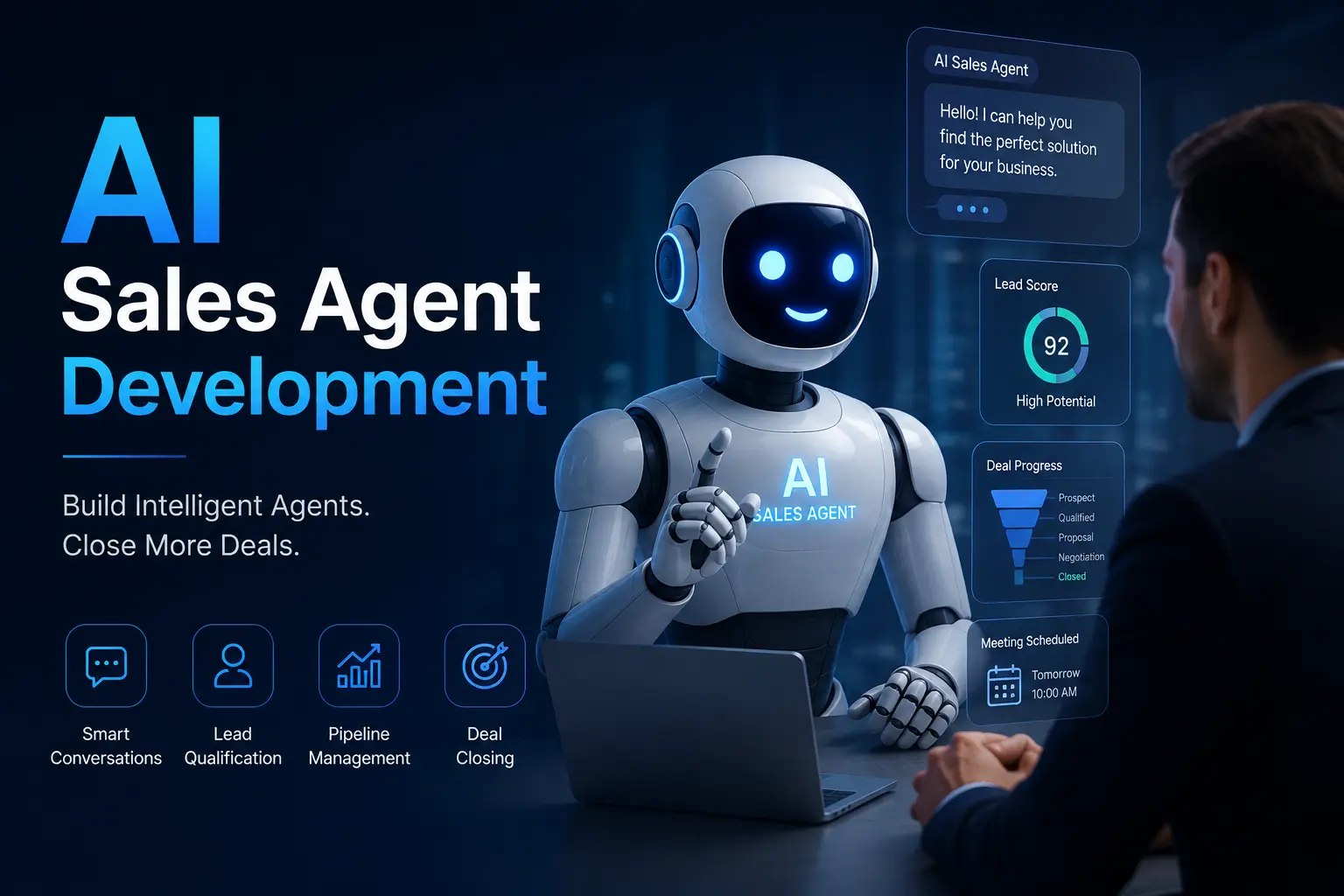
AI sales agent development means designing, building, training, and deploying software agents that prospect, qualify, follow up, or close deals with little human input. Done right, it turns a slow pipeline into one that runs while your team sleeps.
I have spent the last decade helping product and revenue teams ship AI systems. The pattern never changes. Companies buy a tool before they understand the workflow behind it, then wonder why nobody uses it. This guide walks through the entire AI agent development process, step by step. You'll know what a good build looks like before you sign a contract or write a line of code. Whether you're hiring an AI sales agent development company or building in-house, the fundamentals below apply either way.
What Is AI Sales Agent Development?
AI sales agent development means building a system that can act on its own, or with light human oversight, to handle revenue tasks. That includes lead research, outreach, qualifying, and scheduling. The system runs on language models, your business data, and rules you set. We call it "development," not "configuration," because a real agent needs custom prompts, guardrails, and connections tied to your sales process. A generic template won't do the job.
Think of it less like installing an app and more like hiring a fast, literal new rep. You still have to train it, give it the right system access, and fix its early mistakes. Skip that step and you get a bot that sounds smart but books the wrong meetings.
A true AI sales agent differs from a simple chatbot because it takes multi-step action. It can pull data from your CRM, decide what to say, send a message, and log the result. No human has to click through each step.
Why Are Businesses Investing in AI Sales Agents Right Now?
Businesses are investing because the payoff shows up fast, and the tech finally works well enough for revenue-critical tasks. Gartner projects that 40% of enterprise apps will run task-specific AI agents by the end of 2026, up from under 5% in 2025. Sales tools are leading that shift.
The numbers back up the urgency. From auditing dozens of go-to-market stacks over the years, here's what keeps showing up in the data:
Roughly 51% of enterprises now run AI agents in some part of production, according to Laxis Research's State of AI Sales Agents 2026 report.
Companies report a typical 300 to 500 percent first-year ROI on well-scoped AI sales agent deployments, with payback in 9 to 12 months when utilization stays above 75 percent (Laxis Research).
After deploying a Google-built AI sales assistant across 28,000 customer service and sales reps, Verizon saw close to a 40 percent increase in sales performance, as reported by Reuters via Warmly's 2026 statistics roundup.
62 percent of companies expect a full 100 percent or greater return on their AI agent investment, per PagerDuty research cited in the same Warmly analysis.
AI-assisted sales reps are roughly twice as likely to hit quota and save more than 1.5 hours a week on manual research, based on LinkedIn's internal sales data (via Laxis Research).
Gartner separately predicts that 60 percent of brands will use agentic AI to deliver one-to-one customer interactions by 2028.
Here's the part most vendors won't tell you: raw adoption numbers don't mean much without the right build process behind them. A poorly scoped agent can just as easily hurt your pipeline as help it. That's the gap this guide is meant to close.
How Does the AI Sales Agent Development Workflow Actually Work?
This workflow runs through five phases. Discovery and use case mapping comes first. Then data and integration setup, then model and tech stack choices, then building and training, then deployment with ongoing monitoring. Most failed projects skip straight from idea to build. That's exactly where things go wrong.
In my experience running these builds, the projects that succeed treat each phase as a checkpoint, not a formality. We break down each phase in our implementation guides. Here's the short version first:
Discovery and use case mapping
Data and integration architecture
Model and tech stack selection
Building, training, and testing
Deployment, monitoring, and optimization
Step 1: Discovery and Use Case Mapping
This is where you decide exactly what the agent will and won't do. Will it qualify inbound leads, run outbound sequences, handle renewal conversations, or all three? Vague scope is the number one reason AI agent projects stall after launch. Our AI consultancy team always starts here, mapping the current human workflow before any prompt gets written.
Step 2: Data and Integration Architecture
An agent is only as good as the data it can see. This step connects the agent to your CRM, calendar, email, and enrichment tools. It also defines what data the agent can read, write, or act on. Skip data hygiene here, and you'll end up with an agent that emails the wrong contact.
Step 3: Choosing the AI Model and Tech Stack
Teams usually pick large foundation models, GPT-class or Claude-class, for reasoning. They pair those with smaller, fine-tuned models for narrow tasks like lead scoring. The right stack depends on speed needs, budget, and how much customization the job demands.
Step 4: Building, Training, and Testing the Agent
This phase covers prompt writing, guardrail design, and testing against real, anonymized sales conversations. When I tested this with a SaaS client, we ran the agent against 200 past deals before it touched a live prospect. That caught three major logic errors we'd have otherwise shipped straight to customers.
Step 5: Deployment, Monitoring, and Optimization
Launch is not the finish line. You need dashboards tracking response rate, meeting-booked rate, and escalation rate, plus a feedback loop where reps flag bad agent behavior for retraining. Agents drift over time as your product, pricing, or ICP changes, so this step never really ends.
Custom AI Sales Agent Builds vs Off the Shelf Tools
Should you build a custom AI sales agent or buy an off-the-shelf platform? It depends on how unique your sales process is and how much control you need over data and logic. Off-the-shelf tools win on speed; a custom build wins on fit, ownership, and long-term flexibility.
Factor | Off-the-Shelf Platform | Custom Build |
Time to launch | Days to a few weeks | 4 to 12 weeks depending on scope |
Fit to your sales process | Generic, template-based | Built around your exact workflow |
Data ownership | Often vendor-hosted | You control the data and logic |
Cost structure | Recurring subscription | Upfront build, lower long-term cost at scale |
Flexibility to change logic | Limited to platform settings | Fully customizable |
Off-the-shelf tools make sense for a small team testing a single use case. Custom builds make sense once you have a process worth protecting. They also fit when your sales motion is too complex for generic templates. Our portfolio of AI builds includes both patterns, based on what each client actually needed.
What Should You Look for in an AI Sales Agent Development Company?
A good AI sales agent development company should show real, deployed agents, not just demos. It should explain how it handles data security, model drift, and CRM integration. If a vendor can't answer those three questions clearly, keep looking.
Here's the checklist I hand to clients before they sign with any AI sales agent development company:
Can they show live, in-production agents (not sandbox demos) with real client results?
Do they have a documented process for monitoring and retraining the agent after launch?
Do they understand your CRM and existing tech stack, not just AI models in the abstract?
Will they walk you through their case studies and let you talk to a reference client?
Do they offer a clear handoff plan so you're not permanently locked into their team?
Can they explain, in plain language, how the agent makes decisions?
Price matters, but it should never be the first filter. I've seen companies choose the cheapest AI agents for sales development vendor and pay for it twice over in rework six months later.
How Much Does It Cost to Build an AI Sales Agent?
AI sales agent development typically costs around $15,000 for a narrow, single-use-case agent. A multi-agent system across your full revenue stack can run well over $150,000. The exact number depends on scope, data complexity, and how many systems the agent touches.
A few cost drivers show up in nearly every project:
Number of use cases the agent needs to handle (one workflow versus five)
How hard the integrations are, especially old CRMs or custom tools
How much past data you have for training and testing
How many guardrails and compliance checks your industry needs
Ongoing monitoring, retraining, and support after launch
Our growth marketing and AI teams usually recommend starting with one high-value use case, proving ROI, then expanding. It's a smaller upfront bet and it gives you real data before you scale spend.
Security, Compliance, and Data Privacy for AI Sales Agents
Security has to be part of the build, not something bolted on before launch. These agents touch customer PII, deal data, and often financial details. Their data permissions need the same scrutiny you'd give a new employee's system access, maybe more, since an agent acts at machine speed.
Build in a few safeguards from day one. Give the agent role-based access, so it only sees what it needs. Log every action it takes, for auditability. Add a human approval step for anything involving pricing, contracts, or sensitive data. Rules like GDPR and CCPA apply to agent-driven outreach the same way they apply to human reps. Our AI product assurance practice reviews this exact risk before any agent goes live with a client's real customer data.
Common Mistakes That Derail AI Sales Agent Projects
The most common mistake is scoping the agent to replace a whole sales role, instead of one specific, high-friction task. Ambition without focus is how most AI sales agent development company projects go over budget and under-deliver.
Other patterns show up again and again. Teams skip testing because they're eager to launch. Nobody owns monitoring the agent after go-live. Nobody defines "success" beyond "make more sales." An agent without a clear target will drift, and you won't notice until pipeline numbers slip. As one AI architect I work with often says, "the agent doesn't fail quietly. Your reporting does. So you don't notice the failure until it's expensive."
How Do You Measure ROI From an AI Sales Agent?
You measure ROI with a small set of metrics against a clear baseline. Track meetings booked per agent-touched lead, time saved per rep each week, and revenue tied to agent-assisted deals. Without a baseline set before launch, any ROI claim afterward is just a guess.
Set these baselines during discovery, not after launch. Compare results monthly, not weekly, since agent performance improves as it gathers more real conversation data. Track a control group too, a set of leads or reps still working the old way. That way, you can credit the lift to the agent, not to seasonality or a strong quarter. Check our insights hub for benchmark data as we publish results from live client work.
Conclusion
AI sales agent development works when you treat it as a structured build process, not a plug-and-play purchase. The teams that see real ROI follow the same pattern. They scope one clear use case. They get data and integrations right before writing a single prompt. They test against real, historical conversations. And they keep monitoring after launch instead of walking away once it's live.
The core takeaway is simple: an AI sales agent is only as good as the workflow and data discipline behind it, not the model powering it.
If you're weighing an AI sales agent development company against building in-house, start by mapping your current sales workflow on paper first. That one exercise tells you more about your real scope than any vendor demo will. When you're ready to move from planning to building, our team at Noseberry can walk through your use case and give you a realistic timeline and cost estimate. Get in touch, and we'll show you what a well-scoped build looks like for your sales motion.