
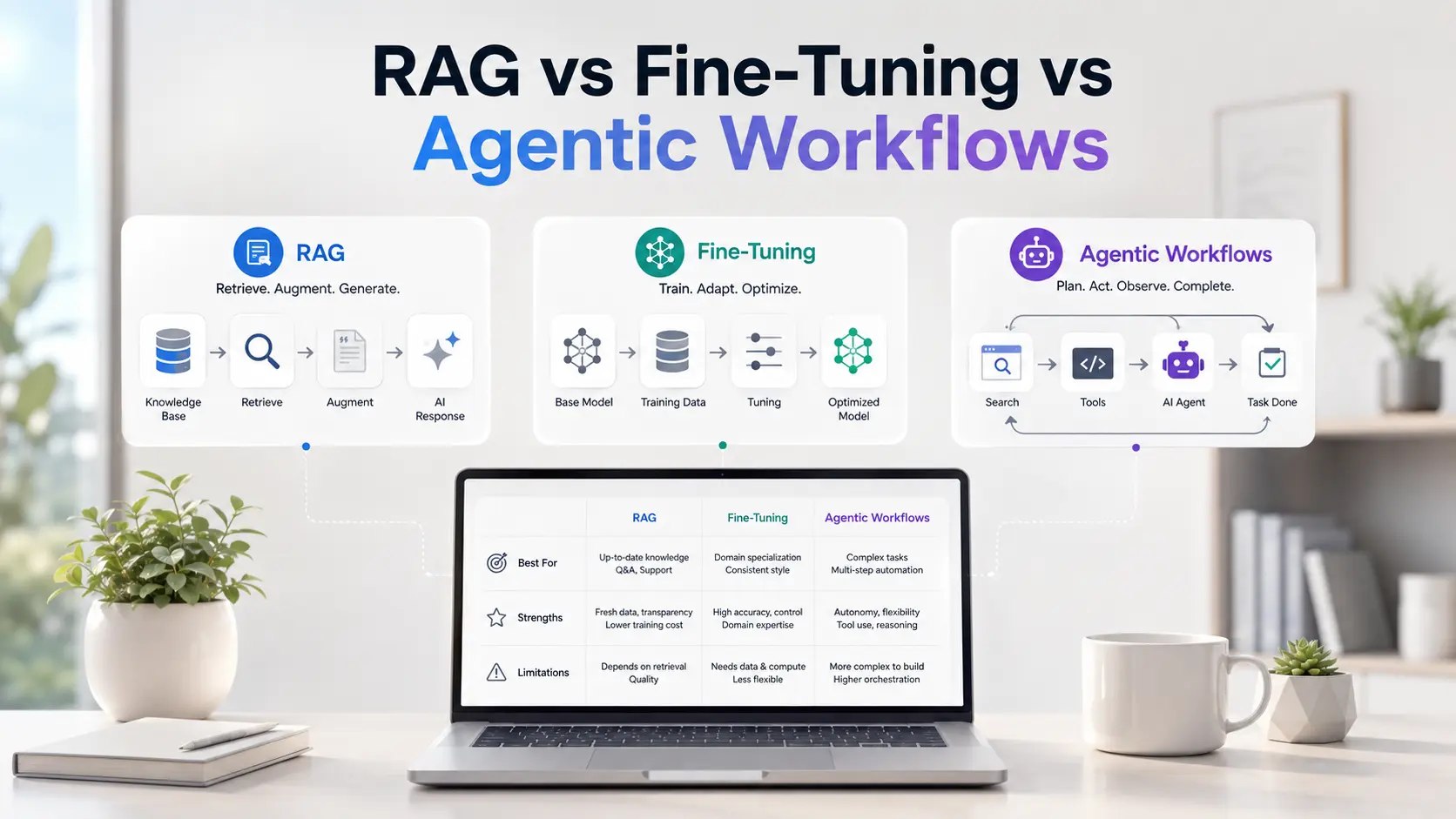
RAG AI architecture adds outside knowledge to a model at answer time. Fine-tuning AI architecture changes the model itself through extra training. Agentic workflows let AI take multi-step action on its own. Most businesses need just one of these as a starting point, not all three at once. This guide breaks down what each one actually does, what it costs, and how to pick the right fit for 2026.
Vendors love to pitch all three as if they solve the same problem. They don't. In my decade helping teams plan AI builds, the biggest waste I see is picking a heavy, multi-step build for a task that plain RAG would have solved in half the time. Our AI consultancy team walks new clients through this exact choice every month, so this guide covers what the pitch decks leave out.
What Are RAG, Fine-Tuning, and Agentic Workflows?
RAG AI architecture is a setup where the model pulls fresh, relevant information from your own documents before it answers, because that keeps answers current without retraining anything. Fine-tuning AI architecture is a setup where you retrain part of a model on your own data, because that changes how the model behaves, not just what it knows. Agentic workflows let an AI system plan, act, and use tools across multiple steps, because a single answer is not enough for the task.
Think of it this way. RAG is like giving someone a stack of reference books to check before answering. Fine-tuning is like sending that person back to school to learn a new skill. Agentic workflows are like handing them a full task list and letting them work through it on their own, checking in only when needed.
None of these approaches are mutually exclusive by design. Many production systems in 2026 use two, or all three, layered together. But each one solves a different problem, and picking the wrong one first is how AI budgets get wasted.
Why Does Choosing the Right AI Architecture Matter in 2026?
Choosing the right architecture matters because most AI investments right now are not paying off, and the wrong pick is a common reason why. Getting this decision right early saves real money and avoids a rebuild six months later.
Here's what the data shows:
95% of generative AI pilots have produced no measurable financial return, according to an MIT Media Lab and Project NANDA report covered by the Harvard Business Review.
88% of organizations now use AI in at least one business function, yet only a small fraction report real profit impact, per McKinsey's State of AI research.
Gartner predicts that over 40% of agentic AI projects will be canceled by the end of 2027, largely due to rising costs and unclear business value.
Gartner senior analyst Anushree Verma put it plainly: "Most agentic AI propositions lack significant value or return on investment, as current models don't have the maturity and agency to autonomously achieve complex business goals."
Hybrid retrieval setups for RAG AI architecture show 20 to 40% higher recall than simple dense-only search, according to FloTorch's 2026 RAG performance benchmarks.
Fine-tuning AI architecture can cost as little as $300 for a small model using LoRA, or well over $15,000 for a full fine-tune on a larger model, per 2026 cost analysis from AI Superior.
The pattern is clear. Most failures trace back to picking a heavier, more expensive architecture than the task actually needed.
How Does RAG AI Architecture Work, and When Should You Use It?
RAG AI architecture works by searching your own documents for relevant passages, then feeding those passages to the model along with the question, so the answer is grounded in real, current information. It's the right choice when your data changes often and accuracy on facts matters more than tone or style.
A typical RAG setup has three moving parts. A vector database stores your documents in searchable form. A retrieval step finds the most relevant chunks. The model then writes the final answer using those chunks as context. Retrieval quality drives most of the results here. Sloppy chunking can drop accuracy by 35 percentage points or more, based on FloTorch's benchmark testing.
Use RAG AI architecture when you need answers grounded in a knowledge base that updates weekly or daily, such as internal policy documents, product catalogs, or support articles. Our data engineering team usually builds the retrieval layer first, since a weak retrieval setup will sink even the best model on top of it.
How Does Fine-Tuning AI Architecture Work, and When Should You Use It?
Fine-tuning AI architecture works by taking an existing model and training it further on your own examples, so it changes how the model responds, not just what facts it can recall. It fits best when you need a consistent tone, a specific output format, or a skill the base model doesn't handle well out of the box.
Most 2026 fine-tuning projects use a technique called LoRA, which trains a small add-on layer instead of the whole model. LoRA keeps 80 to 95% of the quality of a full fine-tune, at a fraction of the cost and training time. A small model can be fine-tuned for well under $1,000, while a full fine-tune on a larger model can run into five figures once you include GPU time and data preparation.
Use this approach when your task depends on consistent style or behavior more than fresh facts. Good examples include matching a brand's tone across thousands of support replies, or teaching a model a specialized format your team uses daily. It's a poor fit if your facts change weekly, since you'd have to retrain constantly just to stay current.
How Do Agentic Workflows Work, and When Should You Use Them?
Agentic workflows work by giving an AI system a goal, a set of tools, and the ability to plan multiple steps toward that goal without a human directing each one. They fit tasks that involve several actions across different systems, not a single question and answer.
A basic agentic setup includes a planning step, tool access such as APIs or databases, and a way to check its own progress before reporting back. This is the most powerful option on this list, and also the riskiest. Given the cancellation numbers above, agentic workflows are the architecture most likely to get funded with excitement and cut later once the real cost and unclear ROI become obvious.
Use agentic workflows when a task genuinely needs multiple steps and decisions, like researching a lead, updating three systems, and drafting a follow-up email in one pass. Skip them if a single well-grounded answer, the kind RAG AI architecture already delivers, would solve the problem just as well.
RAG vs Fine-Tuning vs Agentic Workflows: Side-by-Side Comparison
Here's a direct comparison across the factors that matter most when picking an architecture.
Factor | RAG | Fine-Tuning | Agentic Workflows |
|---|---|---|---|
Best for | Fresh, fact-based answers | Consistent tone or format | Multi-step tasks and actions |
Typical cost | Low to moderate | $300 to $15,000+ | Moderate to high |
Data freshness | Updates instantly | Needs retraining to update | Depends on tools used |
Setup complexity | Moderate | Moderate to high | High |
Main risk | Weak retrieval quality | Stale knowledge over time | Cost and reliability at scale |
No single row on this table should decide your choice alone. Most teams weigh cost against how often their underlying data changes, then pick the lightest architecture that still solves the actual problem.
Can You Combine RAG, Fine-Tuning, and Agentic Workflows?
Yes, and most mature 2026 systems combine at least two of these approaches rather than picking just one. Layering them plays to each one's strength instead of forcing a single method to do everything. We map this out step by step in our implementation guides.
A common pattern looks like this:
Fine-tune the model for tone, format, and domain vocabulary.
Add RAG AI architecture on top for fresh, fact-grounded answers.
Wrap the whole thing in an agentic workflow that decides when to search, when to answer directly, and when to call an external tool.
A support system might fine-tune for brand voice, use RAG to pull the latest policy details, and add a light agent layer that updates a ticket or issues a refund once it has an answer. Our portfolio of AI builds includes several projects built this way, layered rather than all-or-nothing.
What Should You Look for When Choosing an AI Architecture Partner?
A good AI architecture partner should recommend the simplest setup that solves your actual problem, not the most impressive-sounding one. If every conversation leads straight to a full agentic build, that's worth questioning.
Run through this checklist before committing to a build:
Can they explain, in plain language, why they recommend RAG, fine-tuning, agentic workflows, or a mix?
Do they have case studies showing real outcomes, not just technical demos?
Will they start with a small pilot before recommending a full rollout?
Do they have a plan for measuring ROI before and after the build, not just after?
Can they explain how they'll handle security and data access, similar to how our AI product assurance practice reviews every client build?
Do they offer ongoing support once the system is live, or do they disappear after launch?
The right partner will sometimes talk you out of the most exciting option. That's usually a good sign, not a bad one.
Common Mistakes Businesses Make Choosing an AI Architecture
The most common mistake is reaching for the most advanced-sounding option first, when a simpler RAG setup would have solved the actual problem. Ambition without a clear task definition is exactly how Gartner's cancellation numbers happen in practice.
Other patterns show up again and again. Teams fine-tune a model to fix a knowledge problem that RAG would have solved faster and cheaper. Teams skip a pilot and go straight to a company-wide rollout, then discover the ROI isn't there once the excitement fades. And teams rarely revisit their architecture choice after the first year, even as their data and needs change. From reviewing dozens of client AI roadmaps, the businesses that succeed treat architecture choice as a decision to revisit, not a one-time bet. Check our insights hub for more benchmark data as we publish results from live client work.
Conclusion
RAG, fine-tuning, and agentic workflows solve different problems. The businesses getting real value from AI in 2026 are the ones matching the architecture to the actual task, not chasing the most impressive-sounding option.
The core takeaway is simple: start with the lightest architecture that solves your real problem, and only add complexity once you've proven the simpler version works.
If you're not sure which architecture fits your business, start by writing down the actual task you want AI to handle, not the technology you want to use. That single step will tell you more about your real needs than any vendor pitch will. When you're ready to map out a plan, our team at Noseberry can review your use case and recommend the simplest setup that actually works. Get in touch, and we'll walk through what fits your business, not just what's trending.