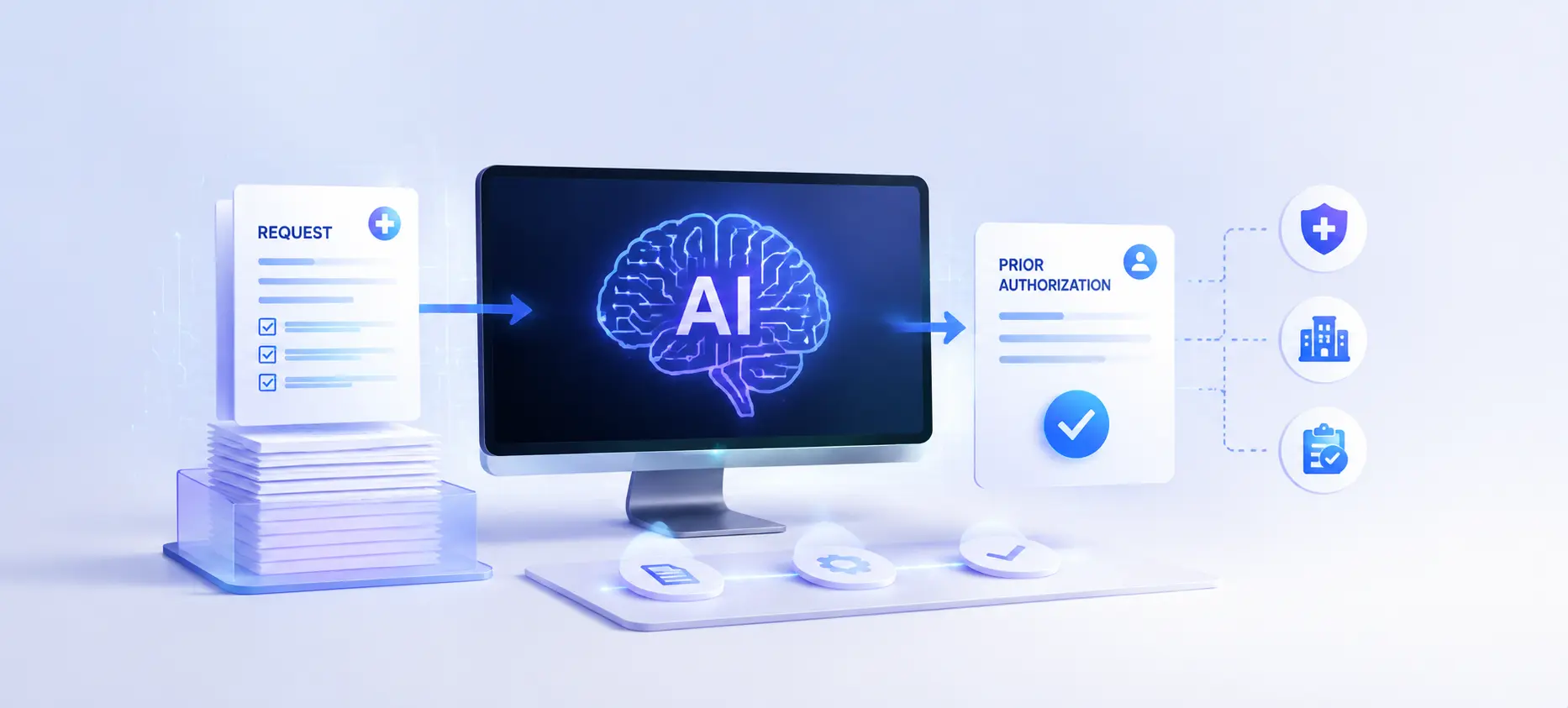

Generative AI is reactive: it produces content when prompted. Agentic AI is proactive: it pursues goals autonomously across multiple steps and systems.
Most enterprise AI systems use generative AI as the reasoning core with an agentic layer on top, so these are often complements, not competitors.
65% of organizations already use generative AI regularly (McKinsey, 2024), while agentic AI is still in early-to-mid adoption across most industries.
Gartner projects that 15% of day-to-day work decisions will be made autonomously by AI agents by 2028, up from less than 1% in 2024.
Generative AI suits content production, drafting, research assistance, and knowledge summarization. Agentic AI suits multi-step workflow automation with real-world action.
Businesses not yet operationally ready (fragmented data, undocumented processes) should start with generative AI and build toward agentic readiness.
Agentic AI carries higher risk because it takes real actions. Governance, audit logging, and human-in-the-loop checkpoints are non-negotiable.
A phased approach (generative AI first, then agentic) produces 40% higher satisfaction outcomes than jumping straight to autonomous systems (Deloitte, 2025).
The best ROI from agentic AI comes from high-frequency, clearly defined, multi-step processes where cycle-time reduction compounds across thousands of runs.
Choose your AI type based on your bottleneck: slow content production points to generative AI; slow multi-step execution points to agentic AI.
Generative AI creates content when you prompt it. Agentic AI takes action on its own to complete a goal. That's the core distinction, and it matters enormously when you're deciding where to invest. One makes your team faster at producing things. The other gets things done without your team needing to lift a finger.
If you've been following the AI conversation over the past two years, you've probably noticed that the terms keep shifting. First everyone talked about ChatGPT and content generation. Then "AI agents" started popping up in product announcements and board decks. Now "agentic AI" is everywhere, and it's easy to confuse the two or assume they're synonyms. They are not. Understanding the difference between agentic AI vs generative AI is one of the most practical things a business leader can do right now, because the wrong choice wastes budget, and the right one can genuinely transform operations.
I've spent the better part of a decade helping businesses figure out where AI fits into their workflows, and this question comes up in almost every strategy conversation. Let me break it down clearly.
Generative AI is an AI system that produces new content, including text, images, code, audio, and video, based on a prompt you give it. It is reactive by design: you ask, it answers. It does not take actions in the world, browse the web on your behalf, update your CRM, or send emails unless something else in the system is built to do that.
The underlying technology is typically a large language model (LLM), a diffusion model for images, or a similar deep learning architecture trained on massive datasets. When you type a prompt into ChatGPT, Claude, or Gemini, you're interacting with generative AI. When a marketing team uses Midjourney to create visuals, that's generative AI. When a developer uses GitHub Copilot to autocomplete code, same thing.
According to McKinsey's 2024 Global AI Survey, 65% of organizations reported regularly using generative AI in at least one business function, up from 33% just one year prior. That rapid adoption tells you this technology is already embedded in most industries.
The key trait to remember: generative AI is a tool that augments human work. You still hold the wheel.
Agentic AI is an AI system that acts autonomously to complete multi-step goals, making decisions, using tools, and adapting its behavior without needing a human to prompt each step. It is proactive where generative AI is reactive. It plans, executes, monitors outcomes, and adjusts, sometimes over minutes, sometimes over days.
Think of it this way: if generative AI is a brilliant intern who answers every question you ask, agentic AI is a capable project manager who you brief once and who then goes off, coordinates resources, and delivers results.
Agentic AI systems typically include several components working together: a reasoning layer (often an LLM), tool access (web browsing, APIs, database queries, code execution), memory (short and long-term context), and an orchestration layer that decides what to do next. Real-world examples include AI systems that autonomously research a topic, draft a report, and email it to stakeholders, all from a single high-level instruction.
Gartner predicted that by 2028, at least 15% of day-to-day work decisions will be made autonomously through agentic AI systems, a number that was less than 1% in 2024. That's not a minor shift. That's a fundamental change in how organizations operate.
If you want a deeper look at how agentic systems are being deployed right now, our guide on AI Agents for Business in 2026 walks through practical build and deployment strategies.
Before diving into use cases and decision-making, here's a direct comparison to anchor the key differences:
Feature | Generative AI | Agentic AI |
|---|---|---|
Core behavior | Reactive (responds to prompts) | Proactive (pursues goals autonomously) |
Output type | Content (text, images, code, etc.) | Actions and outcomes (tasks completed) |
Decision-making | None, produces output only | Plans and makes sequential decisions |
Tool use | Limited or none | Extensive (APIs, browsers, databases, code) |
Human input needed | Every interaction | Once at goal-setting |
Memory | Usually within one session | Persistent across sessions and tasks |
Best for | Content creation, research assistance, drafting | Workflow automation, complex task execution |
Examples | ChatGPT, Claude, Midjourney, Copilot | AutoGPT, custom AI agents, enterprise AI pipelines |
Risk level | Lower (human reviews output) | Higher (autonomous action, needs guardrails) |
Implementation cost | Lower to medium | Medium to high |
Generative AI shines wherever speed and quality of content production matters. Here are the most common high-ROI applications:
Marketing and copywriting: Drafting blog posts, ad copy, product descriptions, and social content at scale
Customer support: Generating first-response drafts that agents review and send
Software development: Code generation, documentation, and code review support
Internal knowledge management: Summarizing long documents, meeting notes, and reports
Sales enablement: Personalizing pitch decks, proposals, and outreach emails from templates
A HubSpot State of Marketing report found that marketers using AI tools save an average of 2.5 hours per day on content-related tasks, with the majority of those savings coming from generative AI tools.
Agentic AI earns its value in processes that involve multiple steps, multiple systems, and minimal human touch between start and finish:
Automated research pipelines: The agent searches, reads, synthesizes, and delivers a structured briefing
Lead qualification and follow-up: The agent scores leads, personalizes outreach, and books calls without human handoffs
IT operations: Monitoring system health, detecting anomalies, and executing predefined remediation steps
E-commerce operations: Managing inventory alerts, updating pricing based on competitor data, and triggering purchase orders
Financial reporting: Pulling data from multiple sources, running calculations, and formatting the output
Our insight on how agentic AI is transforming e-commerce operations goes deep on the operational side if that's your industry.
Here's something most articles miss: agentic AI almost always runs on top of generative AI. The LLM is the brain of the agent, handling reasoning, language understanding, and output generation. The agentic layer is the nervous system, connecting that brain to tools, data, and real-world actions.
So the question isn't always "which one do I use." Often, the answer is "I need generative AI as the foundation, and an agentic layer to make it act."
Think of a sales agent that:
Reads incoming inquiry emails (generative AI parsing language)
Searches your CRM for context on the sender (agentic tool use)
Drafts a personalized response (generative AI content creation)
Schedules a follow-up task if no reply arrives in 48 hours (agentic action)
That system is both. Understanding this hybrid architecture is essential when you're evaluating vendors or planning a build. If you're weighing whether to buy off-the-shelf or build a custom system, our comparison of custom AI solutions vs off-the-shelf tools is a good place to start.
This is the question that matters, and the answer depends on three things: your operational maturity, your core bottleneck, and your risk tolerance.
Ask yourself honestly: is your team slow at producing things, or slow at doing things?
If your biggest productivity drain is generating content, drafting emails, summarizing research, or producing creative assets, generative AI probably solves 80% of that problem today, at relatively low cost and low risk.
If your biggest drain is repetitive multi-step processes where someone has to log into three systems, copy data, make a decision, and trigger a workflow, that's where agentic AI earns its cost.
Agentic AI requires clean data, well-defined processes, and reliable integrations. If your internal systems are fragmented or your processes aren't documented, an autonomous agent will amplify the chaos, not fix it. In my experience working with mid-sized businesses, about 60% of companies that want agentic AI aren't yet ready for it operationally. They need to clean house first.
Generative AI is far more forgiving. You can start using it in days, not months, and the feedback loop is short because a human reviews every output.
Agentic AI takes real actions. It can send emails, update databases, execute code, and place orders. A misconfigured agent doesn't just produce a bad draft; it can create real-world consequences. You need governance frameworks, audit trails, and human-in-the-loop checkpoints at critical decision nodes.
If your organization doesn't have those safeguards in place, start with generative AI while building the operational infrastructure for agents.
Here's a quick decision guide:
Choose generative AI if you:
Need faster content production across marketing, sales, or support
Want AI assistance that humans review before anything goes out
Are just starting your AI adoption journey
Have a limited budget for initial AI investment
Need rapid time-to-value (days or weeks, not months)
Choose agentic AI if you:
Have clearly defined, multi-step repetitive processes that eat team hours
Want autonomous execution with minimal human touchpoints
Have clean data and integrated systems already in place
Have governance frameworks for AI-driven actions
Are ready for a more significant investment in exchange for real operational leverage
If you're not sure which category your business falls into, our AI consulting services can help you map your current state and define the right architecture.
For most businesses, generative AI deployment starts with selecting a platform (OpenAI, Anthropic, Google Gemini, or an enterprise wrapper like Microsoft Copilot), connecting it to your workflows via API or native integrations, and setting up prompt templates that produce consistent outputs.
A typical timeline for a functional generative AI deployment in a marketing or sales context runs 2-8 weeks. Costs range from $20/month for individual tools to $50,000+ for custom enterprise implementations backed by fine-tuned models.
Our custom AI solutions service covers both ends of this spectrum, whether you need a focused tool or a fully integrated system.
Agentic deployment is more involved. You need to define the goal structure, the tools the agent can access, the guardrails on its behavior, and the human-in-the-loop points. You also need logging and observability so you can see what the agent did and why.
A standard enterprise agentic deployment runs 2-4 months for initial scope, with ongoing iteration. According to Forrester, companies with mature AI agent deployments report an average of 32% reduction in process cycle time for automated workflows, which is a meaningful ROI when you're running high-frequency business processes.
Our enterprise software solutions team regularly works with organizations on exactly this kind of integration-heavy build.
If you run a content-driven business or rely on organic search for growth, you should know that both AI types are reshaping SEO. Generative AI tools have made it trivially easy to produce volume. Agentic AI is starting to automate entire content production workflows, from keyword research to publishing.
But here's the counter-intuitive truth: as AI makes content cheaper to produce, the signal that actually matters to Google is deepening, experience, authority, and trust. That's not a new rule. It's an old one that's becoming more important as AI floods the web with generic output.
Our SEO and content strategy team focuses on building content that AI can't commoditize: original research, expert perspective, and evidence-backed analysis.
The honest answer for most businesses in 2026 is: partially. You're ready to deploy generative AI almost certainly. You may need 6-12 months of operational groundwork before agentic AI delivers its full value.
The businesses that will win with agentic AI over the next three years aren't necessarily the ones who move fastest. They're the ones who move most deliberately, starting with generative AI to build familiarity, cleaning up their data and processes in parallel, and then layering in autonomous agents where the ROI math is clear.
According to a 2025 Deloitte report on AI adoption, organizations that phased their AI deployment, starting with augmentation and moving to autonomy, reported 40% higher satisfaction with AI outcomes compared to those who tried to jump straight to autonomous systems.
For guidance on choosing the right AI and machine learning partner for this journey, our insight on how to choose the right AI and ML development partner in 2026 covers what to look for and what questions to ask.
The difference between agentic AI vs generative AI comes down to this: generative AI helps your team work smarter, while agentic AI works for your team. Both are genuinely valuable. Neither is universally "better." The right one for your business depends on where your biggest operational drag actually lives.
If your bottleneck is content production, communication speed, or knowledge synthesis, start with generative AI. You can be up and running in weeks, see measurable improvements fast, and build team confidence with AI. If your bottleneck is repetitive multi-step processes, workflow handoffs, or tasks that require pulling data from multiple systems and taking action, agentic AI is where the real leverage lives.
Most businesses I work with end up using both, and that's the architecture worth aiming for. Generative AI handles the language and content layer. Agentic AI handles the action and orchestration layer. Together, they cover the full stack of what AI can do for a business.
The key is starting where you are, not where the hype says you should be. Be honest about your operational readiness. Define the problem before you choose the technology. And make sure whatever you build has proper governance so it actually works in your favor.
If you're ready to map out the right AI architecture for your specific business context, the team at Noseberry has done this with companies across SaaS, e-commerce, fintech, and enterprise software. We can help you figure out where generative AI and agentic AI fit in your stack, what to build, what to buy, and how to phase it.
Get in touch with the Noseberry AI strategy team for a no-commitment consultation. Bring your biggest process headache, and we'll tell you honestly whether AI is the right answer and which kind.
FAQ
Generative AI is a reactive system that creates content (text, images, code) when given a prompt. Agentic AI is a proactive system that pursues goals autonomously by planning, using tools, and executing multi-step actions without needing a prompt at every stage. The core distinction is agency: one assists, the other acts.
ChatGPT in its standard form is generative AI. It responds to prompts and produces content without taking real-world actions on its own. However, ChatGPT with plugins enabled, or with "tasks" features activated, starts to exhibit agentic behavior. OpenAI's operator products and GPT-based agents represent the shift toward full agentic capability.
Yes, and most enterprise AI systems do exactly this. Agentic AI systems typically use a generative AI model (like an LLM) as their reasoning core, then wrap it with tools, memory, and an orchestration layer. So the two aren't competing choices. Generative AI handles the language intelligence, and the agentic layer handles the execution and action.
For most small businesses, generative AI is the better starting point. It's faster to deploy, lower cost, lower risk, and delivers immediate value in content creation, customer communication, and internal productivity. Agentic AI is better suited to businesses with well-defined, repetitive processes and the technical infrastructure to support autonomous operation.
Generative AI tools start at $20-100 per user per month for off-the-shelf platforms, while custom integrations range from $5,000 to $50,000+. Agentic AI implementations typically start at $25,000 for scoped projects and can exceed $200,000 for complex enterprise deployments. The ROI equation shifts in favor of agentic AI when the automated process runs at high frequency.
Agentic AI carries higher operational risk because it takes real-world actions. A poorly configured agent can send incorrect communications, modify data incorrectly, or trigger unintended system events. Generative AI risk is primarily quality risk (bad content), not action risk. Businesses deploying agentic AI need audit logging, human-in-the-loop checkpoints, and clearly defined action boundaries.
Generative AI delivers strong ROI in content-heavy industries like marketing, media, legal, and education. Agentic AI shows the highest ROI in process-intensive industries: e-commerce (inventory and fulfillment), fintech (compliance and reporting), IT operations (monitoring and remediation), and sales (lead qualification and follow-up). Most industries benefit from both applied to different parts of the value chain.
Your business is ready for agentic AI if you have: clearly documented, repeatable multi-step processes; integrated and reliable data systems; a team capable of defining and maintaining AI guardrails; and an appetite for a 2-4 month implementation timeline. If any of those are missing, generative AI augmentation is the better short-term investment while you build toward agentic readiness.
In marketing, generative AI writes the blog post when you give it a topic brief. Agentic AI monitors your content calendar, identifies upcoming publishing gaps, researches trending topics in your niche, drafts a brief, queues it for writer review, and schedules the slot, all without being asked. The output of both involves content, but the level of autonomous execution is completely different.
Start with generative AI for customer service: it drafts responses, suggests knowledge base articles, and helps agents reply faster. Once you've mapped your most common query types and built confidence in AI-generated answers, add an agentic layer for fully automated resolution of simple, high-confidence cases. This phased approach reduces risk while building toward genuine automation.